The Junta’s Weaponization of Hunger and ASEAN’s Diplomatic Failure
30 May 2026
While international aid attempts to mitigate the disaster, the military is actively deploying starvation as a weapon of war against civilian populations.
The humanitarian and human rights catastrophe inside Myanmar has reached unprecedented depths as the military junta systematically weaponizes starvation and lethal violence against the civilian population. Military airstrikes, village burnings, movement restrictions, and repeated attacks on agricultural livelihoods have compounded economic shocks, severely undermining food production and access to markets. While the military commits mass atrocities, regional blocs like ASEAN are actively failing the people of Myanmar by lending dangerous legitimacy to the perpetrators. Five years of the completely failed Five-Point Consensus have proven that ASEAN’s complicity only emboldens the military junta. The international community must stop indulging the junta’s manipulation of humanitarian access. It is imperative that donor countries explicitly bypass the military junta and its mechanisms entirely to ensure aid reaches the most vulnerable populations. Humanitarian aid must be directly channeled through border-based mechanisms led by trusted local humanitarian and civil society organizations who have been the Myanmar’s frontline responders with proven access to these most vulnerable populations across the country.
Concrete data exposes the staggering severity of Myanmar’s escalating food crisis. The World Food Programme (WFP) reports that one in four people in Myanmar, totaling 12.4 million people, are now acutely food insecure, with 1 million facing emergency levels of hunger. The convergence of ongoing conflict and global economic shocks, including fuel shortages linked to the Middle East crisis, has driven staple food prices up by 18 percent nationwide since February 2026. For families with limited income, savings, or access to livelihoods, these increases are pushing even basic meals further out of reach. Highlighting the scale of the crisis, WFP Country Director for Myanmar Michael Dunford warned that the humanitarian situation is no longer driven solely by domestic factors such as conflict, as global shocks are now reaching markets, farms, and households across the country. In response, the European Union contributed EUR 8 million to the WFP on 19 May to provide urgent food and nutrition assistance to families displaced by conflict and economic hardship.
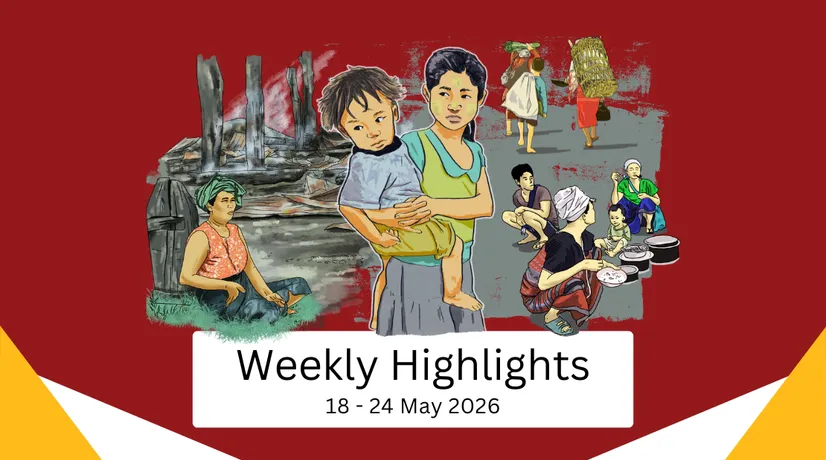
While international aid attempts to mitigate the disaster, the military is actively deploying starvation as a weapon of war against civilian populations. Magwe Region is enduring the steepest economic strangulation, recording a 38 percent increase in staple food prices. In a blatant escalation of this strategy, junta troops stationed in Pakokku, Myaing, and Yesagyo townships have blocked the transport of food, medicine, and essential items to surrounding rural areas since 13 May. The blockade specifically targets areas recently placed under expanded martial law and effectively cuts off life-saving supplies to Pakokku District, a critical junction connecting Chin State and Sagaing Region. By sealing town entrances and restricting the movement of goods, the military is intentionally depriving civilians in liberated areas of basic necessities. The restrictions are so severe that local volunteers report they cannot carry even a single roselle plant out of the towns. Local residents warn that if these blockades continue, catastrophic shortages and widespread loss of life will follow. This weaponization of hunger is occurring alongside military offensives that have displaced tens of thousands of civilians across Pakokku District and neighboring Pauk Township, further undermining access to food, livelihoods, and humanitarian assistance.
Despite this horrific reality, regional diplomacy continues to fail the people of Myanmar as its quiet endorsement of the illegal junta is increasingly reflected through recent bilateral engagements. On 19 May, Malaysian Foreign Minister Mohamad Hasan visited Naypyidaw and met directly with the junta-appointed foreign minister. The junta immediately used the meeting to project diplomatic normalization and whitewash its mass atrocity crimes. Five years after the adoption of the 5PC, ASEAN’s de facto normalization with a murderous criminal syndicate destroys the trust of Myanmar’s people, while further enabling the junta’s blanket impunity.
In addition, ASEAN’s continued negligence regarding the junta’s weaponization of aid and its failure to deliver aid to the most vulnerable populations remain a major obstacle. ASEAN must operationalize its October 2025 Summit decision to deliver aid to conflict-affected communities through border channels and ensure that assistance bypasses the junta and its controlled mechanisms, including the ASEAN Coordinating Centre for Humanitarian Assistance.
Furthermore, to prevent further unmitigated disaster, ASEAN must relinquish its exclusive mandate, and the international community must act decisively. Donor governments must bypass the military junta and channel humanitarian assistance through border-based mechanisms led by trusted local humanitarian and civil society organizations and frontline responders. ASEAN must formally reject the junta’s sham election results and rebrand, while the broader international community must advance universal jurisdiction and accountability efforts. Rather than legitimizing perpetrators through futile diplomatic engagement, international actors must support an inclusive dialogue among the stakeholders of Myanmar’s revolution and resistance movement as they continue to rebuild a new federal democratic Myanmar under immense challenges.
_______________________
[1] One year following the 1988 pro-democracy uprising, the former military junta changed the country’s name from Burma to Myanmar overnight. Progressive Voice uses the term ‘Myanmar’ in acknowledgement that most people of the country use this term. However, the deception of inclusiveness and the historical process of coercion by the former State Peace and Development Council military regime into usage of ‘Myanmar’ rather than ‘Burma’ without the consent of the people is recognized and not forgotten. Thus, under certain circumstances, ‘Burma’ is used.
Progressive Voice is a participatory, rights-based policy research and advocacy organization that was born out of Burma Partnership. Burma Partnership officially ended its work on October 10, 2016 transitioning to a rights-based policy research and advocacy organization called Progressive Voice. For further information, please see our press release “Burma Partnership Celebrates Continuing Regional Solidarity for Burma and Embraces the Work Ahead for Progressive Voice.”
Resources
Statements & Press Releases
By Arakan Rohingya National Council
SED Energy Holding’s Kurt Waldeland Must End Burma/Myanmar Gas Project
By Burma Campaign UK
[Joint Statement] ASEAN must stand with the people of Myanmar, condemn military junta’s crimes
By FORUM-ASIA, ALTSEAN-Burma and Progressive Voice
Myanmar: No Redress for Rohingya Muslims in Arakan Army Massacre
By Human Rights Watch
Middle East Crisis Deepens Hunger in Myanmar; EU Responds with EUR 8 Million for Urgent Relief
By World Food Programme
Reports
By Athan – Freedom of Expression Activist Organization
The Situation of Freedom of Expression in Myanmar (April 2026)
By Athan – Freedom of Expression Activist Organization
Digital Hate: Monthly Report for April 2026 (English / Myanmar)
By Burma Human Rights Network
By Human Rights Watch
29 April-12 May 2026: Attacks on Health Care in Myanmar
By Insecurity Insight
At A Glance On Armed Struggles (15 May – 21 May 2026)
By Nyan Lynn Thit Analytica
Chinese Rare Earth Mines in Eastern Shan State Using Trafficked Burmese Scammers as Slave Labour
By Shan Human Rights Foundation
Read Next
10 July 2026