Skeletons and Skulls Scattered Everywhere’: Arakan Army Massacre of Rohingya Muslims in Hoyyar Siri, Myanmar
18 May 2026

Summary
In July 2024, Omar Ahmod along with other Rohingya Muslim villagers sneaked back into their now desolate village of Hoyyar Siri in Myanmar’s Rakhine State. Two months earlier, they had survived a massacre in the village by the Arakan Army, an ethnic Rakhine armed group. Omar Ahmod said that when the villagers returned to salvage some belongings, they found their homes looted and burned and the remains of their loved ones and neighbors:
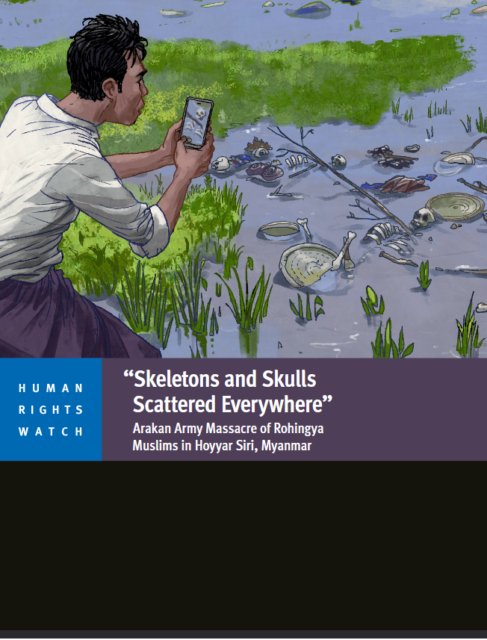
We saw no cattle in the village, though every household once had livestock and poultry. I heard the Arakan Army had taken them…. I also went to the paddy field where almost 80 villagers, including my immediate relatives, were massacred. There, I saw heaps of skeletons and skulls scattered everywhere, clothes still intact though the flesh had decayed.
Human Rights Watch research shows that on May 2, 2024, the Arakan Army may have killed at least 170 Rohingya men, women, and children – and likely injured or killed hundreds more – in Hoyyar Siri village (known as Htan Shauk Khan in Burmese), in Buthidaung township, northern Rakhine State. Fighters had fired upon civilians as they were attempting to flee fighting between the advancing Arakan Army and Myanmar military forces at nearby army camps.
The mass killing could only be confirmed more than a year later, when survivors eventually crossed into Bangladesh and found their way to the Rohingya refugee camps in Cox’s Bazar. Omar Ahmod, for instance, only reached Bangladesh in July 2025. The United League of Arakan, the Arakan Army’s political wing, denied killing civilians at Hoyyar Siri. Survivors said that the group coerced some villagers, while still in Rakhine State, to provide false video testimony exonerating them.
This report sets out a detailed account of the May 2, 2024, massacre and its immediate aftermath, drawing on interviews with 41 witnesses. These accounts were corroborated through satellite imagery, as well as photographs and videos posted to social media or shared with researchers, that Human Rights Watch has analyzed and verified.
Human Rights Watch found that the Myanmar military may have violated the laws of war by not taking adequate measures to protect civilians from harm. More significantly, the Arakan Army’s mass killing of civilians and destruction of civilian property amounted to numerous grave violations amounting to war crimes. War crimes committed included deliberate attacks on civilians, murder, unlawful detention, torture and other mistreatment in custody, arson and other destruction of civilian property, looting, and failure to provide adequate medical assistance.
Although the massacre occurred two years ago, the United League of Arakan and its armed wing, the Arakan Army, have not taken any action either to provide accountability for the atrocities or redress for the Rohingya victims or their families. In a written response to queries from Human Rights Watch, the United League of Arakan said that the Arakan Army “has strictly adhered to the international laws of war and the Geneva Conventions in the conduct of its military operations in all battles.” The group also said that in Hoyyar Siri they followed “the principles of early warning, proportionality, and distinction in accordance with international humanitarian law,” and “systematically conducted evacuation activities in collaboration with Muslim community leaders.”
Human Rights Watch research contradicts these claims to find that the Arakan Army poses the same deadly threat to the Rohingya population as before. Moreover, it is clear that concerned governments and Myanmar’s international partners have not taken sufficient measures to address the risks to the Rohingya posed by both the Myanmar junta and the Arakan Army.
Download full report (English)