World Refugee Day: Junta is The Architect of Displacement, Not a Peacemaker
26 June 2026
“ As long as the military cartel continues its campaign of terror, neither safe refuge for Myanmar’s people nor lasting regional stability will be possible.“
For over 5.3 million people from Myanmar, the search for refuge is not a distant concept commemorated once a year on the calendar; it is a daily struggle for survival. As the international community marked World Refugee Day on 20 June, Myanmar’s displacement crisis remained a direct consequence of the illegal military junta’s nationwide campaign of terror. The latest UN High Commissioner for Refugees data paints a devastating picture: more than 3.7 million people are internally displaced within Myanmar, while a further 1.6 million have been forced to flee across borders as refugees. This stark reality stands in direct contrast to the World Refugee Day 2026 theme, “Until Everyone is Safe,” underscoring a fundamental truth: as long as the junta continues its campaign of terror, no one in Myanmar is truly safe.
For decades, the Myanmar military offensives have displaced millions of civilians across Myanmar’s ethnic states. Since the military’s illegal 2021 coup attempt, however, the crisis has expanded nationwide as the illegal junta’s systemic attacks continue to force civilians from their homes both within Myanmar and across its borders. Entire communities have been uprooted and countless villages deliberately razed, forcing hundreds of thousands to flee into forests with little more than the clothes on their backs. The humanitarian consequences are dire. Families escaping airstrikes, village burnings, and targeted attacks now struggle to survive in displacement camps across the country and along Myanmar’s borders, where access to food, healthcare, shelter, and protection remains critically scarce. These conditions expose both internally displaced persons (IDPs) and refugees to heightened risks of malnutrition, preventable diseases, exploitation, and continued violence, even after they have fled their homes.
The junta remains the primary driver of Southeast Asia’s refugee crisis, actively and deliberately weaponizing violence, mass displacement and starvation against Myanmar’s civilian population. As long as the military cartel continues its campaign of terror, neither safe refuge for Myanmar’s people nor lasting regional stability will be possible. ASEAN and regional actors must therefore confront the root cause of this crisis. This requires unequivocally condemning the junta’s atrocity crimes, actively denying all political legitimacy to its sham civilian rebranding, strengthening legal protection for refugees, and ensuring that life-saving humanitarian assistance is exclusively channeled through border-based local humanitarian responders.
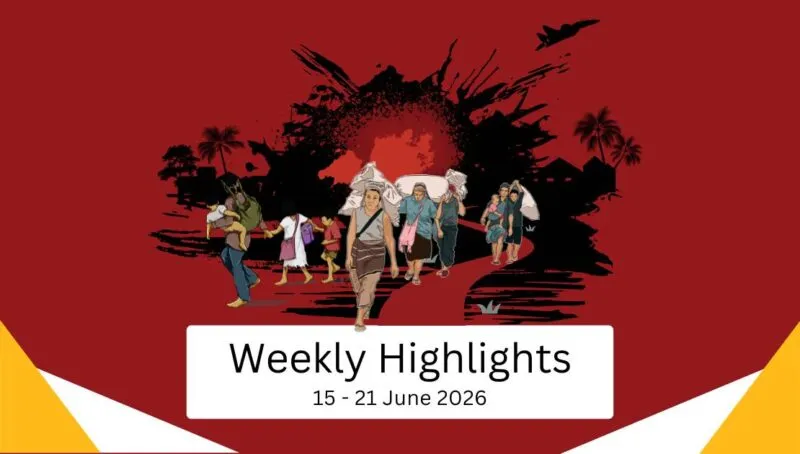
The junta’s escalating atrocity crimes continue to expose the hollowness of its campaign for international legitimacy. While junta chief Min Aung Hlaing stages carefully choreographed displays of “peace” and seeks international normalization by recasting himself as a civilian president, military operations on the ground tell a very different story. Throughout the week of 15-21 June, the junta intensified its aerial attacks against civilian communities in what appears to be a deliberate strategy of terror and displacement.
On 17 June 2026, junta aircraft launched devastating airstrikes on residential areas in Kyauktaw, Rakhine State. According to local witnesses, a fleet of seven military aircraft dropped more than 20 bombs within a single hour, killing at least 10 civilians, including women and children, and injuring dozens more. On the same day, a junta jet bombed a village in Wetlet Township, Sagaing Region, killing five civilians, including a pregnant woman. The military has deliberately targeted places of refuge for civilians. On 16 June, junta forces bombed an internally displaced persons (IDP) site in Ye Chaung Phyar, Mon State, which had been established with support from Japan’s Nippon Foundation. This pattern continued on 19 June when the military dropped nearly 30 bombs on IDP sites in Demoso Township, Karenni State. These attacks are not isolated incidents or collateral damage. They form part of a deliberate military strategy to render liberated areas uninhabitable, forcibly displace civilian populations, and obstruct humanitarian relief. Such conduct underscores the junta’s systematic use of violence against civilians and reinforces the urgent need for international accountability.
The devastating impact of the junta’s violence demands robust regional protection, a call powerfully articulated by local civil society organizations. A newly released report by the Human Rights Foundation of Monland (HURFOM) underscores that conflict-affected communities refuse to be mere victims, they are actively demanding accountable, community-led protection mechanisms that safeguard their daily safety. This determination to uphold dignity and agency was echoed in a joint statement by the Karen Women’s Organization (KWO) and the Karen Peace Support Network (KPSN), which welcomed Thailand’s recent initiative to issue identification cards to refugees while warning that declining humanitarian assistance continues to leave displaced communities highly vulnerable. The Border Consortium (TBC), in its latest report, further revealed that refugee camp committees along Thailand-Myanmar border are increasingly being forced to finance and manage their own essential services, including water supplies and healthcare, as international funding continues to decline.
This vulnerability is further exacerbated by ASEAN’s broader failures. The Malaysia National Organising Committee of the Asean Civil Society Conference/Asean Peoples’ Forum (ACSC/APF) unequivocally condemned the growing tide of hate speech targeting the Rohingya refugees in Malaysia, alongside threats of deportation that place refugees at further risk. At the same time, diplomatic developments in New York on 19 June 2026 saw Bangladesh renew its call for the early repatriation of Rohingya refugees to Myanmar—a deeply troubling proposal given the junta’s continuing commission of atrocity crimes and the complete absence of conditions for safe, voluntary, and dignified return. The international community must respond to this escalating crisis with decisive and coordinated action. Expressions of solidarity on World Refugee Day ring hollow when accompanied by diplomatic engagements that lend legitimacy to the junta’s rebranded civilian façade. First, international donors and the global community must significantly increase humanitarian assistance for Myanmar’s refugees and IDPs by providing sustained, flexible funding through border-based delivery mechanisms partnering with Ethnic Resistance Organizations (EROs), the National Unity Government (NUG), and trusted local humanitarian responders—completely bypassing the junta. Second, the international community and all ASEAN Member States must reject the junta’s false narratives of peace, refuse to recognize its administrative structures, and establish effective temporary protection mechanisms and measures that guarantee no person from Myanmar is subjected to refoulement. ASEAN must move beyond its ineffective policy of non-interference, and instead prioritize the protection of civilians, uphold international refugee protection principles, and address the military junta as the root cause of Myanmar’s displacement crisis.
Finally, the UN Security Council and individual UN Member States must deprive the junta of the means to wage war against the people of Myanmar by imposing coordinated, targeted sanctions on aviation fuel and arms, while advancing accountability through the exercise of universal jurisdiction and a referral to the International Criminal Court (ICC). Ultimately, the international community must recognize that the junta remains the principal driver of Myanmar’s displacement crisis and act accordingly. Protecting refugees and internally displaced persons requires more than humanitarian assistance—it demands sustained international action to end impunity, deny legitimacy to the junta, and address the root cause of forced displacement. _______________________
[1] One year following the 1988 pro-democracy uprising, the former military junta changed the country’s name from Burma to Myanmar overnight. Progressive Voice uses the term ‘Myanmar’ in acknowledgement that most people of the country use this term. However, the deception of inclusiveness and the historical process of coercion by the former State Peace and Development Council military regime into usage of ‘Myanmar’ rather than ‘Burma’ without the consent of the people is recognized and not forgotten. Thus, under certain circumstances, ‘Burma’ is used.
Progressive Voice is a participatory, rights-based policy research and advocacy organization that was born out of Burma Partnership. Burma Partnership officially ended its work on October 10, 2016 transitioning to a rights-based policy research and advocacy organization called Progressive Voice. For further information, please see our press release “Burma Partnership Celebrates Continuing Regional Solidarity for Burma and Embraces the Work Ahead for Progressive Voice.”
Resources
Statements & Press Releases
By Burma Human Rights Network
Statement on the 81st Birthday of State Counsellor and Public Leader Daw Aung San Suu Kyi
By Committee Representing Pyidaungsu Hluttaw and National Unity Government
Coinciding with the UN International Day for the Elimination of Sexual Violence in Conflict
By Equality Myanmar
Statement on World Refugee Day
By Karen Human Rights Group
KWO and KPSN Message on World Refugee Day 2026
By Karen Women’s Organization and Karen Peace Support Network
By Karenni Human Rights Group
By National Unity Government
By National Unity Government
By Network for Human Rights Documentation-Burma (ND-Burma)
By Network for Human Rights Documentation-Burma (ND-Burma)
Myanmar’s Economy shows tentative stabilization, but fuel shock intensifies pressures
By The World Bank
World Refugee Day: Worsening Crisis in Burma Demands Urgent Action
By U.S. Campaign for Burma
Reports
Analysis of Conflict-Related Sexual Violence in Myanmar in the Aftermath of the 2021 Coup D’état
By Equality Myanmar
Attacks on Health Care in Myanmar: 27 May – 09 June 2026
By Insecurity Insight
By Network for Human Rights Documentation-Burma (ND-Burma)
By The World Bank
Read Next
10 July 2026