Pride Amid Persecution: LGBTQIA+ Resistance and Equality in Myanmar’s Revolution
20 June 2026
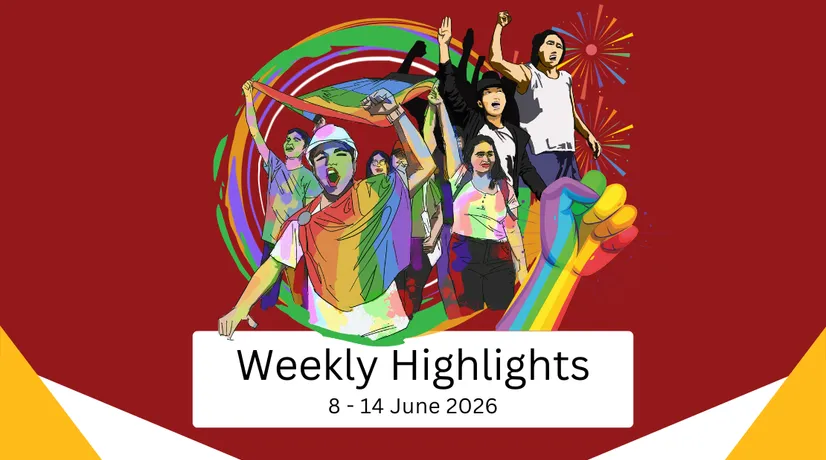
“When we started the strikes, we already thought we would be mocked. But because of the slogans we held like ‘We may be queer, but we have no fear,’ people realized we could do it and joined us”
As the world celebrates Pride Month this June, the LGBTQIA+ community in Myanmar is marking the occasion with profound resilience, unwavering courage, and a deep commitment to the Spring Revolution. Demonstrating their pride on the frontlines of the democratic resistance and in exile, they persist in their struggle amid an escalating humanitarian and security crisis that demands immediate protective intervention from revolutionary governance bodies and calls for international and regional solidarity.
Since the illegal February 2021 coup attempt, queer revolutionaries have stood at the forefront of the nationwide resistance, transforming Pride from a celebration of visibility into an urgent struggle for survival and federal democracy. However, their high-profile visibility has made them primary targets of the military junta, which routinely weaponizes gender-based violence, torture, and predatory conscription to crush dissent. As noted by Justice For Myanmar, “LGBTQIA+ revolutionaries in Myanmar have courageously stood at the forefront of the resistance against a criminal military junta that perpetrates gender-based violence with total impunity.” Despite their immense contributions, they continue to face severe persecution, including systemic discrimination, arbitrary arrests, and horrific abuse.
To honor their courage, sacrifices, and contributions, the National Unity Government (NUG), the National Unity Consultative Council (NUCC), and Ethnic Resistance Organizations (EROs) must move beyond rhetorical solidarity and immediately implement concrete legal and operational protections for LGBTQIA+ activists and revolutionaries. The international community must complement these efforts by providing legal and financial support for protection initiatives and by directing humanitarian, legal and political assistance to Myanmar’s LGBTQIA+ grassroots networks.
Vibrant solidarity initiatives in recent weeks have highlighted the cross-border resilience of Myanmar’s LGBTQIA+ community despite severe military terror. On 9 and 10 June 2026, exiled queer activists and allies mobilized in Mae Sot, Thailand, gathered for the EXILE PRIDE 2026 (Queer Thabin) festival. Spearheaded by the Queers of Burma Alternative (QBA) in collaboration with Kings N Queens, the Myanmar Rainbow Political Community, Than Lwin Khet, and Gar Studio, the two-day gathering served as a powerful space for both cultural expression and political resistance. Through panel discussions, debates, art exhibitions, and documentary screenings, participants celebrated their diversity, human dignity, and revolutionary spirit, while reaffirming their commitment to equality, inclusivity, and democracy, and the Spring Revolution. Alongside the festival, QBA convened a major advocacy forum titled Strengthening LGBTQIAN+ Advocacy for Inclusive Federalism in Myanmar, bringing together diverse grassroots leaders to advance the inclusion of rights within Myanmar’s future federal democratic framework. The community issued the Declaration of Queers, a manifesto calling for the dismantling of heteronormative and patriarchal structures and setting out key demands, including constitutional guarantees of LGBTQIA+ rights, meaningful political representation and participation at all levels of decision-making, and unconditional release of queer and other political prisoners and comprehensive physical and psychological support for survivors of arbitrary arrest, inhumane interrogation, and detention.
On the physical frontlines within Myanmar, queer revolutionaries are fighting not only the military junta but also deeply entrenched societal discrimination. A powerful feature by the women-led media outlet Honest Information, titled The Struggle of the Rainbow Colors Resisting Discrimination Simultaneously, highlights the contributions and sacrifices of LGBTQIA+ resistance members.
Among them is Ma ET, a transgender woman and strike leader in Shwebo Township in Sagaing Region, who reflected on both the challenges and triumphs of queer visibility in the revolution. “When we started the strikes, we already thought we would be mocked. But because of the slogans we held like ‘We may be queer, but we have no fear,’ people realized we could do it and joined us” Ma ET explained. This courage has come at a tremendous cost. Hunted by the junta under an arrest warrant on four separate occasions and forced into hiding after her home was destroyed, Ma ET nevertheless remains steadfast, declaring that “the strikes resisting the military will never stop.”
Queer leadership is equally visible within the armed resistance. May, a young bisexual female military instructor with the Bamar People’s Liberation Army (BPLA), left her restrictive home to join the armed struggle after witnessing junta forces terrorize children in her neighborhood. Today, she trains hundreds of recruits, both female and male, on an equal basis. She noted that while some ethnic resistance groups initially doubted the capabilities of LGBTQIA+ recruits, their commitment and performance have challenged these prejudices, prompting official statements of inclusion and LGBTQIA+ awareness training in liberated areas. As U Aung Myo Min, the NUG Minister for Human Rights, observed, the queer community is not only resisting dictatorship but also helping dismantle long-standing systems of discrimination in Myanmar—demonstrating that the struggle for federal democracy and the struggle for equality are inseparable.
While the LGBTQIA+ community has earned unprecedented respect through its contributions to the Spring Revolution, heteronormative and patriarchal prejudices remain deeply embedded within Myanmar society, including parts of the resistance movement. Their rights must therefore be more than celebrated during Pride Month; they must be firmly embedded in the foundations of Myanmar’s future federal democratic system.
The NUG, NUCC, EROs, and emerging federal governance units and institutions must translate rhetorical recognition into political action. This includes guaranteeing the rights of LGBTQIA+ individuals in all interim constitutional and governance frameworks; adopting and enforcing anti-discrimination and equality policies across revolutionary institutions and resistance forces; ensuring meaningful LGBTQIA+ representation in decision-making processes; preventing and responding to gender-based violence within their ranks; and reforming humanitarian assistance mechanisms to address the specific needs of displaced queer communities. The international community and donors must complement these efforts by providing sustained political, financial, and technical support to LGBTQIA+ organizations and grassroots networks and protection initiatives. As Myanmar’s revolution seeks to dismantle military tyranny and build a federal democratic future, equality, inclusion, and dignity for LGBTQIA+ people must be treated not as peripheral concerns, but as essential pillars of lasting peace and justice.
_______________________
[1] One year following the 1988 pro-democracy uprising, the former military junta changed the country’s name from Burma to Myanmar overnight. Progressive Voice uses the term ‘Myanmar’ in acknowledgement that most people of the country use this term. However, the deception of inclusiveness and the historical process of coercion by the former State Peace and Development Council military regime into usage of ‘Myanmar’ rather than ‘Burma’ without the consent of the people is recognized and not forgotten. Thus, under certain circumstances, ‘Burma’ is used.
Progressive Voice is a participatory, rights-based policy research and advocacy organization that was born out of Burma Partnership. Burma Partnership officially ended its work on October 10, 2016 transitioning to a rights-based policy research and advocacy organization called Progressive Voice. For further information, please see our press release “Burma Partnership Celebrates Continuing Regional Solidarity for Burma and Embraces the Work Ahead for Progressive Voice.”
Resources
Statements & Press Releases
Joint Statement on the 15th Anniversary of The Resumed War in the Kachin Region
By 129 Civil Society Organizations
By ASEAN Parliamentarians for Human Rights
By Blood Money Campaign
By Blood Money Campaign
FIFA Must Cancel World Cup Broadcasting Contract with Burmese Military
By Burma Campaign UK
Thailand: End Arbitrary Detention, Torture, and Forced Returns of Refugees
By Fortify Rights
Singapore must do more to end the Myanmar military’s atrocities against civilians
By Justice For Myanmar
By Justice For Myanmar
Reject Hate, Uphold Justice: Standing with the Rohingya Against Persecution
By Malaysia National Organising Committee of the Asean Civil Society Conference/Asean Peoples’ Forum (ACSC/APF) and 74 Civil Society Organizations
Statement on the 15th Anniversary of Renewed War in Kachinland
By World Kachin Congress
Reports
Regime’s proposed Anti-Online Fraud Law targets dissent, not scams
By Human Rights Myanmar
Frontline Armed Incident Tracker: March 2026
By Nyan Lynn Thit Analytica
Read Next
10 July 2026