The Military Junta: Not a Partner but a Roadblock for BIMSTEC
3 July 2026
“ A junta that wages a campaign of terror against civilians is not a partner for regional cooperation but a roadblock for the peace and stability on which regional cooperation, connectivity, and economic integration depend.“
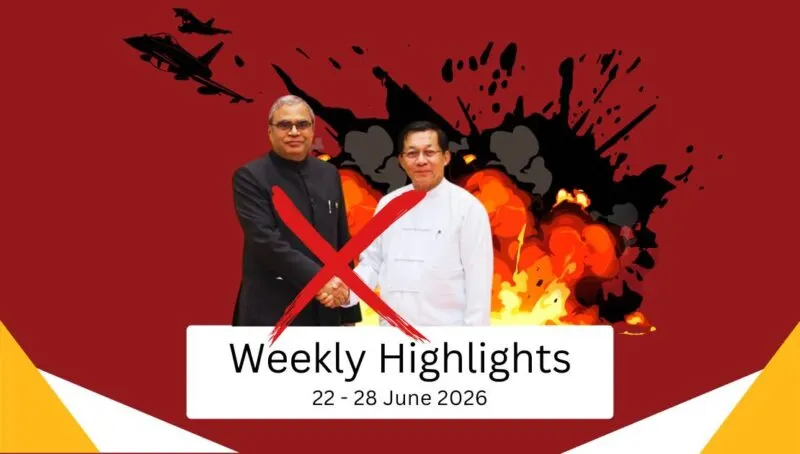
The Bay of Bengal Initiative for Multi-Sectoral Technical and Economic Cooperation (BIMSTEC), a regional organization comprising seven countries including Myanmar, is risking deeper complicity in the illegal military junta’s ongoing commission of international crimes, including crimes against humanity, by increasing its engagement with the junta. First, it is poised to reward the junta with the organization’s rotating Secretary-General position next year. Second, on 22 June 2026, BIMSTEC Secretary-General Indra Mani Pandey visited Naypyidaw and met with junta chief Min Aung Hlaing and his ministers. During the meeting, Indra Mani Pandey congratulated the junta on its sham election and endorsed Min Aung Hlaing’s recent visits to India and China.
BIMSTEC’s member states must reckon with the fact that every handshake and agreement with the military junta, made in the name of regional connectivity and prosperity, serves only as a roadblock to the organization’s stated purpose. Furthermore, by recognizing of the junta, they enable its campaign of terror against the peoples of Myanmar and prolong their suffering.
BIMSTEC has chosen the worst possible moment to deepen its engagement with the junta, ignoring the repeated calls of the Myanmar’s peoples to disengage from it and stop lending it any form of political or diplomatic legitimacy.
At the 5th BIMSTEC Summit in March 2022, the junta-appointed Foreign Minister, Wunna Maung Lwin, participated virtually. Three years later, at the 6th BIMSTEC Summit in Bangkok in April 2025, junta chief Min Aung Hlaing attended in person, providing the junta with another opportunity to advance its efforts to gain international recognition through regional engagement.
In tandem, Min Aung Hlaing deliberately created the false impression that the military junta remains in control of border administration and cross-border trade despite having lost control of large swathes of territory and key cross-border trade routes to the democratic resistance forces. His claim of control is detached from the realities on the ground.
Following Min Aung Hlaing’s visit to India at the end of May, the junta’s subsequent military offensives further exposed the gap between its claims of control and the realities on the ground. The junta launched a major offensive along the India–Myanmar–Thailand Trilateral Highway, a 1,360-km regional trade corridor. The highway stretches from Manipur State in India through Tamu, Kalewa, Monywa, Mandalay, Naypyidaw, Bago, Hpa-an, and Myawaddy in Myanmar before crossing into Thailand. The offensive has displaced more than 30,000 civilians, while villages have been torched.
More recently, junta-appointed Deputy Commander-in-Chief Kyaw Swar Lin signaled intensified military campaign in Dawei, Tanintharyi Region. He ordered officers to attack resistance-held areas surrounding strategic projects, including the Dawei Deep Sea Port, as well as civilians travelling along the Yay–Dawei–Myeik–Bokepyin–Kawthaung Union Highway. Further suffering for the people is imminent.
Still, turning a blind eye to the junta’s ongoing atrocities, India and Thailand, both founding members of BIMSTEC, continue to deepen their engagement with the illegal junta in pursuit of their own economic interests, at the expense of Myanmar’s people’s lives.
On 22 and 23 June, India’s Ambassador, Abhay Thakur, met with junta-appointed ministers to advance discussions on a direct rupee–kyat payment system, the Kaladan Multi-Modal Transit Transport Project (KMMTTP), and the junta’s so-called peace plan. The meetings also included discussions on training programs for members of the junta’s façade parliament. Instead of standing with the people of Myanmar in their struggle for federal democracy, India has deliberately chosen to engage with, and provide institutional legitimacy to the criminal junta, abandoning the democratic values it has long claimed to uphold as the world’s largest democracy.
A recent report of the United Nations High Commissioner for Human Rights revealed that the junta killed more than 700 civilians during its sham election period between August 2025 and January 2026. Every step in the junta’s roadmap—from its sham election and rebranded civilian façade to renewed economic partnerships—is carefully calibrated to launder its failed 2021 coup into an internationally legitimized civilian government. The people of Myanmar pay the price with their lives, while foreign governments through their continued engagement with the junta, provide the legitimacy, revenue, and political space that enable its ongoing commission of atrocities.
The junta’s campaigns of violence against civilians are unfolding along strategic transport corridors, including the India–Myanmar–Thailand Trilateral Highway and the KMMTTP, which underpin the region’s broader connectivity agenda. Through these military operations, the junta seeks not only to regain territorial control but secure international legitimacy, ensure its economic survival, and generate revenue needed to finance its ongoing campaign of war against the people of Myanmar.
Since the junta’s attempted coup in 2021, BIMSTEC has chosen to remain silent in the face of its brutal atrocities while continuing to engage with, and lend false legitimacy to, the junta. A junta that wages a campaign of terror against civilians is not a partner for regional cooperation but a roadblock for the peace and stability on which regional cooperation, connectivity, and economic integration depend. To genuinely promote peace, prosperity, and sustainable development for the peoples of its member states, BIMSTEC must end its complicity in the junta’s crimes by ceasing all political, diplomatic, and economic engagement. It must immediately suspend the military junta’s participation in all BIMSTEC summits and related meetings and prevent the illegal junta, disguised as a civilian government, from assuming the position of Secretary-General next year in the name of Myanmar’s sovereign state.
The solution is clear: BIMSTEC should formally engage with the National Unity Government (NUG), Ethnic Resistance Organizations (EROs), and federal governance units—the legitimate representatives of the Myanmar people that exercise effective control over large swathes of Myanmar’s territory—and support their efforts to establish a federal democratic Myanmar and advance peace, connectivity, and sustainable development in the region.
_______________________
[1] One year following the 1988 pro-democracy uprising, the former military junta changed the country’s name from Burma to Myanmar overnight. Progressive Voice uses the term ‘Myanmar’ in acknowledgement that most people of the country use this term. However, the deception of inclusiveness and the historical process of coercion by the former State Peace and Development Council military regime into usage of ‘Myanmar’ rather than ‘Burma’ without the consent of the people is recognized and not forgotten. Thus, under certain circumstances, ‘Burma’ is used.
Progressive Voice is a participatory, rights-based policy research and advocacy organization that was born out of Burma Partnership. Burma Partnership officially ended its work on October 10, 2016 transitioning to a rights-based policy research and advocacy organization called Progressive Voice. For further information, please see our press release “Burma Partnership Celebrates Continuing Regional Solidarity for Burma and Embraces the Work Ahead for Progressive Voice.”
Resources
Statements & Press Releases
By ASEAN Parliamentarians for Human Rights
U.K.: Lead Coalition to Refer Myanmar to the International Criminal Court, Impose Fresh Sanctions
By Fortify Rights
By Independent Press Council Myanmar
Myanmar: Foreign indifference compounds suffering of civilians – UN report
By Office of the High Commissioner for Human Rights
Reports
Digital Hate: Monthly Report for May 2026
By Burma Human Rights Network
News audience suppression under Myanmar’s digital coup
By Human Rights Myanmar and Independent Press Council Myanmar
အတွင်း သတင်းပရိသတ်များကို ပိတ်ဆို့နှိပ်ကွပ်ခြင်း
By Human Rights Myanmar and Independent Press Council Myanmar
Strikes on detention sites holding captured military personnel in Myanmar
By Myanmar Witness
At A Glance On Armed Struggles (19 June – 25 June 2026)
By Nyan Lynn Thit Analytica
By Nyan Lynn Thit Analytica
By Office of the High Commissioner for Human Rights
Health and Wellbeing of Children ‘Who Stay Back’ in Refugee Camps due to Parental Labour Migration
By The Border Consortium
Read Next

10 July 2026