People-led Healthcare as Resistance to the Junta’s Crimes Against Care
14 February 2026
Protecting it is not charity—it is a moral and legal obligation.
Since the military junta’s attempted coup on 1 February 2021, Myanmar has been plunged into a man-made humanitarian and healthcare catastrophe driven by systematic violence, collective punishment, the deliberate obstruction of humanitarian assistance and medical care that can constitute crimes against humanity, and economic collapse. Attacks on civilians, the destruction of health infrastructure, and the weaponization of aid have become central instruments of the military’s campaign of terror. Yet amid these grave violations, people-led healthcare and humanitarian response mechanisms driven by local communities, Civil Disobedience Movement (CDM) health workers, and ethnic health providers continue to deliver life-saving care to the most vulnerable populations in Myanmar under extreme constraints. These locally led systems represent the most credible response to Myanmar’s deepening humanitarian catastrophe and demand urgent international support.
As of 2025–2026, approximately one-third of an estimated 18–20 million people require humanitarian assistance, with more than 16 million in urgent need of food, water, healthcare, and protection. According to UNOCHA, over 3.6 million people had been internally displaced as of November 2025, although the actual number may be significantly higher due to the junta’s obstruction of access. Meanwhile, many others have fled to neighboring countries, including Thailand and India. The 7.7-magnitude earthquake in March 2025 further compounded displacement and humanitarian needs. Severe hunger continues to escalate, with 12–12.4 million people projected to face critical food insecurity in 2026, including around one million at emergency levels. United Nations’ Myanmar Health Cluster Bulletin, January Issue, has warned that the country’s healthcare system is rapidly deteriorating due to severe medicine stock-outs caused by the junta-imposed blockages of supply routes, rising acute respiratory infections in Karen State, widespread skin diseases in Karenni, Rakhine, Magway, and Tanintharyi Regions, new outbreaks of acute watery diarrhea in Chin and Rakhine States, and increasing malaria cases in Chin State. UN Resident and Humanitarian Coordinator Gwyn Lewis has emphasized that restrictive travel authorizations and limited access to conflict-affected areas have left Myanmar facing one of the world’s most severe yet critically underfunded humanitarian crises.
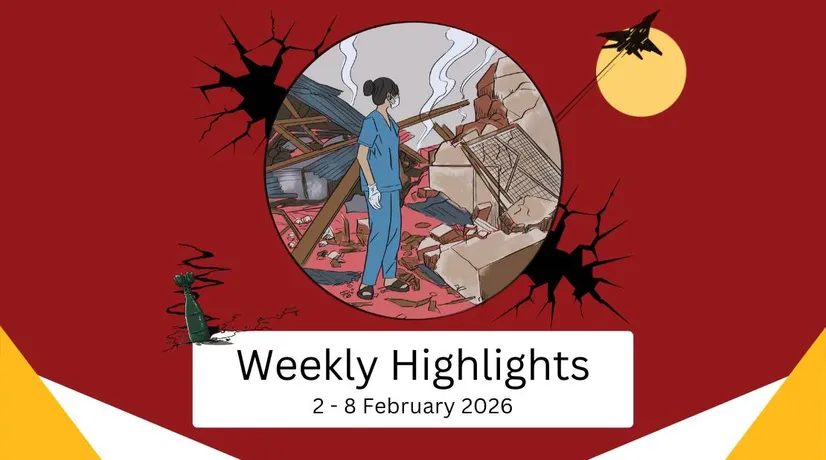
Since 2022, approximately 1,853 healthcare facilities have been attacked by military airstrikes. On 10 December 2025, International Human Rights Day, approximately 34 people were killed and more than ten critically injured when the military bombed Mrauk-U Hospital in Rakhine State. Earlier in 2025, a junta airstrike targeted a district hospital in Kyaukme, northern Shan State, killing at least three people, including a male patient and two women public health workers affiliated with the CDM, critically injuring dozens, and destroying most of the hospital buildings. A week later, just after midnight on 31 January 2025, the junta bombed a hospital in resistance-controlled Singu Township, Mandalay Region. In Mandalay Township, junta’s authorities also ordered seven private hospitals to close, citing allegations that they employed CDM health workers.
Beyond direct attacks, the junta has systematically obstructed civilians’ access to healthcare, worsening preventable disease outbreaks across Myanmar. In Karenni State, scabies has spread widely in villages and displacement camps in Hsah Taw and near Demoso, where insecurity and transport restrictions prevent access to medicines, even when they are available. In eastern Loikaw, severe water shortages have heightened health risks, forcing displaced families to pay unaffordable prices for water. In Magway Region’s Pauk Township, around 1,000 displaced people, including newborns, suffer from skin diseases linked to unsafe water and prolonged displacement. Similar scabies outbreaks affect nearly 900 displaced people in Tanintharyi Township due to military-imposed restrictions on transporting medicines. In Rathedaung Township, Rakhine State, more than 2,000 displaced residents, including children, face rising infections amid a lack of medical assistance. Comparable outbreaks were reported in 2025 in IDP camps in Kachin and Rakhine States after aid routes were deliberately blocked by the junta, reflecting a nationwide pattern of healthcare denial and the weaponization of humanitarian assistance.
In defiance of the military junta’s atrocities, healthcare professionals within the Civil Disobedience Movement, together with community-based organizations and local leaders, continue to deliver life-saving care and build people-led healthcare systems across Myanmar. As junta violence intensifies, these frontline responders—working alongside the National Unity Government (NUG), ethnic resistance organizations and interim federal units’ health departments—remain essential to protecting the right to health in conflict-affected and displaced communities. Along the border, Mae Tao Clinic provided maternal and neonatal care to more than 9,700 displaced women in 2023 and over 11,000 in 2024, with services continuing to expand in 2026. Since 2021, the NUG has established more than 1,000 health facilities nationwide, while people-led hospitals in areas such as Karenni and Kachin States continue to expand emergency care despite severe constraints.
The international community has failed to halt the junta’s atrocities or adequately support Myanmar’s people-led healthcare response since 2021. To protect civilians, international actors—including ASEAN, the European Union, UN agencies, governments, and humanitarian organizations—must urgently change course by providing flexible, multi-year funding and technical support directly to CDM health workers, ethnic health organizations, and groups independent from the junta. Donors must prioritize locally led humanitarian aid delivery mechanisms channeling through borders that strengthen people-led health systems and bypass junta obstruction. Immediate, coordinated action is essential to uphold the right to health and confront crimes against care—the systematic targeting of health systems and the deliberate denial of medical access to civilians that constitute not only violations of international humanitarian law but can amount to what can be regarded as ‘crimes against care.’
As ASEAN Chair, the Philippines bears a particular responsibility to immediately implement the October 2025 ASEAN Summit decision calling for the “…safe, effective, and non-discriminatory delivery of humanitarian assistance, including through cross-border channels, ensuring aid reaches internally displaced persons affected by armed conflict, in line with the Joint Needs Assessment and evolving humanitarian needs”. The ASEAN Special Envoy and the Philippine Secretary of Foreign Affairs must urgently convene consultations with Myanmar’s legitimate stakeholders, particularly the NUG, EROs, and interim federal units. Healthcare in Myanmar has become an act of resistance. Protecting it is not charity—it is a moral and legal obligation.
_______________________
[1] One year following the 1988 pro-democracy uprising, the former military junta changed the country’s name from Burma to Myanmar overnight. Progressive Voice uses the term ‘Myanmar’ in acknowledgement that most people of the country use this term. However, the deception of inclusiveness and the historical process of coercion by the former State Peace and Development Council military regime into usage of ‘Myanmar’ rather than ‘Burma’ without the consent of the people is recognized and not forgotten. Thus, under certain circumstances, ‘Burma’ is used.
Progressive Voice is a participatory, rights-based policy research and advocacy organization that was born out of Burma Partnership. Burma Partnership officially ended its work on October 10, 2016 transitioning to a rights-based policy research and advocacy organization called Progressive Voice. For further information, please see our press release “Burma Partnership Celebrates Continuing Regional Solidarity for Burma and Embraces the Work Ahead for Progressive Voice.”
Resources
Statements & Press Releases
By Arakan Rohingya National Council
APHR Commends Timor-Leste’s War Crime Proceedings Against the Myanmar Junta
By ASEAN Parliamentarians for Human Rights
Timor Leste Opens Unprecedented Legal Proceedings Against Myanmar Junta
By Chin Human Rights Organisation and Myanmar Accountability Project
By European Council
International IDEA Statement: Marking five years since Myanmar’s military coup
By International IDEA
Reports
By ALTSEAN-Burma and International Federation for Human Rights
The Critical Role of Civil Society Organisations in Documenting Atrocity Crimes in Myanmar
By Asia Pacific Centre for the Responsibility to Protect
Myanmar Health Cluster Bulletin (January 2026)
By Health Cluster Myanmar and World Health Organization
By Nyan Lynn Thit Analytica
At A Glance on Armed Struggles (23 January – 29 January)
By Nyan Lynn Thit Analytica
At A Glance on Armed Struggles (30 January – 5 February)
By Nyan Lynn Thit Analytica
Myanmar: WHO Health Emergency Appeal 2026
By World Health Organization
Read Next
26 June 2026