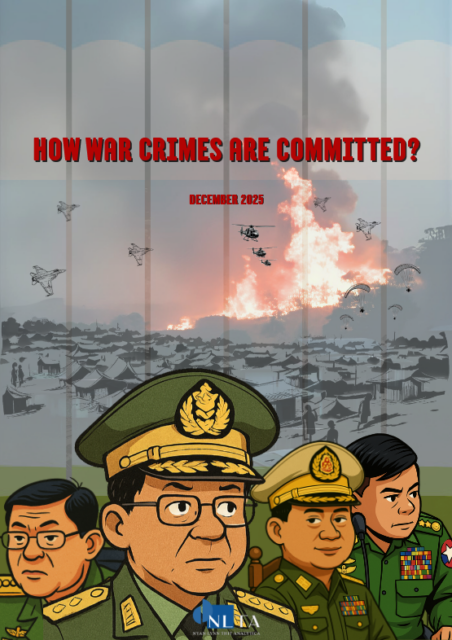
How War Crimes Are Committed?
2 February 2026

Preamble
On 26 December 1947, the Burma Independence Army (BIA) was formally established in Bangkok, Thailand. Prior to the independence, the armed forces underwent successive reorganizations and name changes, such as from the Burma Independence Army to the Burma Defence Army (BDA) and successively to the name the Burma National Army (BNA), and the Patriotic Burmese Forces (PBF). In accordance with the Kandy Agreement, the
force was unified as a permanent national military on 7 September 1945 during the per-independence period and was officially designated as the “Burma Armed Forces” (Tatmadaw). Subsequently, on 15 December 1947, the Burma Volunteer Air Force was reorganized and formally established as the “Burma Air Force” (Myanmar Air Force). On 24 December 1947, the Burma Royal Volunteer Naval Force was likewise reorganized and officially designated as the “Burma Navy” (Myanmar Navy).
Among the three branches of the armed forces—the army, navy, and air force—the Myanmar Army has progressively assumed a dominant institutional role. Since the establishment of the armed forces, the position of Commander-in-Chief has been held exclusively by professional military officers, with the majority originating from the army. Historically, Commanders-in-Chief of the army have held the rank of General or Brigadier General, while the chiefs of the navy and air force have held the rank of Lieutenant Colonel. From the establishment of the armed forces to the present, a total of twenty individuals have served as Minister for the Defence Ministry. Of these, three were civilians – U Nu, U Win, and U Ba Swe, and only one from the navy, Senior General Tin Aung San – who served as Commander-in-Chief (Navy). With the exception of these four individuals, the remaining sixteen Ministers of Defence were drawn from the army. Until the formation of the civilian-led government under President Thein Sein in 2011, the roles of Commander-in-Chief and Minister of Defence were exercised concurrently. Since 2010, senior officers operating under the authority of the Commander-in-Chief have assumed the position of Minister of Defence.
Since the independence in 1948, the military has seized state power through four coups d’état, occurring in 1958, 1962, 1988, and 2021. Following the 1962 coup, the military expanded its role beyond its mandate of national defence and progressively assumed authority over executive and judicial functions, resulting in the concentration of state power within the military institution. In order to consolidate control over political power and the justice system, the military established councils, committees, and military tribunals to exercise direct authority. In parallel, serving military officers were appointed to civilian administrative positions while retaining their military status, and retired military personnel were subsequently appointed to civilian offices. These practices contributed to the militarization of civilian governance structures and undermined the separation of powers and civilian oversight.
Following the 1988 military coup led by Senior General Saw Maung, the military expanded its regional commands, combat units, and support forces. In parallel, vocational and training institutions under the military were established to produce graduates, thereby minimizing reliance on civilian professionals required by the armed forces and institutionalizing a structural separation between military and civilian spheres. Military planning initiatives included the training of military academy–educated professionals, such as engineers and medical doctors, as well as the establishment of military-controlled media outlets. During successive coup periods, civilian intellectuals and professionals were incorporated into legislative, executive, and judicial powers however, effective control over the three branches of the power remained concentrated in the hands of the Commander-in-Chief and senior military officers, who exercised discretionary appointment authority. Crimes against the civilian population across successive military regimes were committed by senior military leadership to operational and tactical levels, including the army, navy, air force, support forces and paramilitary forces, including people militia, in which strategic directives were issued in accordance with a hierarchical structure of responsibility and established chains of command.
For decades, the Myanmar military has exercised coercive control over the civilian population through the systematic use of armed forces. In 2021, it attempted to unlawfully seize state power through a military coup and has since continued to commit indiscriminate and deliberate violations against civilians, including the killing of protected persons, the destruction of civilian possessions, and the burning of entire villages. Preventing the
perpetrators of such crimes from benefiting from impunity requires comprehensive and systematic documentation, which constitutes a critical element of accountability and justice processes. Systematic documentation must identify the individuals and entities responsible for the commission of war crimes, as well as examine the command responsibility, planning, coordination, and operational mechanisms through which such crimes are perpetrated. Accordingly, a research report series entitled “How War Crimes Are Committed?” will be compiled and presented in order to contribute to future accountability efforts.
This report constitutes the first study in a broader research report series and focuses specifically on “The structure of the hierarchical command-and-control system of the military regime”. The study examines with particular attention on the mechanisms to joint operations involving the army, navy, and air force, as well as the associated command structures and chains of command through which the military authorities implement
nationwide repressions, including military offensives deliberately targeting civilians, including airstrikes. The report aims to enhance understanding of the concentration of authority within the military junta leadership and the operational command patterns of the military apparatus as a whole. It represents an initial step toward identifying those leaders situated at the apex of the command structure who exercise directive authority, as well as their subordinate commanders and personnels, in relation to war crimes committed against the civilians, both in the past and on an ongoing basis.This report seeks to inform future research and support the processes required for the systematic implementation of transitional justice during a period of political transition in a future Myanmar.
Download full report (English)
Announcements
19 May 2026