The Price of ASEAN’s Failed Approach to Myanmar
12 June 2026
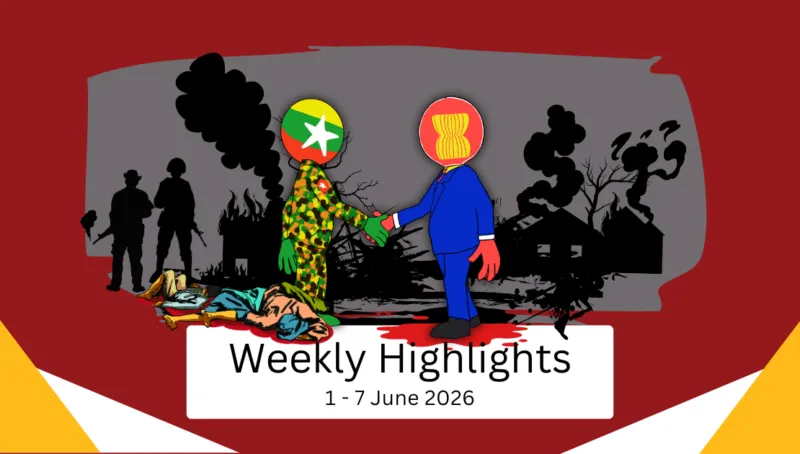
More than five years after the military’s attempted coup, ASEAN has demonstrated neither the capacity nor the political resolve necessary to address Myanmar’s military-made polycrisis.
Since Min Aung Hlaing’s self-appointed presidency announced its so-called “100-day peace offer” on 20 April, the suffering of people across Myanmar has only intensified. Through escalating ground offensives and airstrikes that have caused high civilian casualties and widespread destruction of civilian property, the rebranded military junta has once again demonstrated that its promises of peace amount to little more than a continuation of its campaign of terror and collective punishment. Since announcing the “100-day peace offer,” the junta has killed 143 civilians and continues to terrorize, displace, and impoverish communities by destroying homes, schools, churches, hospitals, and other civilian infrastructure across the country.
These escalating atrocities underscore a reality that the international community—and particularly members of the Association of Southeast Asian Nations (ASEAN)—must no longer ignore: the junta has no genuine commitment to peace, and ASEAN’s Five-Point Consensus has failed to alter its behavior. More than five years after the military’s attempted coup, ASEAN has demonstrated neither the capacity nor the political resolve necessary to address Myanmar’s military-made polycrisis.
According to a report by Democratic Voice of Burma (DVB), from the attempted coup to 10 June 2026, the military junta carried out at least 475 airstrikes and raids that killed five or more civilians in a single attack. These atrocities form part of a broader campaign of violence that has claimed the lives of more than 5,000 people, including women and children.
Behind these figures are communities devastated by the junta’s repeated attacks, illustrating the scale and brutality of its terror campaign against civilians.
During a nearly month-long military operation from 10-31 May 2026 in Myit Chay and nearby villages in Pakokku Township, Magway Region, junta soldiers allegedly killed around 50 civilians—including women, children, a newborn baby, and a postpartum mother, while many others remain missing. Junta troops burned approximately 1,000 homes and left decomposing bodies scattered throughout the town and surrounding villages, with some reportedly stripped naked and body parts dragged away by dogs.
A female aid volunteer described the aftermath, “They [the slain civilians] are scattered across the town on the streets, inside residential homes, and even within religious buildings.” According to a survivor, junta soldiers no longer attempt to hide their crimes. They reportedly torture and kill civilians while openly boasting about the number of people they have murdered.
Nor was this an isolated incident. On 1 June 2026, advancing junta columns killed at least five villagers during a raid in Okpho Township, Bago Region, and burned hundreds of homes in Chaung Gwa, Chaung Son Lay, and Kywe Te Kone Villages. Thousands of people displaced from 25 villages are now sheltering in temporary camps across the Bago Yoma forests, where dwindling humanitarian assistance has left many facing severe shortages of food and medical supplies. In response, resistance groups have reportedly shared their limited provisions with displaced communities.
The military’s deliberate and systematic attacks flagrantly violate international humanitarian law and may constitute war crimes. According to the Karenni Human Rights Groups (KnHRG), junta arson attacks destroyed more than 106 structures in Hpruso Township, Karenni State, in May alone, including religious buildings, schools, and other public facilities. On 2 June 2026, three Myanmar migrant workers were killed and two others injured when a Myanmar military drone exploded on the Thai side of the border. The incident demonstrates that the consequences of the junta’s violence are no longer confined within Myanmar borders. Neighboring countries must recognize that the Myanmar military poses a grave threat not only to the people of Myanmar but also to regional security and stability.
Yet rather than increasing pressure on the perpetrators, ASEAN continues to engage with the junta and its representatives. Recent visits to Naypyidaw by the Foreign Minister of Malaysia and Indonesia risk normalizing engagement with a military that continues to commit widespread atrocities against civilians. While Malaysia’s Foreign Minister was meeting junta representatives on 19 May 2026, the military was reportedly carrying out airstrikes against civilians fleeing military operations in Budalin Township, Sagaing Region, killing two people. On 8 June 2026, the same day Indonesia’s Foreign Minister met with the junta, military aircraft reportedly dropped around 10 bombs on Najet (Lower) Village in Yetashay Township, Bago Region, killing one civilian and injuring two others.
The timing of these attacks underscores the junta’s disregards for diplomatic engagement and highlights the failure of ASEAN’s current approach. Continued engagement absent meaningful accountability measures has done little to deter the military’s ongoing attacks on civilians and risks reinforcing a culture of impunity.
As the people of Myanmar remain steadfast in their struggle to build an inclusive, bottom-up federal democratic society free from military tyranny, ASEAN and the wider international community must stop lending legitimacy to a military junta that lacks both legality and popular legitimacy. With the military having lost significant territorial control and administrative authority across large parts of the country, continued engagement with the junta neither reflects the realities on the ground nor advances a genuine path toward peace.
Instead, the ASEAN should join and strengthen international efforts to end the junta’s campaign of terror through coordinated, targeted, and sustained sanctions, a comprehensive arms embargo, an end to the sale and transfer of arms, munitions, and dual-use goods, and aviation fuel. ASEAN member states should also back ongoing international efforts to pursue accountability for atrocity crimes through universal jurisdiction, including cases advanced in Timor-Leste and Indonesia.
_______________________
[1] One year following the 1988 pro-democracy uprising, the former military junta changed the country’s name from Burma to Myanmar overnight. Progressive Voice uses the term ‘Myanmar’ in acknowledgement that most people of the country use this term. However, the deception of inclusiveness and the historical process of coercion by the former State Peace and Development Council military regime into usage of ‘Myanmar’ rather than ‘Burma’ without the consent of the people is recognized and not forgotten. Thus, under certain circumstances, ‘Burma’ is used.
Progressive Voice is a participatory, rights-based policy research and advocacy organization that was born out of Burma Partnership. Burma Partnership officially ended its work on October 10, 2016 transitioning to a rights-based policy research and advocacy organization called Progressive Voice. For further information, please see our press release “Burma Partnership Celebrates Continuing Regional Solidarity for Burma and Embraces the Work Ahead for Progressive Voice.”
Resources
Statements & Press Releases
APHR to India: ‘Min Aung Hlaing is Not Myanmar’s Legitimate President’
By ASEAN Parliamentarians for Human Rights
By Justice For Myanmar, Mekong Watch, ayus:Network of Buddhists Volunteers on International Cooperation, Pacific Asia Resource Center (PARC), Friends of the Earth Japan, Japan International Volunteer Center (JVC) and Network Against Japan Arms Trade (NAJAT)
By Justice For Myanmar, Mekong Watch, ayus:Network of Buddhists Volunteers on International Cooperation, Pacific Asia Resource Center (PARC), Friends of the Earth Japan, Japan International Volunteer Center (JVC) and Network Against Japan Arms Trade (NAJAT)
By Karen National Union and Interim Executive Council of Karenni State
Statement of the Salween Peace Park: World Environment Day
By Salween Peace Park
Reports
Myanmar Health Cluster Bulletin (May 2026)
By Health Cluster Myanmar and World Health Organization
Attacks on Health Care in Myanmar: 13 – 26 May 2026
By Insecurity Insight
Myanmar’s New Administration: Military Consolidation, Not Transition
By International Crisis Group
By International Crisis Group