The Cost of Delay: How ASEAN’s Peace Plan Enables Military Atrocities
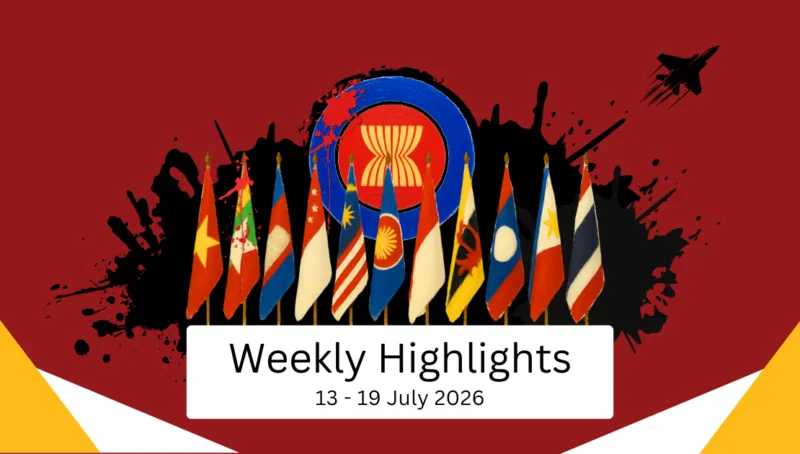
By treating this criminal junta as legitimate, regional leaders are transforming the 5PC into a diplomatic shield that buys time for the military cartel and endorses ongoing mass atrocities.
The Association of Southeast Asian Nations (ASEAN) and the broader Regional Coordinating Mechanism (RCM) continue to demonstrate a catastrophic failure to protect the people of Myanmar, relegating their human rights protection frameworks, such as the ASEAN Regional Plan of Action on Women, Peace and Security (RPA on WPS), to hollow diplomatic rhetoric. As highlighted by Myanmar civil society organizations in their March 2026 WPS Position Paper, the military cartel’s actions prove that RPA on WPS is completely unfulfilled. This institutional hypocrisy is illustrated when comparing the October 2025 Final ASEAN Leaders’ Review of the Five-Point Consensus (5PC) with actions in mid-July 2026. In that review, regional leaders performatively denounced the military junta’s indiscriminate continued violence and claimed to restrict political representation.
However, regional actors actively contradicted these commitments in mid-July 2026. Official statements regarding engagements by Foreign Affairs Secretary Ma. Theresa Lazaro, acting as the ASEAN Special Envoy, began referring to the illegal junta as “the government,” an unacceptable departure from five years of diplomatic precedent. Further exposing this complicity, a 13 July 2026 statement from the Philippine Department of Foreign Affairs validated the military cartel by highlighting the junta’s fabricated “100-day peace plan.” By treating this criminal junta as legitimate, regional leaders are transforming the 5PC into a diplomatic shield that buys time for the military cartel and endorses ongoing mass atrocities.
While ASEAN ministers conduct performative meetings on the WPS agenda and normalize the Myanmar military junta, the junta actively weaponizes sexual violence and deliberate economic strangulation against women. According to the United Nations Development Programme (UNDP) and UN Women report “Uneven Burdens,” updated on 13 July 2026, 42 percent of women in Myanmar now have no income at all, a figure nearly double the rate for men. Concurrently, civil society documentation proves conflict-related sexual violence is weaponized as a tool of political terror. The March 2026 WPS Position Paper outlines how junta troops deploy systematic tactics to terrorize communities, including forced nudity, gang rape, and the deliberate killing of women to destroy evidence, as documented in a Khit Thit Media report detailing junta troops abducting women in Kalewa Township, Sagaing Region, and gang-raping them at a local football field. This systematic economic and physical violence directly exposes the moral bankruptcy of the ASEAN WPS agenda, proving that regional engagement with the military cartel guarantees the destruction of security for Myanmar’s women.
This brutality on the ground is matched by a devastating campaign from above, demonstrating exactly what ASEAN’s diplomatic cover enables. On 15 July 2026, three gyrocopters deployed from the junta’s Northwestern Command in Monywa dropped bombs on a teashop in Kan Yin Village, Ayadaw Township, Sagaing Region killing three civilians, including a late-term expectant mother, her unborn baby, and another female villager, while seriously injuring a man. According to the National Unity Government (NUG) Human Rights Ministry, as of 30 June 2026, the illegal junta has conducted 12,896 aerial attacks since the 2021 coup, slaughtering 5,846 civilians, with Sagaing Region being the hardest hit. Shockingly, the Myanmar Internet Project (MIP) revealed that nearly all the junta’s deadly airstrikes occur in areas where the internet has been deliberately blacked out. The MIP data confirms that 95 percent of the 314 airstrike deaths between April 2026 and June 2026 occurred in areas subjected to total internet shutdowns, demonstrating a calculated strategy to hide mass atrocities from the world.
This systemic violence is further compounded by the junta’s scorched-earth and aggressive forced conscription campaigns, which have pushed nationwide displacement to nearly 3.8 million people. According to the United Nations Office for the Coordination of Humanitarian Affairs (OCHA), recent hostilities in Pakokku, Pauk, and Saw townships in the Magwe Region alone forced over 100,000 civilians to flee, while junta troops in nearby Myaing Township executed two civilian hostages and burned local villages. Simultaneously, the military cartel is terrorizing urban centers and minority communities through forced abductions. Between 9 and 14 July 2026, military and police units in Monywa Township, Sagaing Region, forcibly abducted nearly 200 young men from streets and residential areas using unmarked vehicles. Beyond these localized abductions, the military cartel’s relentless persecution of marginalized communities continues to drive deadly mass displacement by sea. In early July 2026, UN agencies reported that more than 500 people were feared dead after two vessels carrying mostly Rohingya refugees capsized off the coast of Myanmar after departing from conflict-ravaged Rakhine State.
The synthesis of this data reveals a deliberate pattern: in addition to systematically weaponizing internet blackouts to blind the world and massacring civilians, the junta has inflicted violence against women while attempting to hijack the WPS narrative at ASEAN-sponsored forums to manufacture political legitimacy. However, the women of Myanmar remain the unwavering vanguard of Myanmar’s democratic resistance movement. This leadership is visible daily, from Women Alliance Burma (WAB) organizing urban anti-dictatorship protests and anti-conscription campaigns, to frontline networks like the Women’s League of Burma (WLB) managing critical border-based humanitarian pipelines to deliver life-saving aid to the internally displaced.
Their resistance and resilience sharply expose the moral bankruptcy of regional actors. By refusing to confront the military cartel’s atrocities and shifting diplomatic language to validate its illegality, ASEAN actively guarantees the junta’s perpetual campaign of violence against women and the people of Myanmar.
To make the Women, Peace and Security agenda work, ASEAN must stop shielding perpetrators and genuinely address how its framework has failed the women of Myanmar. ASEAN should partner with international allies to enforce targeted sanctions on aviation fuel, arms, and dual-use technologies against the military cartel, while backing accountability through the International Criminal Court and universal jurisdiction cases in Indonesia and Timor-Leste. Furthermore, ASEAN must support Myanmar’s women in achieving a federal democracy and deliver humanitarian aid through locally led border-based mechanisms, exclusively in collaboration with Ethnic Resistance Organizations (EROs) and the National Unity Government (NUG)—completely bypassing the criminal junta.
_______________________
[1] One year following the 1988 pro-democracy uprising, the former military junta changed the country’s name from Burma to Myanmar overnight. Progressive Voice uses the term ‘Myanmar’ in acknowledgement that most people of the country use this term. However, the deception of inclusiveness and the historical process of coercion by the former State Peace and Development Council military regime into usage of ‘Myanmar’ rather than ‘Burma’ without the consent of the people is recognized and not forgotten. Thus, under certain circumstances, ‘Burma’ is used.
Progressive Voice is a participatory, rights-based policy research and advocacy organization that was born out of Burma Partnership. Burma Partnership officially ended its work on October 10, 2016 transitioning to a rights-based policy research and advocacy organization called Progressive Voice. For further information, please see our press release “Burma Partnership Celebrates Continuing Regional Solidarity for Burma and Embraces the Work Ahead for Progressive Voice.”
Resources
Statements & Press Releases
By 306 Myanmar Civil Society Organizations
ASEAN must not allow the Myanmar junta to host its environment meetings
By 123 Environmental and Human Rights Organizations
By 123 Environmental and Human Rights Organizations
ASEAN’s Re-engagement Risks Legitimizing Junta Without Delivering for Myanmar’s People
By ASEAN Parliamentarians for Human Rights
ASEAN’s Re-engagement Risks Legitimizing Junta Without Delivering for Myanmar’s People
By ASEAN Parliamentarians for Human Rights
UK cuts aid to Burma from £66 million to £55 million
By Burma Campaign UK
More than 500 Rohingya Feared Dead After Arakan Army Forced Boat to Depart Despite Severe Weather
By Burmese Rohingya Organisation UK
By Department of Foreign Affairs (Philippines)
Secretary Lazaro Convenes Back-to-Back Meetings on Myanmar in Bangkok and Pattaya, Thailand
By Department of Foreign Affairs (Philippines)
Myanmar: Pro-Democracy Resistance Forces Should Establish War-Crimes Investigative Units
By Fortify Rights
အာဇာနည်နေ့ နိုင်ငံလုံးဆိုင်ရာ လူထုလှုပ်ရှားမှုနှင့် စပ်လျဉ်း၍ ထုတ်ပြန်ကြေညာချက်
By General Strike Coordination Body
By Justice For Myanmar
New Report: ‘Inhumane Acts’ Exposes Human Rights Violations in Kachin State
By Kachin Human Rights Watch
ASEAN Must Match Its Engagement with Burma to the Regime’s Actions
By Karen Peace Support Network
National Unity Government Union Minister Holds Video Conference with the ASEAN Special Envoy
By National Unity Government
The Philippines’s Failure on Myanmar is Existential for ASEAN
By Special Advisory Council for Myanmar
By Steering Council for the Emergence of a Federal Democratic Union
By Steering Council for the Emergence of a Federal Democratic Union
Reports
“Inhumane Acts” A Report by Kachin Human Rights Watch
By Kachin Human Rights Watch
Attacks on Health Care in Myanmar: 24 June – 07 July 2026
By Insecurity Insight
What Missing-Person Ads Reveal about Forced Conscription in Myanmar
By Myanmar Witness
At A Glance On Armed Struggles (10 July – 16 July 2026)
By Nyan Lynn Thit Analytica
Read Next

10 July 2026
215