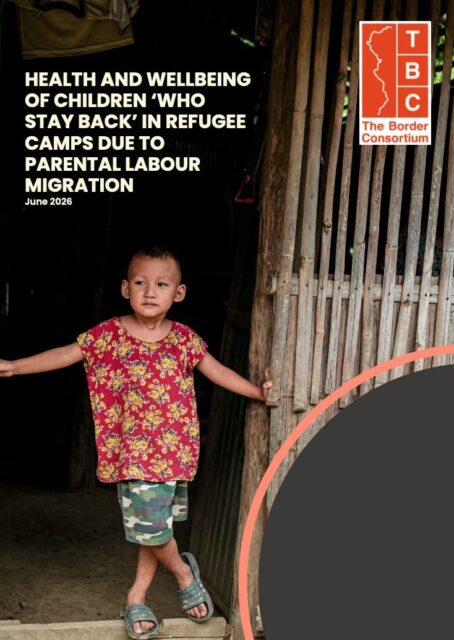
Health and Wellbeing of Children ‘Who Stay Back’ in Refugee Camps due to Parental Labour Migration
22 June 2026
Executive Summary
This assessment used a qualitative approach to explore participants’ perceptions of wellbeing outcomes for children staying back in refugee camps along the Thai-Myanmar border, due to parental labour migration associated with Thailand’s new Right to Work policy.
At the time of the assessment parental labour migration was found to be low, due to a range of barriers to accessing and maintaining employment with the policy.
These barriers led to a transition phase of heightened stressors within the camp, with these limitations on income generation occurring simultaneously with major cuts to food rations, health care access, and protection capacities.
During this phase, the wellbeing of children staying back was being safeguarded by informal care networks and formal protection organisations within the camps. However, the pressures of this transition phase led to a weakening of these systems, with caregivers’ capacity to provide care being strained, organisations acting in a reduced capacity, and collaboration issues arising across these systems.
Both observed and anticipated impacts on the wellbeing of children staying back were identified across education, nutrition, protection, health care access and emotional wellbeing. However, few impacts were directly attributable to parental labour migration alone. This assessment found that during these early phases of implementation, the impacts of parental labour migration cannot be understood independently from the broader contexts of these camps, including humanitarian withdrawal, economic insecurity and reduced service Capacity.
Overall, children staying back appear to be a vulnerable group within an already vulnerable environment. Strengthening economic opportunities, monitoring systems, caregiving supports and access to essential services will be critical to protecting child wellbeing as parental labour migration increases.
Download full report (English)