From Impunity to Justice: Denying the Junta Legitimacy and Advancing Accountability
8 May 2026
The responsibility to end the crisis in Myanmar falls squarely on UN Member States, the UN Security Council, ASEAN, and international donors. These actors must stop enabling the military’s violence through inaction or appeasement, or direct support to the junta.
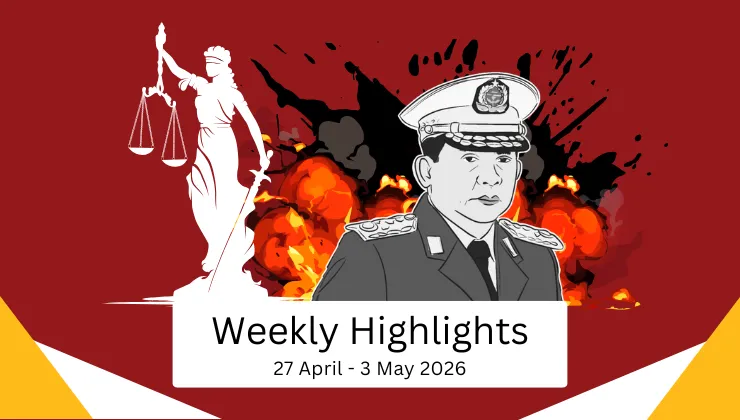
The pursuit of justice and accountability remains the most critical challenge in addressing the polycrisis in Myanmar. On 27 April 2026, the former UN Special Rapporteur on the situation of human rights in Myanmar, Tom Andrews, released a pivotal paper titled “From Impunity to Justice: Accountability for Grave Human Rights Violations in Myanmar,” which underscores that ending the Myanmar military’s entrenched impunity is essential to halting the cycle of violence. Concurrently, momentum for accountability is building through universal jurisdiction within the Southeast Asia region, with historic legal developments unfolding in Timor-Leste and Indonesia. The international community, and the Association of Southeast Asian Nations (ASEAN) in particular, must actively support these legal proceedings. While the European Union’s extension of sanctions against the junta until 30 April 2027, is welcome, much stronger coordinated action among international governments and institutions is urgently needed.
In his final report concluding his six-year mandate, Tom Andrews establishes a stark baseline, noting that entrenched impunity remains the primary catalyst for the military’s relentless campaign of violence. The report details ongoing brutality, noting that junta forces have systematically employed airstrikes, arson, torture, mass executions, and sexual violence to crush resistance. These abuses are the predictable result of a culture in which military leaders operate entirely above the law. Consequently, the Special Rapporteur argues that genuine stability is impossible without holding the junta legally and financially accountable, warning the international community against accepting its recent sham elections. Most glaringly, the UN Security Council has failed to propose a single resolution referring Myanmar to the International Criminal Court (ICC) under Chapter VII, despite the ICC Prosecutor requesting an arrest warrant for Min Aung Hlaing in November 2024. With the highest levels of international law paralyzed by geopolitical gridlock, and Myanmar remaining outside the Rome Statute, utilizing universal jurisdiction and State Party referrals to the ICC currently represents the most viable legal strategy to piercing the military’s shield of impunity.
The consequences of this impunity are reflected in the escalating refugee crisis at sea. According to the United Nations refugee agency (UNHCR), 2025 was the deadliest year on record for Rohingya refugees fleeing by boat, with nearly 900 individuals reported missing or dead in the Andaman Sea and Bay of Bengal. This desperate exodus has continued into 2026. Earlier this month, more than 250 Rohingya refugees and Bangladeshi migrants were reported missing after their vessel capsized in the Andaman Sea while navigating the dangerous route toward Indonesia. This mounting loss of life underscores the immediate and fatal cost of the international community’s failure to secure justice and protect vulnerable populations.
As the humanitarian toll mounts, the military junta continues its attempts to manipulate international perception and evade justice. On 30 April 2026, the military junta officially announced that the remaining prison sentence of 80-year-old State Counselor Daw Aung San Suu Kyi was commuted to be served at a “designated residence,” leaving her with just over 18 years left to serve. While some UN officials initially noted the transfer as a meaningful step, her son, Kim Aris, her legal team, and people inside and outside Myanmar continue to demand proof of life and her full, unconditional release. As warned in the Special Rapporteur’s report, the international community must recognize such maneuvers not as genuine reform, but as calculated political theater designed to relieve diplomatic pressure while atrocities continue unabated.
Where international bodies have faltered, grassroots civil society and women have courageously stepped forward to demand justice, driving a powerful, decentralized shift toward accountability. This momentum was demonstrated in January 2026, when the Chin Human Rights Organization filed a war crimes complaint in Timor-Leste. Building on this momentum, a Rohingya activist filed a landmark genocide complaint against Min Aung Hlaing in Indonesia in April 2026.
The responsibility to end the crisis in Myanmar falls squarely on UN Member States, the UN Security Council, ASEAN, and international donors. These actors must stop enabling the military’s violence through inaction or appeasement, or direct support to the junta. To deny the junta all legitimacy, the international community must categorically reject its playbook of deception and refuse to recognize Min Aung Hlaing or lend his rebranded junta any false legitimacy. Instead, international actors must urgently redirect political and material support to the National Unity Government (NUG), the Steering Council for the Emergence of a Federal Democratic Union (SCEF), and frontline democratic actors working to build a genuine and inclusive federal democracy. Furthermore, global leaders must coordinate targeted, multilateral sanctions against the junta, while State Parties to the Rome Statute should jointly refer Myanmar to the ICC under Article 14. Finally, international donors must increase humanitarian assistance through direct support to local civil society and community-based responders, while scaling up humanitarian aid delivery channelling through borders.
_______________________
[1] One year following the 1988 pro-democracy uprising, the former military junta changed the country’s name from Burma to Myanmar overnight. Progressive Voice uses the term ‘Myanmar’ in acknowledgement that most people of the country use this term. However, the deception of inclusiveness and the historical process of coercion by the former State Peace and Development Council military regime into usage of ‘Myanmar’ rather than ‘Burma’ without the consent of the people is recognized and not forgotten. Thus, under certain circumstances, ‘Burma’ is used.
Progressive Voice is a participatory, rights-based policy research and advocacy organization that was born out of Burma Partnership. Burma Partnership officially ended its work on October 10, 2016 transitioning to a rights-based policy research and advocacy organization called Progressive Voice. For further information, please see our press release “Burma Partnership Celebrates Continuing Regional Solidarity for Burma and Embraces the Work Ahead for Progressive Voice.”
Resources
Statements & Press Releases
By Burma Human Rights Network
BROUK Welcomes UN Report: States Must Enforce Arrest Warrants to End Impunity for Rohingya Genocide
By Burmese Rohingya Organisation UK
Myanmar: EU Restrictive Measures Extended until April 2027
By European Council
IPCM Statement on the Targeted Persecution of Media Professionals
By Independent Press Council Myanmar
By Independent Press Council Myanmar
IPCM Statement on World Press Freedom Day
By Independent Press Council Myanmar
ကမ္ဘာ့သတင်းလွတ်လပ်ခွင့်နေ့ ထုတ်ပြန်ကြေညာချက်
By Independent Press Council Myanmar
By Justice For Myanmar
By Justice For Myanmar
By Mekong Watch, Pacific Asia Resource Center, Friends of the Earth Japan, Network Against Japan Arms Trade (NAJAT), ayus:Network of Buddhists Volunteers on International Cooperation and Japan International Volunteer Center (JVC)
Myanmar Labor Alliance
Myanmar: UN expert calls for international action to end impunity and break cycle of violence
By Office of the High Commissioner for Human Rights
Statement on the Declaration of the Pawklo Indigenous Stewardship Territory (PIST)
By Pawklo Indigenous Stewardship Territory (PIST)
ပေါခလိုးဌာနေလူမျိုးစုတို့ထိန်းသိမ်းနယ်မြေအား တရားဝင်အတည်ပြုကြေငြာခြင်း
By Pawklo Indigenous Stewardship Territory (PIST)
Reports
Digital Hate – Annual Hate Speech Report Jan-Dec 2025
By Burma Human Rights Network
By Human Rights Foundation of Monland
At A Glance on Armed Struggles (24-30 April 2026)
By Nyan Lynn Thit Analytica
By Special Rapporteur on the situation of human rights in Myanmar and Office of the High Commissioner for Human Rights
Read Next
10 July 2026