Junta’s Massacres from Sky and Ground: Civilian Protection at Risk in Myanmar
20 March 2026
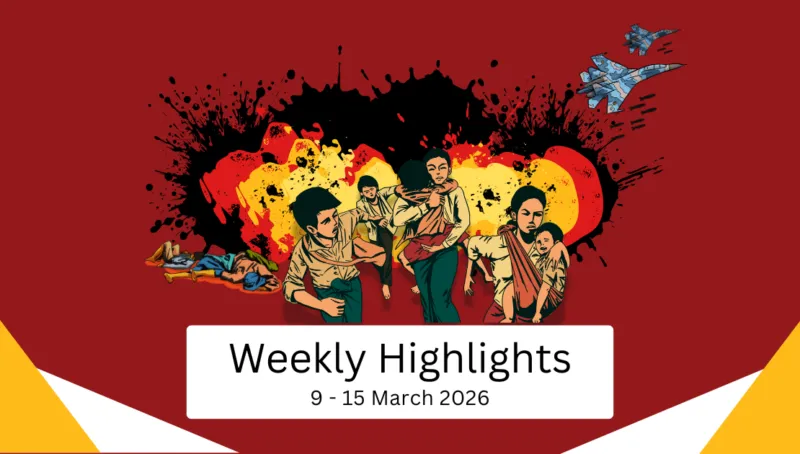
Cutting the junta’s access to aviation fuel remains one of the most immediate and effective measures to reduce its capacity to conduct aerial assaults.
The Myanmar military junta has systematically and deliberately carried out mass atrocities against civilians through coordinated aerial bombardments and ground assaults across the country since the attempted coup in February 2021. These acts amount to war crimes. The international community—particularly the Association of Southeast Asian Nations (ASEAN)—must take immediate and decisive actions to halt the junta’s campaign of violence against the people, the first point of its Five-Point Consensus (5-PC) on Myanmar.
Strong, coordinated measures are urgently required, including the non-recognition of the junta and its sham electoral outcomes, diplomatic isolation, and targeted economic sanctions against the military and its suppliers. A global embargo on aviation fuel, arms, and dual-use goods remains critical to curbing the junta’s capacity to carry out deadly aerial attacks.
Credible documentation indicates that, to date, the junta has committed at least 520 massacre incidents, including airstrikes, involving the killing of five or more civilians in a single incident. These ongoing atrocities have resulted in the deaths of 5,505 civilians, including women and children.
As of 10 March 2026, the military has carried out over 5,000 aerial attack incidents, totaling 10,651 aerial bombardments using jet fighters, drones, gyrocopters, and paramotors. These attacks were carried out across numerous parts of the country, particularly in the Sagaing, Mandalay, Magway, Bago, Ayeyarwady Regions, and Chin, Kachin, Karenni, Karen, Rakhine, and Shan States.
Evidence of these mass killings is reflected in multiple high-profile incidents. The military junta bombed a community gathering in Pazigyi village in Sagaing Region, killing approximately 165 civilians, including women and children, in April 2023. Earlier, in September 2022, helicopter gunships opened fire on a school compound in Let Yet Kone village, Sagaing Region, killing 13 civilians, including several children.
During the junta’s sham election period between December 2025 and February 2026, aerial attacks intensified further. The junta carried out more than 400 airstrikes, killing over 170 people. In Rakhine State, approximately 34 people were killed, and more than ten were critically injured when the military bombed Mrauk-U Hospital. Two additional massacres were documented: in Bhamo Township, Kachin State, airstrikes targeted a funeral and prayer ceremony, killing at least 27 people and injuring more than 40; and in Kyauktaw Township, Rakhine State, at least 21 civilians were killed, including pregnant women, infants, and children.
A particularly alarming case occurred on 5 March 2026 in Nyaunglebin Township, Bago Region. Junta forces under the 77th Light Infantry Division launched indiscriminate attacks on multiple villages using airstrikes, drones, heavy artillery, and ground incursions. At least 41 civilians were killed, including 18 children, a pregnant woman, and elderly persons. More than 160 villagers were taken hostage and used as human shields. Survivors reported being threatened with death if they attempted to flee and described the killing of a child in front of other villagers and his mother.
In response, resistance forces mobilized to protect civilians and rescue those held hostage. Units of the People’s Defense Force under the NUG Ministry of Defense, alongside the Karen National Liberation Army (Brigade 3), conducted a joint operation that enabled hundreds of villagers to escape. A survivor recalled: “I thought I would die soon, but you rescued us. Because of you, we are still alive.” The operation came at a high cost, with nine PDF fighters and two KNLA soldiers killed, and several others seriously injured.
On 8 March 2026, the military conducted a devastating aerial bombardment on a prison camp under the Arakan Army’s administration in Rakhine State, killing 116 prisoners of war (POWs) and injuring 32. This deliberate killing by the junta raises serious concerns about attempts to eliminate witnesses and destroy evidence. Days later, on 12 March, an aerial strike on a religious site in Zee Kone village, Htigyaing Township, Sagaing Region, killed 10 people, including two Buddhist monks and four novice monks, along with several residents.
These systematic attacks flagrantly violate international humanitarian law and constitute war crimes. Cutting the junta’s access to aviation fuel remains one of the most immediate and effective measures to reduce its capacity to conduct aerial assaults. Disrupting supply chains through regional transit routes—including Vietnam—is therefore critical. The current Chair of ASEAN must convince ASEAN member states to take responsibility and end their complicity in the Myanmar military’s atrocity crimes.
Regional actors bear a particular responsibility to act. ASEAN must move beyond statements and take concrete steps to advance accountability, including supporting Timor-Leste’s universal jurisdiction efforts to pursue justice for international crimes committed in Myanmar.
ASEAN Summit’s commitment of October 2025 to deliver safe, effective, and transparent humanitarian assistance, including cross-border aid, was a critical step in the right direction it has taken since the inception of the 5-PC. However, with one in three people in Myanmar now in need of humanitarian assistance and twelve million facing acute hunger, urgent implementation of this decision is essential. Aid delivery must be coordinated with Myanmar’s legitimate representatives—including the NUG, EROs, and civil society—to ensure assistance reaches communities without military interference, as emphasized by Khin Ohmar, Acting Executive Director of Progressive Voice, at the 61st Session of the UN Human Rights Council (UNHRC).
Finally, ASEAN and the broader international community must support an inclusive political dialogue among Myanmar’s democratic and revolutionary actors—without the military junta, whose ongoing atrocities against civilians underscore its lack of legitimacy. They must also demand the immediate and unconditional release of all political prisoners and refuse to recognize or legitimize any outcomes of the junta’s sham electoral process.
_______________________
[1] One year following the 1988 pro-democracy uprising, the former military junta changed the country’s name from Burma to Myanmar overnight. Progressive Voice uses the term ‘Myanmar’ in acknowledgement that most people of the country use this term. However, the deception of inclusiveness and the historical process of coercion by the former State Peace and Development Council military regime into usage of ‘Myanmar’ rather than ‘Burma’ without the consent of the people is recognized and not forgotten. Thus, under certain circumstances, ‘Burma’ is used.
Progressive Voice is a participatory, rights-based policy research and advocacy organization that was born out of Burma Partnership. Burma Partnership officially ended its work on October 10, 2016 transitioning to a rights-based policy research and advocacy organization called Progressive Voice. For further information, please see our press release “Burma Partnership Celebrates Continuing Regional Solidarity for Burma and Embraces the Work Ahead for Progressive Voice.”
Resources
Statements & Press Releases
By 46 Myanmar Civil Society and Strike Groups
By 149 Myanmar Civil Society Organizations
By Defend Myanmar Democracy
By European Union
By FORUM-ASIA
By Justice For Myanmar
By Justice For Myanmar
By Karen National Union
41 Civilians Killed in Burmese Military Attacks, Including 18 Children
By Karen Peace Support Network
Statement from Karen Rivers Watch for International Day of Action for Rivers and Against Dams
By Karen River Watch
By Ministry of Defence and National Unity Government
Statement Regarding the Mass Killing of Civilians in Nyaunglaybin Township
By National Unity Government
By UN Special Rapporteur on the Human Rights Situation in Myanmar and Office of the High Commissioner for Human Rights
Burma Army Massacres Civilians in Ler Doh Township–30 Dead, 160 Used as Human Shields
By U.S. Campaign for Burma
Reports
The Status of Freedom of Expression in Myanmar during February 2026
By Athan – Freedom of Expression Activist Organization
After the Sham Election: Recalibrating the Bridge to Peace in Myanmar
By Defend Myanmar Democracy
At A Glance On Armed Struggles (6 March -12 March 2026)
By Nyan Lynn Thit Analytica
Attacks on Health Care in Myanmar (18 February-03 March 2026)
By Insecurity Insight
The Interim Executive Council of Karenni State – Annual Activity Report for 2025
By Interim Executive Council of Karenni State
The Junta’s Sham Election: Attempt to Manufacture Legitimacy Through Violence and Fraud
By Progressive Voice
By UN Special Rapporteur on the Situation of Human Rights in Myanmar
Read Next
10 July 2026