The Junta’s Sham Election: Attempt to Manufacture Legitimacy Through Violence and Fraud
10 March 2026

Executive Summary
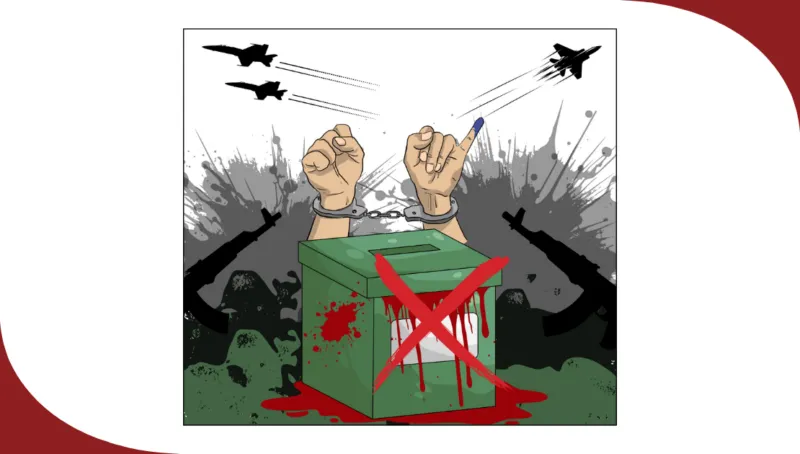
This report highlights how the Myanmar military junta’s sham election, conducted between December 2025 and January 2026, produced fabricated results designed to perpetuate military power and entrench authoritarian control while falsely projecting to the international community that Myanmar is undergoing political reform. In reality, as it faces a profound legitimacy crisis, weakened territorial control, and widespread public boycott, the junta cynically weaponized the electoral process to manufacture a deceptive façade of stability and democratic transition. This exercise represents an unprecedented escalation of electoral fraud in Myanmar’s modern history. Falling far below international standards for a free, fair, and credible election, the process functioned as a calculated strategy to repackage dictatorship under a thin civilian veneer. The international community must categorically reject this charade and refuse to legitimize its outcomes.
The junta staged a three-phase general election on 28 December 2025, 11 January 2026, and 25 January 2026. Conducted amid surveillance, displacement, widespread gross human rights violations, and the criminalization of dissent, the process was devoid of genuine political competition. Independent election observation was absent, and the junta-controlled Union Election Commission (UEC) maintained full control over the administration and the counting of results. Voter turnout was strikingly low, with widespread reports of coercion, including threats of arrest, economic retaliation, denial of public services, and intimidation used to compel participation. Millions of eligible voters were excluded due to insecurity and displacement, while millions more actively boycotted the process. Throughout the election period, atrocity crimes intensified: hundreds of attacks on civilians and airstrikes occurred even as polling proceeded in militarized settings. Election-related laws were also weaponized to arrest critics and suppress dissent, underscoring the fundamentally coercive character of the exercise.
Despite severe repression, people-led campaigns and public resistance remained widespread and resolute. Communities across ethnic states, youth movements, civil society networks, and the diaspora mobilized boycotts and protests, transforming nonparticipation into collective political defiance. While many international actors rejected the process, selective engagement by certain states risks emboldening the junta’s continued violence and undermining international legal norms.
The junta’s sham election, conducted amid war crimes and crimes against humanity, constitutes not a democratic exercise but a deliberate strategy to entrench authoritarian rule. Any credible international response must refuse recognition of its results, strengthen accountability mechanisms, and support people-led resistance and the pursuit of a federal democratic future grounded in justice, human rights, and freedom from military domination and repression.
Introduction
This report provides a critical examination of the Myanmar military junta’s sham election, situating it within the broader landscape of ongoing mass atrocity crimes, systemic repression, and the deliberate manipulation of legal and political institutions. It analyzes how the junta and its aligned structures have engineered a façade of civilian governance through coercive legislation, institutional restructuring, and manufactured electoral outcomes, seeking to entrench a fraudulent system of rule and construct a military-led parliamentary order beyond 2026.
The report is intended to inform the international community—including the United Nations (UN), the European Union (EU), the Association of Southeast Asian Nations (ASEAN), regional governments, and global civil society actors engaged in human rights protection, humanitarian response, and accountability initiatives. It underscores the urgent obligation to reject the junta’s electoral façade and to pursue coordinated international action grounded in international law, democratic legitimacy, and the expressed political will of the people of Myanmar to build a genuine federal democratic union.
First Phase – 28 December 2025
The initial phase was conducted across selected townships nationwide. The junta-controlled Union Election Commission (UEC)[1] claimed broad implementation, yet credible verification was absent. Serious procedural irregularities were reported by political parties involved in the process. A political party leader in the Ayeyarwady Region stated, “I want to clearly say that this is not a free and fair election; that is why I did not sign the UEC results.”[2] Several political parties further reported that voter lists were inaccurate, incomplete, or inaccessible, with many eligible voters unable to locate their names on official registers and therefore unable to cast ballots. These failures highlighted widespread mismanagement of voter registration systems and polling station administration.
Public participation during the first phase was strikingly low when compared to the 2020 general election. Those who appeared at polling stations were overwhelmingly pro-military supporters, civil servants, or individuals compelled to vote under threats of retaliation, including administrative punishment or other coercive measures[3]. The absence of voluntary participation constituted a clear and collective rejection by the population of the junta’s electoral charade.
On 28 December, the junta’s leader, Min Aung Hlaing, cast his vote at a polling station in Naypyidaw and publicly denounced the 2020 general election, claiming it had been “very bad”,[4] and asserting—without credible evidence—that it had been thoroughly investigated. He further claimed that the 2025–2026 election, conducted under direct military control, was “free and fair,” a statement fundamentally incompatible with international electoral standards. Observers from China and Russia issued favorable assessments of the process despite the absence of transparency or independent monitoring. China’s Special Envoy for Asian Affairs stated that Myanmar’s election was conducted “based on an understanding reached between Chinese leader Xi Jinping and the junta’s chief Min Aung Hlaing,”[5] underscoring the explicitly political nature of such endorsements rather than any objective or rights-based evaluation.
In contrast, on 30 December 2025, Malaysian Prime Minister Anwar Ibrahim stated that the junta’s sham election should be closely assessed and warned against premature official recognition.”[6] His remarks reflected growing regional concern regarding the legitimacy of the process and the risks of normalizing a militarized electoral exercise conducted amid widespread repression and ongoing atrocities.
Notably, the electoral process unfolded alongside an escalation—not a reduction—of military violence. During the first phase of the election, at least 556 human rights violations were documented nationwide. During this period, the junta carried out 262 airstrikes, resulting in the deaths of at least 198 civilians and injuries to 375 others, with Sagaing Region bearing the brunt of the attacks. On 5 December, a particularly egregious incident occurred in Ma Ra Kan (also spelled Maungkan) Village, Tabayin (or Depayin) Township, where a junta airstrike targeting civilians watching a football match killed 18 people, including a child.[7] The deliberate destruction of civilian homes, schools, and religious buildings during this period reflects a systematic strategy of terror aimed at suppressing the population and dismantling community resilience. These violations underscore the fundamental incompatibility between the junta’s claimed electoral process and the realities of widespread and systematic violence against civilians.
Second Phase – 11 January 2026
The second phase of the junta’s sham election was conducted on 11 January 2026. Turnout during the second phase remained extremely low amid persistent reports of intimidation, surveillance, and systematic electoral manipulation. In major urban centers such as Yangon and Mandalay, polling stations were largely deserted. In Yangon, junta officials and military personnel were observed visiting selected polling stations, reinforcing an atmosphere of fear and coercion rather than voluntary participation. A garment factory worker from Htantabin Township described the pressure exerted on workers and their families:
“Whether factories are open or closed, we are told to take leave on voting day and return to vote. Our families are called and pressured to make us come back. Authorities threaten that if we do not vote, we will not be eligible for agricultural loans, and they say they are recording the names of those who do not vote.”[8]
Similarly, a resident of Shwepyitha Township reported that identification documents were used as tools of compulsion rather than civic inclusion:
“We are being issued identification documents shortly before voting day and then compelled to cast ballots. After voting, people with ink-stained thumbs are required to gather and be photographed at local administrative offices. Authorities warned that refusal to vote could result in imprisonment[9].”
These practices underscore the coercive and punitive nature of the electoral process, in which participation was extracted through threats rather than freely given.
Advance voting raised particular concern due to its administration by the junta-controlled UEC. The absence of transparency, independent monitoring, and accountability mechanisms rendered advance voting especially vulnerable to manipulation.[10] As in previous military-managed sham elections, including the 2010 election, advance ballots were weaponized to engineer predetermined outcomes rather than reflect the genuine will of voters.
Following the conclusion of the first and second phases, the junta announced results claiming that the military proxy, the Union Solidarity and Development Party (USDP), had secured 181 seats in the Pyithu Hluttaw—figures that lacked independent verification and further proved the lack of credibility of the process.
Between 10 January and 21 January 2026, the junta carried out at least 389 armed clashes and military attacks, including 102 airstrikes, across 112 townships nationwide. In the Sagaing Region alone, the military reportedly dropped 60 bombs within a single day.[11] During this period, the junta also intensified forced military conscription, targeting youth and working-age adults to sustain its ongoing campaign of violence.
Final Phase – 25 January 2026
The final phase of the junta’s sham election was conducted on 25 January 2026. As in previous phases, polling stations were largely deserted. Authorities escalated coercive tactics, including loudspeaker announcements, door-to-door summons, road blockades, and explicit threats.[12] Credible reports documented forced voting, coerced written pledges of participation, and the photographing of ballots or ink-stained fingers as proof of compliance, further underscoring the compulsory nature of the process.
In Salingyi Township in the Sagaing Region, a polling station was reportedly established inside the compound of the China-owned Yangtze Copper Mining Project, while nearby villages were simultaneously subjected to artillery shelling, forcing residents to flee. Civilians were compelled to cast paper ballots marked exclusively for the USDP, while civilian vehicles were confiscated and repurposed for election-related operations.[13] This episode starkly illustrated the convergence of military violence, corporate interests, and electoral coercion under the junta’s rule.
At least 404 individuals—324 men and 80 women—were arrested under the junta’s so-called electoral laws during this period.[14] Among those detained was a former parliamentarian accused of alleged links to resistance forces, demonstrating how election-related legislation was weaponized to criminalize political opposition rather than to safeguard electoral integrity. These arrests formed part of a broader strategy of repression aimed at silencing dissent and enforcing participation through fear.
Between 21 and 25 January 2026, at least two major massacres were documented. In Bhamo Township, Kachin State, junta airstrikes killed at least 27 people and injured more than 40 others during a funeral and prayer ceremony.[15] In Kyauktaw Township, Rakhine State, another airstrike killed at least 21 civilians, including pregnant women, an infant, and children.[16] As stated earlier, at least 389 clashes and military attacks were documented by ALSEAN-Burma during the second and final phases of the sham election period, including 102 airstrikes across 112 townships nationwide. In a single day alone, military aircraft reportedly dropped 60 bombs across just two townships in the Sagaing Region.[17] Overall, the final phase of the sham election conclusively demonstrates that the process functioned not as a democratic exercise but as a mechanism to institutionalize military dictatorship.
Junta’s Politics in Electoral Manipulation and Weaponization
In the months preceding the sham election scheduled between November 2025 and December 2025, Myanmar’s military junta systematically engineered the political environment to guarantee the reinstallation of military domination. Central to this strategy was the weaponization of the electoral system. The junta-controlled UEC, historically operated under military influence, acted as a direct instrument for the junta to weaponize the electoral systems.
The USDP, formerly known as the Union Solidarity and Development Association (USDA), has long served as a military-created, military-controlled proxy. Established under successive military rules, the USDP has consistently served as a vehicle for junta propaganda, political manipulation, and the mobilization of ultranationalist and exclusionary narratives. The party has actively promoted hate speech, stoked inter-religious tensions, and aligned itself with extremist nationalist networks, all while advancing the strategic interests of the military. In the lead-up to the sham election, USDP Chairperson Khin Yi—a former senior military official appointed under the junta—openly urged voters to support parties that “live side by side with the military.” While asserting that USDP members had been killed since 2021, Khin Yi conspicuously omitted any acknowledgment of the tens of thousands of civilians who have been killed, injured, or subjected to grave violations by the military, including indiscriminate airstrikes, artillery shelling, sexual and gender-based violence, extrajudicial killings, and ground assaults. The USDP has thus functioned not as a pro-junta party in the democratic sense, but as a political shield for perpetrators of mass atrocities and a mechanism for laundering the junta’s crimes, including the Rohingya genocide.
Pro-military figures amplified these narratives through tightly controlled press conferences and junta-aligned media outlets. Moe Hein, a former activist turned pro-junta journalist, publicly described Min Aung Hlaing as the “most trusted” figure in Myanmar and promoted him as a future president. Similarly, U Ko Ko Kyi portrayed the election as essential for national progress while erasing or ignoring the junta’s extensive record of international crimes. A small number of celebrities and pro-junta parties echoed these claims; however, they represented only a marginal and highly curated segment of public opinion, under conditions of repression, censorship, and fear.
Senior military officials, including spokesperson Zaw Min Tun, further demonstrated the junta’s contempt for international law and global norms by openly declaring that international recognition was irrelevant and that the election would proceed regardless of widespread rejection. In pro-military media, he asserted that the election was “not forced,” claiming that “people want this election” and that it was conducted “for Myanmar’s people.”[18]
Before and during the sham election period, Senior General Min Aung Hlaing repeatedly claimed that the election was necessary for Myanmar’s “future,” while simultaneously attacking the credibility of the 2020 general election—widely recognized as free and fair. His assertion that the 2025–2026 electoral process was being “well managed”[19] by the military underscored the fundamentally anti-democratic nature of the exercise, in which military domination was presented as a prerequisite for political participation.
Despite efforts by the USDP, pro-military groups, and junta-aligned media to manufacture an appearance of public support, there is no credible evidence that the election enjoyed meaningful public participation or legitimacy.
Post Junta’s Sham Election
In the aftermath of the sham election in January 2026, the junta intensified its strategy to “legalize” its repression and institutional restructuring to reinstate military rule. On 3 February 2026, the junta-controlled UEC formally announced the results and enacted legislation establishing the so-called Union Consultative Council (UCC). Framed as an inclusive advisory mechanism, the body in practice centralizes power under a junta-appointed president, who oversees advisory structures responsible for security, rule of law, foreign affairs, legislative functions, and the peace process.[20]
This plan by the military is a political trick to continue its attempt to seize control of Myanmar in its hands while pretending to form a “civilian” government. Such a move would only cement military dominance and tighten authoritarian rule under a new label.
People’s Rejection, Civil Resistance, and International Response
Despite the junta’s ongoing campaign of terror, peaceful resistance and public opposition to the junta’s sham election were widespread. Nationwide voter avoidance constituted a powerful act of collective boycott, signaling unequivocal public rejection of military rule. At the local level, communities in Karen State organized public protests on 9 January 2026,[21] while in Karenni State, representatives from six community-based organizations across eleven districts mobilized to denounce the electoral process, asserting that “without the people, it is not democracy.” Youths played leading roles in these acts of resistance, underscoring the resilience and determination of Myanmar’s civil society.[22] On 13 January 2026, community members and protest groups further demonstrated under the message: “Through your vote, do not allow the junta to kill the people.”[23] Myanmar diaspora communities worldwide also mobilized to challenge the junta’s sham election.
International rejection of the junta’s sham election was swift and largely unequivocal. On 20 January, Malaysia’s Foreign Minister, speaking on behalf of ASEAN, stated that the bloc would neither send observers nor endorse the junta-led polls.[24] Japan’s Chief Cabinet Secretary warned that the election would deepen national divisions, citing the exclusion of pro-democracy forces and the continued detention of political prisoners[25]. The EU similarly rejected the election as illegitimate and confirmed that sanctions would remain in place until at least April 2026. The EU emphasized that pervasive violence, mass arrests, and ongoing armed conflict rendered the process incompatible with international standards.[26]
The United Nations High Commissioner for Human Rights (UNHCHR), Volker Türk, further condemned the process, stating that the “military-controlled ballot exacerbates violence and social division.” He noted that many people chose either to vote or not to vote purely out of fear, in direct contradiction to internationally guaranteed civil and political rights, with cascading impacts on economic, social, and cultural rights. He further emphasized that conflict and insecurity continued unabated across large parts of the country and that opposition candidates and ethnic groups were systematically excluded from participation.”[27]
Youth-led resistance played a central role in amplifying this rejection. A powerful coordinated campaign led by youth groups under the message “We Do Not Vote”[28] circulated widely on Myanmar social media platforms, rapidly going viral despite censorship and surveillance. Moreover, on 25 January, protests led by People’s Voices Action (PVA) emerged in Yangon using Bluetooth speakers in public places,[29] and sticker campaigns against the sham election were also carried out by youth groups in the downtown area of Yangon.[30] These actions demonstrated the depth of public rejection and ongoing civil resistance against the junta’s electoral charade.
Conclusion
The 2025–2026 junta-engineered election was nothing but a calculated mechanism to perpetuate military rule behind a façade of democracy. Conducted amid ongoing systematic repression and violence, and the deliberate exclusion of large segments of the country’s population, the process was wholly weaponized by the military through its controlled UEC and structurally designed to secure victory for its proxy USDP. Combined with constitutionally reserved military seats, the outcome consolidated authoritarian domination by the military.
Yet Myanmar’s people responded with defiant rejection through mass boycotts, silent strikes, and youth-led resistance. Authentic political legitimacy resides not in junta-fabricated institutions, but in the country’s democratic movement.
Under international human rights principles, elections conducted in conditions of coercion, atrocity crimes, and impunity cannot confer democratic legitimacy. The international community must refuse recognition of the sham election outcomes, intensify accountability mechanisms, and stand unequivocally with the Myanmar people’s struggle for justice and genuine democracy.
Recommendations
To the United Nations Human Rights Council (UNHRC)
The UN Human Rights Council must assume a leadership role commensurate with the gravity of the situation in Myanmar. The Council is urged to:
- Unequivocally reject the military-orchestrated sham election and refuse to recognize its process, legitimacy, or outcome under any circumstances.
- Reaffirm and operationalize the principles of non-recognition and non-assistance, making clear that any engagement that confers political legitimacy on the junta in its post-sham election is inconsistent with international law and the Council’s human rights mandate on Myanmar.
- Explicitly recognize the nexus between the military junta and transnational organized crime, including large-scale cyber-scam operations, human trafficking networks, and narcotics production, and acknowledge that
- these activities constitute grave human rights violations that may amount to crimes against humanity.
- Strengthen and renew accountability mechanisms related to Myanmar, including the mandates of the Independent Investigative Mechanism for Myanmar (IIMM) and the UN Special Rapporteur on the situation of human rights in Myanmar, ensuring sustained political backing and adequate financial resources.
- Call for concrete pathways toward international criminal accountability, including referral of the situation in Myanmar to the International Criminal Court (ICC) or the establishment of an ad hoc or hybrid international criminal tribunal.
To the International Governments
States bear both legal and moral responsibility to ensure their actions do not legitimize or enable atrocity crimes. Governments and international actors are therefore urged to:
- Formally reject and refuse recognition of the junta’s sham election and its outcomes, including a sham government that the military will form as a result of it.
- Impose and enforce a comprehensive global arms embargo, including targeted sanctions on aviation fuel, weapons, aircraft, drones, and dual-use technologies.
- Expand targeted sanctions against military leaders, military-owned enterprises, and individuals and entities linked to transnational criminal economies.
- Support international justice and accountability mechanisms, including efforts to refer the situation of Myanmar to the ICC, the exercise of universal jurisdiction, and supporting and cooperating with the IIMM.
- Redirect diplomatic engagement and financial support toward the National Unity Government (NUG), ethnic resistance institutions, and people-led governance structures in the framework of the Federal Democracy
- Charter (FDC), and civil society and community-based organizations (CSOs and CBOs) in line with the democratic will and aspirations of the Myanmar people.
To International Human Rights, Humanitarian, and Civil Society Organizations
International organizations play a critical role in shaping narratives that are reflective of the realities of the Myanmar people on the ground, influencing policy responses, and protecting affected communities. In light of the Myanmar military junta’s post-sham election, international human rights, humanitarian, and CSOs are urged to:
- Reject the framing of the junta’s election and its outcomes as a political solution and actively challenge narratives that normalize or legitimize the military’s attempt to consolidate and reinstate power through a fraudulent electoral process.
- Align advocacy, programming, and funding with people-led democratic institutions, including women-led, youth-led, and ethnic community organizations, as well as broader civil society networks.
- Ensure humanitarian engagement prioritizes protection and accountability with integration of non-recognition and atrocity prevention, and that aid delivery mechanisms do not reinforce military control or legitimacy.
- Amplify the voices of Myanmar human rights defenders, survivors, and affected communities in the international policy discussions and advocacy platforms.
- Strengthen coordinated cross-border and transnational advocacy to address the regional and global implications of the Myanmar military’s criminalized governance and illicit economic networks.
Download full report (English)
[1] “Myanmar’s Coup Leaders Name a New Union Election Commission,” The Irrawaddy, February 3, 2021- https://www.irrawaddy.com/news/burma/myanmars-coup-leaders-name-new-union-election-commission.html
“Not Sign on Election Results b People’s Party,” Delta News Agency’s Post, January 1, 2026 – https://deltanewsagency.com/58796/
[3] “The Sham Election of the Myanmar Military Junta,” Mizzima News, January 8, 2026 – https://eng.mizzima.com/2026/01/08/30030
[4] “BBC Interview on free and fair election,” The Irrawaddy, December 28, 2025, https://www.facebook.com/reel/1543188553671458
[5] “Phase 1 Overview,” Date for Myanmar, January 14, 2026. https://drive.google.com/file/d/1DTmcXAnbL_4BVno9l7C-ERBj_vfmZQK6/view?fbclid=IwY2xjawQLW9RleHRuA2FlbQIxMABicmlkETFDbmI3cUp6NzBBQ01NVkJzc3J0YwZhcHBfaWQQMjIyMDM5MTc4ODIwMDg5MgABHnnOBBThz9gAzm8Db6L2lJdnOmEwBvhyfYrGRH9kPOIumGQtxL9WnLwERbIP_aem_Uu1n-eKD3328xk0jIfQF8g
[6] “ASEAN to assess developments in Myanmar after polls: Anwar,” The Straits Times, 30 December 2025 – https://www.straitstimes.com/asia/se-asia/asean-to-assess-developments-in-myanmar-after-polls-anwar
[7] “The Atrocities of Military Junta in 2025 December,” Ministry of Human Rights NUG, January 14, 2026 – https://www.facebook.com/mohrmyanmar/posts/pfbid02ay6eqMe99moNcSfgNH6Ga4sQQ6NoDjiMyDKKYqBMNq3AW1AorXRp6y3UYVxU92D3l
[8] “Yangon Election Day, Forced to vote the family members by the military,” DVB, January 10, 2026 – https://burmese.dvb.no/post/741147
[9] “Sham election phase 2: limitation of voters in some township areas in Yangon,” The Irrawaddy, January 11, 2026,https://www.facebook.com/theirrawaddyburmese/posts/pfbid034cixGs99778SNwFp75mH9BfS4tUNXUt16fnvqiBdi2oci8HwFgrVai1dn6ekh956l?rdid=6C4fUXTh71U6m7QV
[10] “Low Turnout, Intimidation and Attacks Mark Phase 2 of Myanmar Junta’s Election,” The Irrawaddy, January 11, 2026, https://www.irrawaddy.com/news/politics/low-turnout-intimidation-and-attacks-mark-phase-2-of-myanmar-juntas election.html
[11] “Less Votes, More Fraud: Phase 2 Overview,” ALTSEAN-BURMA, January 21, 2026, https://www.facebook.com/photo?fbid=1201424812164177&set=a.561935539446444
[12] “In Thaketa Township, there were incidents in which individuals who did not vote were summoned and threatened at their homes,” Myanmar Pressphoto Agency, 25 January 2026. https://www.facebook.com/photo/?fbid=1454121936077190&set=a.776968607125863
[13] “In Salingyi, the military junta opened a polling station inside a Chinese factory,” Mandalay Free Press-MFP, January 25, 2026 – https://www.facebook.com/photo/?fbid=947557944269993&set=pcb.947558404269947
[14] “More than 400 people were arrested on accusations of disrupting and obstructing the election,” People’s Spring, 21 January 2026 – https://www.ludunwayoo.com/news-mm/2026/01/21/146048/
[15] “Myanmar Junta kills 27 Civilians in Airstrikes on Wedding and Funeral,” The Irrawaddy, January 23, 2026 –
https://www.irrawaddy.com/news/burma/myanmar-junta-kills-27-civilians-in-airstrikes-on-wedding-and-funeral.html
[16] “AA says Kyauktaw bombing kills captives and family members,” The Irrawaddy, January 21, 2026 – https://www.facebook.com/theirrawaddyburmese/posts/pfbid02KxMfbYhvdWMGgpa9W9bDYebh8dBzBv1VtMyd36EfPXqVvk1LWBjMeV44piNpz6ngl?rdid=gKVFUfgcnBTDikIo
[17] “Less Votes, More Fraud Phase 2 Overview,” Anti Sham Election, January 24, 2026 – https://www.facebook.com/photo/?fbid=838579749218019&set=a.148771311532203
[18] “Public Meeting of Junta’s Senior Officials,” Eleven short view, December 17, 2025, https://www.facebook.com/reel/1581209466654649
[19] “First Phase Sham Election,” BBC Burmese, December 28, 2025. https://www.facebook.com/reel/1543188553671458
[20] “Junta enact law to form extra-constitutional consultative council for cementing military control,” Alert, February 17, 2026. https://eusee.hivos.org/alert/junta-enact-law-to-form-extra-constitutional-consultative-council-for-cementing-military-control/
[21] “The KNU-Duplaya district protested the military council’s sham election,” DVB TV News, January 11, 2026, https://www.facebook.com/DVBTVNews/posts/pfbid0kFGiY6V9Ckq12zTuQtK9UYcVG6xcGNNL5GKTaAZ1hvRUDKz89WhVzvzsvSC5zAVVl?rdid=MPsATqCzWZxtqL9c
[22] “Photo Campaign against fake elections held in 11 Karenni regions,” DVB TV News, January 12, 2026, https://www.facebook.com/DVBTVNews/posts/pfbid0jgWV8XhrXtxDKf8MDfhpni8fS4DTWddtctoDygwYh7MihNSSbj5YaWqsqSPMaSkxl?rdid=oFIjDmcxjQQAUvRT
[23] “People in Sagaing and Karen State protest against military-held elections,” People’s Spring, January 13, 2026, https://www.facebook.com/LuduNwayOo/posts/pfbid0C83GFKWdecPdkJpFco61zZiP1ycUw4C2iuLrqwt9GcigFVBSRsA1R4dNT11AMCjGl/
[24] “ASEAN will not certify Myanmar election or send observers, Malaysia says,” The Straits Times, January 20, 2026, https://www.straitstimes.com/asia/se-asia/asean-will-not-certify-myanmar-election-or-send-observers-malaysia-says
[25] “Japan concerned over deeper division in Myanmar after junta-run election,” The Mainichi, January 16, 2026, https://mainichi.jp/english/articles/20260116/p2g/00m/0na/027000c
[26] “Wy Myanmar election won’t change Europe’s mind on junta,” Inquirer.Net, Asia & Pacific, January 20, 2026, https://globalnation.inquirer.net/306335/why-myanmar-election-wont-change-europes-mind-on-junta
[27] “Myanmar: Türk says “military-controlled ballot exacerbates violence and social division,” United Nations Human Rights, January 30, 2026, https://www.ohchr.org/en/press-releases/2026/01/myanmar-turk-says-military-controlled-ballot-exacerbates-violence-and-social
[28] “We do note vote,” Shwe Khin Myo, January 30, 2026, https://www.facebook.com/shwe.khin.myo/posts/pfbid0JwwRy3cgBBsRYABmXHFPJS2krRYP4B9XeVsnZi7WsoJ2W5e996UHg2c4At2XLRaAl
[29] “Anti-Election Protests in Yangon Using Bluetooth Speakers,” BBM TV+, January 25, 2026, https://www.youtube.com/watch?v=O17nOm8vToc
[30] “Protests against sham election in Yangon,” General Strike Coordination Body-GSCB, January 24, 2026, https://www.facebook.com/gscbmyanmar/posts/pfbid02WXgdUNmwELx9t8abg19AUgM4PyCqqytChV5CWxnq5gsXtMsptkXDkL96jaaYjh37l