Unbowed and Unafraid: Myanmar’s Women Resist Violence, Patriarchy, and Impunity
13 March 2026
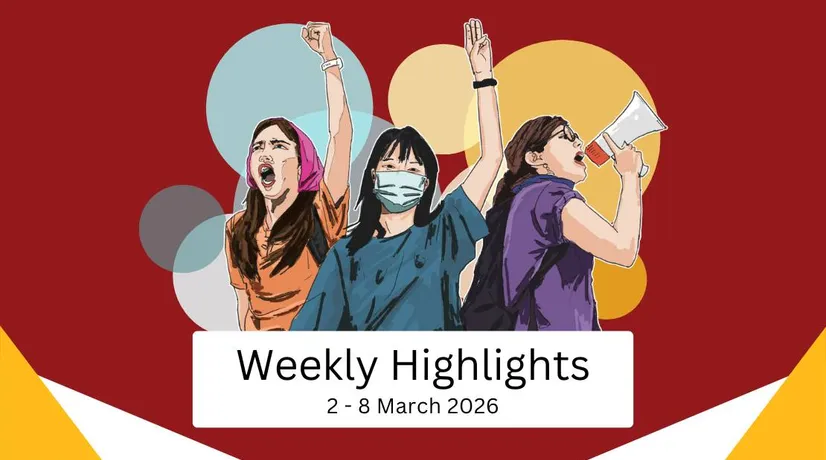
The resilience and leadership of Myanmar’s women continue to challenge both militarized violence and entrenched patriarchy. The international community must stand with them, not only in words, but through concrete actions that support accountability, protection, and documentation, as well as women’s leadership in shaping Myanmar’s democratic future.
As the world marked International Women’s Day 2026 on 8 March, around 300 Myanmar women from civil society organizations, community groups, and human rights and labor rights networks gathered in Chiang Mai to mobilize and raise their collective voice through public demonstrations and advocacy campaigns, including “War, What Is It Good For?” and “Give to Gain.” These initiatives highlighted women’s leadership across sectors and emphasized their frontline role in advancing women’s rights, strengthening leadership, and addressing sexual and gender-based violence (SGBV), including conflict-related sexual violence (CRSV). Youth groups also organized debate sessions on gender equality and inclusive leadership, engaging the next generation in discussions on equality, non-discrimination, and democratic values. These mobilizations underscore the continued leadership of Myanmar’s women in resistance, advocacy, and community protection despite the Myanmar military’s ongoing campaign of terror.
Five years after the military’s attempted coup, women in Myanmar continue to confront some of the most severe gendered impacts of the country’s ongoing crisis. Women and girls face widespread violence, persecution, and systemic repression primarily perpetrated by the military. The Myanmar military’s widespread and systematic use of sexual and gender-based violence directly violates global commitments under the Women, Peace and Security (WPS) agenda, which calls for the protection of women from such violence and their meaningful participation in peacebuilding and political processes. Instead of ensuring protection and participation, women in Myanmar are being systematically targeted and silenced through violence, fear, and repression.
CRSV has also been systematically deployed as a weapon of war. A report by the Women’s League of Burma (WLB) documents 918 cases of CRSV committed by junta forces between February 2021 and May 2025, including rape, gang rape, sexual torture in detention, and other forms of sexual abuse. Karenni State accounts for the highest proportion, with 365 cases (40 percent), followed closely by Sagaing Region with 349 cases (38 percent). Together, these two areas represented nearly 78 percent of all recorded incidents. Additional cases were documented in Shan State (102 cases) and in Kachin State (40 cases), while smaller numbers were reported across other states and regions. These patterns demonstrate how the Myanmar military continues to weaponize violence against women as a strategy of terror and community control in conflict-affected areas.
Yet despite these grave threats, the courage and leadership of Myanmar’s women remain unbroken and undefeated. Across the country, women continue to stand on the frontlines of resistance—exposing atrocities, defending their communities, challenging entrenched patriarchy and a culture of impunity. However, the suffering of women in Myanmar continues to receive insufficient attention from the international community, including the Association of Southeast Asian Nations (ASEAN).
According to the Burmese Women’s Union (BWU), 792 women have been killed and 815 critically injured as a result of military violence since the 2021 coup attempt, underscoring the devastating toll of the junta’s attacks on women and girls. Military airstrikes account for the majority of these deaths, with 621 victims—approximately 78 percent—making aerial bombardment the deadliest tactic used against civilians since the coup. The highest number of women killed was recorded in Sagaing Region, with 217 deaths, followed by 123 in Mandalay Region, 119 in Rakhine State, 81 in Shan State, and 69 in Magway Region. Alarmingly, 154 victims were girls under the age of 18, and five were pregnant women.
In February 2026 alone, 63 women were killed, and 66 were injured. Among those killed, 41 women died from aerial bombardment and 13 from artillery shelling, while others were killed by landmines and conflict-related sexual violence (CRSV). Eighteen of the victims were girls under the age of 18, and one was a pregnant woman—further reflecting the continuing and indiscriminate nature of the Myanmar military’s violence against women and girls.
Women and the LGBTQIA+ community face battles against discrimination and SGBV not only at the hands of the military junta—which has committed these crimes widely and systematically on a massive scale—but also from resistance forces, as well as within their communities, families, and workplaces.
In a recent case, a female member of the People’s Defense Force (PDF) units, operating under the National Unity Government (NUG) in Yinmarbin Township, Sagaing Region was reportedly subjected to sexual and physical violence by the unit’s leader, including discriminatory treatments and torture based on her religious identity as a Muslim woman, raising serious concerns about protection and accountability mechanisms within the revolution. This incident highlights the urgent need for the NUG of Myanmar to ensure full accountability and establish an effective survivor protection framework within the code of conduct governing the PDF units under its command. Demonstrating accountability and adherence to international human rights standards is not only an essential moral and legal obligation but also for strengthening the legitimacy of democratic actors.
In light of these persistent violations, the international community—particularly the ASEAN—must take urgent and principled action to prevent further atrocities and support the women of Myanmar in their struggle for justice, equality, and peace. To date, ASEAN has failed to meaningfully incorporate the lived experiences and priorities of Myanmar’s women into its Regional Plan of Action on the WPS agenda. In response, women’s organizations and broader Myanmar civil society groups have called on ASEAN to overhaul its WPS Regional Plan of Action in a recently published position paper. ASEAN must engage with legitimate democratic actors, including the NUG, ethnic resistance organizations, and women’s rights and women-led civil society groups. Supporting Myanmar women’s leadership is essential not only for addressing gender-based violence but also for advancing inclusive peacebuilding and the bottom-up building of a federal democratic future for Myanmar.
The resilience and leadership of Myanmar’s women continue to challenge both militarized violence and entrenched patriarchy. The international community must stand with them, not only in words, but through concrete actions that support accountability, protection, and documentation, as well as women’s leadership in shaping Myanmar’s democratic future.
_______________________
[1] One year following the 1988 pro-democracy uprising, the former military junta changed the country’s name from Burma to Myanmar overnight. Progressive Voice uses the term ‘Myanmar’ in acknowledgement that most people of the country use this term. However, the deception of inclusiveness and the historical process of coercion by the former State Peace and Development Council military regime into usage of ‘Myanmar’ rather than ‘Burma’ without the consent of the people is recognized and not forgotten. Thus, under certain circumstances, ‘Burma’ is used.
Progressive Voice is a participatory, rights-based policy research and advocacy organization that was born out of Burma Partnership. Burma Partnership officially ended its work on October 10, 2016 transitioning to a rights-based policy research and advocacy organization called Progressive Voice. For further information, please see our press release “Burma Partnership Celebrates Continuing Regional Solidarity for Burma and Embraces the Work Ahead for Progressive Voice.”
Resources
Statements & Press Releases
By 16 Myanmar Women and Gender Organizations
By 16 Myanmar Organizations
Burma Political Prisoner Amnesty a Public Relations Ploy
By Burma Campaign UK
UK Burma/Myanmar Student Visa Ban Exceptionally Cruel and Shortsighted
By Burma Campaign UK
New approach needed on Burma/Myanmar at UN Security Council
By Burma Campaign UK
By Karenni Human Rights Group
Statement on International Women’s Day
By Women’s Peace Network
International Women’s Day 2026: Rights, Justice and Action for All of Myanmar’s Women and Girls
By World Health Organization
Reports
By 43 Myanmar organizations
By Human Rights Foundation of Monland
11 recommendations for proposed national human rights law
By Human Rights Myanmar
Hanging Onto Hope: An Overview of the Human Rights Situation in Karenni State in 2025
By Karenni Human Rights Group
At A Glance on Armed Struggles (27 February – 5 March)
By Nyan Lynn Thit Analytica