Shared Duty Needed for Refugees
25 July 2025
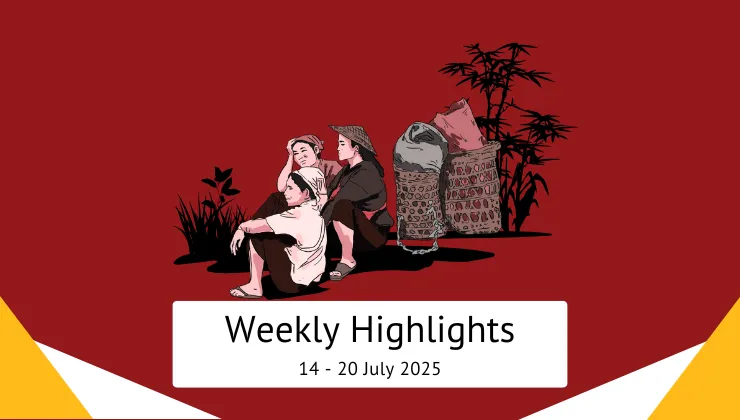
“The international community must increase its support for the diverse skills, knowledge, and capacities of Myanmar’s IDPs and refugees by uplifting their voices, heeding their calls, and strengthening their resilience as active peacebuilders and changemakers who are building sustainable solutions for their communities.”
Myanmar refugees in Thailand are facing growing uncertainty and rapidly deteriorating conditions as the impact of international humanitarian aid cuts becomes acute and Thai policy responses remain unclear. International donors must recognize the need to share Thailand’s burden of hosting refugees and urgently fill the funding gap that has now left refugees in Thailand without food or healthcare support. Myanmar refugees have both the willingness and ability to integrate into Thai society as productive, self-reliant members of their host communities—but they need adequate support and opportunities to do so.
The Thai Government, in cooperation with the United Nations High Commissioner for Refugees (UNHCR), has managed refugee camps along the Thailand-Myanmar border for decades, providing “temporary shelter” and protection to hundreds of thousands of refugees fleeing conflict and violence in Myanmar. However, approximately 100,000 refugees currently residing in the nine camps along the border now face an immediate crisis of survival and uncertain futures. With international aid slashed earlier this year, predominantly by the United States, The Border Consortium (TBC)—the primary humanitarian organization in the camps—announced that all food assistance will cease on 31 July. Already under-resourced, camp conditions have deteriorated rapidly since the US aid cuts with healthcare support in seven of nine camps provided by the International Rescue Committee (IRC) ending abruptly in January and educational opportunities further restricted. International donors must urgently fill the funding gap to ensure access to food, healthcare, and education for refugees who can neither legally support themselves financially nor return home amid the ongoing crisis in Myanmar. For the protection of Myanmar refugees’ fundamental human rights, their dignity and self-reliance, as well as for their potential to more greatly benefit Thai host communities, this international support must be coupled with adjustments to Thai policy.
Locally coordinated education and vocational programs have equipped refugees with the skills to contribute meaningfully to Thailand’s economy and society—such programs are already benefiting local Thai communities. It is now essential that the Thai government grant the opportunities and legal permission for refugees to support themselves and integrate. As voiced in a statement by 12 civil society organizations, “[Thailand’s] policy allowing refugees to survive through dependence, without legal permission to work for their livelihood, may have been suitable only for temporary emergency situations—not for the prolonged displacement that has persisted.” Granting Myanmar refugees the right to work would benefit host communities economically, promote social harmony, and protect refugees’ human rights and dignity while also reducing their reliance on the Thai government and on shrinking supplies of international humanitarian aid. As a re-assuming member of the UN Human Rights Council, Thailand is expected to display and implement the highest level of commitment to human rights protection, which the country can demonstrate in its policies and measures towards Myanmar refugees.
At least 4 million Myanmar people have been forced to flee to Thailand, many of whom lack access to legal documentation and face harassment and deportation by Thai authorities. Whilst not a signatory to the 1951 Refugee Convention, pushbacks and deportation of Myanmar people into the hands of the murderous military junta contravenes the principle of non-refoulement—which is inviolable under customary international law and has been codified into Thai domestic law. A recent report by Human Rights Watch highlights the practice of illegal deportation of Myanmar people from Thailand and its consequences, including forced conscription or imprisonment by the junta upon return. Moreover, Myanmar workers in Thailand, 40 percent of whom lack documentation, are particularly vulnerable to exploitation and abuse by local authorities and businesses alike. People fleeing persecution and violence deserve protection and safety—they must never be turned away to face danger, abuse, or death and to do so contravenes both moral and legal obligations.
With the military junta-created human rights and humanitarian catastrophe only escalating in Myanmar, people continue to be forced to flee their homes within the country and across borders. For the 3.5 million internally displaced persons (IDPs), humanitarian needs are skyrocketing—particularly following the 28 March earthquake—and are not being matched with adequate international support. In Bangladesh, the 1 million Rohingya refugees face conditions that constitute a humanitarian crisis in themselves, with extreme insecurity, deplorable infrastructure and service provision, and severe food shortages. In India and Malaysia, Myanmar refugees face frequent illegal pushbacks and deportation, detention upon arrival, and immense legal challenges impacting integration. The plight of all displaced Myanmar people has been impacted by international aid cuts. This trend cannot continue—the international community must step up to protect the rights and lives of those who have already fled danger and disaster.
Thailand has borne the burden of hosting hundreds of thousands of Myanmar refugees for decades—similarly to Bangladesh with Rohingya refugees—and it is now urgently necessary to adopt policy amendments and measures domestically while international donors also share responsibilities upholding their international obligations. International donors must address the funding gap immediately threatening the basic rights of Myanmar refugees in Thailand and utilize border-based channels through trusted ethnic civil society organizations (CSOs) and community-based organizations, and Thai CSOs to expand humanitarian provision partners inside Myanmar. Thai authorities—and all host state authorities including Bangladesh, Malaysia, and India—must also end all arbitrary detention and forced returns of Myanmar people, which violate international law and expose vulnerable people to grave danger upon return. Myanmar refugees are resilient, capable, and ready to contribute to local economies and communities, but Thai authorities must first guarantee their legal protection and permission to work, in consultation with refugees’ communities themselves, for all to reap the rewards of greater integration.
As clearly stated in a joint statement by 10 CSOs, including Progressive Voice, for World Refugee Day 2025, “The international community must increase its support for the diverse skills, knowledge, and capacities of Myanmar’s IDPs and refugees by uplifting their voices, heeding their calls, and strengthening their resilience as active peacebuilders and changemakers who are building sustainable solutions for their communities.”
_______________________
[1] One year following the 1988 pro-democracy uprising, the former military junta changed the country’s name from Burma to Myanmar overnight. Progressive Voice uses the term ‘Myanmar’ in acknowledgement that most people of the country use this term. However, the deception of inclusiveness and the historical process of coercion by the former State Peace and Development Council military regime into usage of ‘Myanmar’ rather than ‘Burma’ without the consent of the people is recognized and not forgotten. Thus, under certain circumstances, ‘Burma’ is used.
Progressive Voice is a participatory, rights-based policy research and advocacy organization that was born out of Burma Partnership. Burma Partnership officially ended its work on October 10, 2016 transitioning to a rights-based policy research and advocacy organization called Progressive Voice. For further information, please see our press release “Burma Partnership Celebrates Continuing Regional Solidarity for Burma and Embraces the Work Ahead for Progressive Voice.”
Resources
Statements & Press Releases
Thailand: Authorities Abuse, Exploit Myanmar Nationals
By Human Rights Watch
By Karen Refugee Committee, Karen Women’s Organization, Karen Peace Support Network , Karen Student Network Group, Karenni Refugee Committee, Karenni National Women’s Organization, Friends Without Borders FoundaQon, Bridging Voices Project, Council of Indigenous Peoples in Thailand, Human Rights and Development Foundation and Migrant Working Group
By National Unity Government
By National Unity Government
New SAC-M Report: China’s Support for the Myanmar Military’s Production of Aerial Bombs
By Special Advisory Council for Myanmar
Reports
Coup Watch (June 2025) – BurmaJunta pursues bogus election while economy crumbles
By ALTSEAN-Burma, Asia Democracy Network, Asia Forum for Human Rights and Development, Burma Human Rights Network, Initiatives for International Dialogue, International Federation for Human Rights, Progressive Voice, US Campaign for Burma and Women’s Peace Network
“I’ll Never Feel Secure” Undocumented and Exploited: Myanmar Nationals in Thailand
By Human Rights Watch
Myanmar’s Dangerous Drift: Conflict, Elections and Looming Regional Détente
By International Crisis Group
By Shan Human Rights Foundation
By Shan Human Rights Foundation
Factory of Death: China’s Support for the Myanmar Military’s Production of Aerial Bombs
By Special Advisory Council for Myanmar
Read Next
10 July 2026