No Legitimacy: UNHRC Rejects Myanmar Military’s Façade Rule
10 April 2026
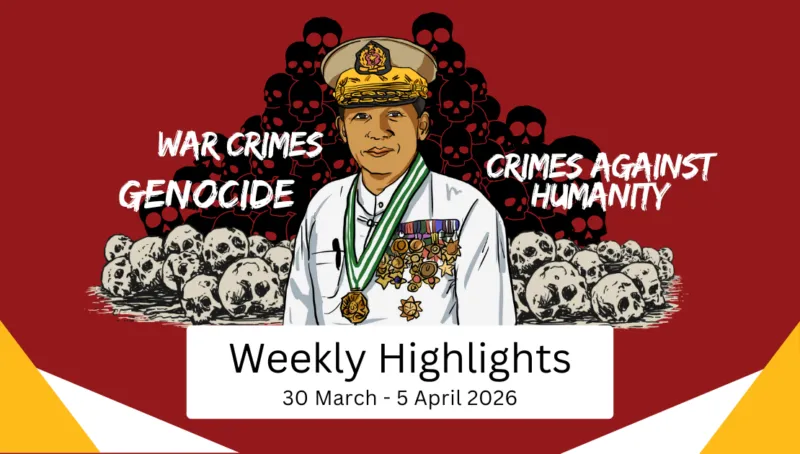
As the fifth year of ASEAN’s Five-Point Consensus is fast approaching on April 24, the question is whether the Philippines, as ASEAN Chair, and its Foreign Affairs Secretary and Special Envoy for Myanmar are ready to take courageous steps and urgently act based on a principled, moral stand in solidarity with the people of Myanmar—or inadvertently legitimize the junta responsible for war crimes and crimes against humanity.
On 27 March 2026, the United Nations Human Rights Council (UNHRC) adopted a resolution on Myanmar by consensus at the conclusion of its 61st regular session. The resolution unequivocally condemns the military’s relentless campaign of violence and atrocities and rejects its sham elections. It underscores the worsening human rights and humanitarian situation across the country and reaffirms the urgent need for stronger, coordinated international action. The Council must now mobilize Member States to move from consensus to concrete measures.
In the resolution, the Council explicitly condemns the junta’s sham elections, underscoring that “the Myanmar military’s attempts to legitimize its coup of February 2021 through elections that were neither free nor fair nor inclusive…” It also condemns “aerial bombings and violence that have killed and injured civilians,” carried out by the junta in furtherance of its sham elections, and expresses alarm at “the Myanmar military’s systematic denial of humanitarian access to victims and survivors”—including access to life-saving aid, medical care, and prosthetics—recognizing that such actions are contrary to international law. Five civil society organizations (CSOs), namely Progressive Voice (PV), Chin Human Rights Organization (CHRO), Burmese Women’s Union (BWU), Human Rights Foundation of Monland (HURFOM), and FORUM-ASIA, welcomed the resolution and urged UN Member States to take decisive, concrete steps individually and collectively to implement their own recommendations set out therein.
Such action is more urgent than ever as the military accelerates efforts to entrench its rule through a façade of civilian governance. On 3 April 2026, a military-led façade parliament appointed junta chief Min Aung Hlaing as “president”—a position he has long sought to secure at the expense of the people of Myanmar. This appointment does not alter the reality that Min Aung Hlaing remains implicated in grave violations and atrocity crimes, including the Rohingya genocide, under proceedings at the International Criminal Court and under universal jurisdiction cases in countries such as Argentina, Timor-Leste, and Indonesia.
In response, the ASEAN Parliamentarians for Human Rights condemned the appointment as an orchestrated maneuver to consolidate illegitimate power. At the same time, key external backers—China, Russia, Belarus—congratulated while two ASEAN member states, Cambodia and Thailand also expressed support.
However, leadership changes within the military signal escalating repression. On 30 March, Ye Win Oo was appointed commander-in-chief, having previously led Military Security Affairs (MSA) since 2020—the military’s intelligence apparatus, widely known for extracting forced confessions through torture and other ill-treatment. According to the Assistance Association for Political Prisoners (AAPP), at least 2,238 people have been killed in detention since the 2021 coup attempt, including women and youth activists, and leaders and members of the National League for Democracy (NLD). Within days of his appointment, junta forces conducted airstrikes in Thandwe Township, Rakhine State, killing a displaced family—including two young children—further underscoring the Myanmar military’s continued pattern of violence and atrocities.
Despite these developments, the military’s attempt to rebrand itself has failed to convince the people of Myanmar. The Myanmar people’s revolution has taken a major step forward with the establishment of the Steering Council for the Emergence of a Federal Democratic Union (SCEF) on 30 March 2026. Guided by the principles of “shared sovereignty” and “collective leadership,” the SCEF seeks to ensure the meaningful inclusion of Ethnic Resistance Organizations (EROs), democratic resistance forces, women’s groups, and representatives of the people.
The formation of the SCEF marks a profound moment, bringing together key stakeholders, including the National Unity Government (NUG), the Committee Representing Pyidaungsu Hluttaw (CRPH), the Karen National Union (KNU), the Kachin Independence Organization (KIO), the Karenni National Progressive Party (KNPP), and the Chin National Front (CNF). It has been welcomed by a wide range of revolutionary organizations and emerging federal units. In tandem, the Special Advisory Council for Myanmar (SAC-M) urged the international community to back SCEF. Yanghee Lee, Member of SAC-M, stated: “The international community needs to get off the fence by fully backing the people’s genuine will and aspirations for an inclusive new Union, and by ostracizing the junta in its current and any future form it takes.”
In light of the UNHRC resolution, UN Member States must immediately cease diplomatic, economic, and security relations with the military junta and its institutions. Instead, they must engage meaningfully and officially with the legitimate representatives of the Myanmar people, including the NUG, the SCEF, federal units, and civil society groups. Member States that continue to provide political, material, or financial support to the junta risk direct complicity in its ongoing atrocity crimes and must end this complicity immediately.
Notably, the resolution also recalls the obligation of State Parties to Arms Trade Treaty (ATT) under Article 6 and 7 to prohibit arms transfers and assess export risks in line with international humanitarian law and international human rights law. In this regard, countries supplying weapons to the military junta, including China, must immediately halt all arms transfers and end any form of support that enables the junta to continue committing atrocities against the people of Myanmar, in full compliance with the Arms Trade Treaty (ATT).
In the same vein, the Philippines, as ASEAN Chair, must refrain from engaging with the military-led façade government at any level and must not invite it to upcoming ASEAN Foreign Ministers’ Meetings or Summits. It is high time for ASEAN to act, as its credibility has already been eroded by its paralyzed Five-Point Consensus and the increasingly problematic engagement of some member states with the Myanmar military junta. Khin Ohmar, Acting Executive Director of PV, urged: “As the fifth year of ASEAN’s Five-Point Consensus is fast approaching on April 24, the question is whether the Philippines, as ASEAN Chair, and its Foreign Affairs Secretary and Special Envoy for Myanmar are ready to take courageous steps and urgently act based on a principled, moral stand in solidarity with the people of Myanmar—or inadvertently legitimize the junta responsible for war crimes and crimes against humanity.”
The lack of robust actions from the ASEAN will only embolden the Myanmar military junta to commit further atrocities. The Philippines, as the current Chair, must act with courage and take decisive steps without further delay to implement the first point of ASEAN’s Five-Point Consensus—the immediate cessation of violence—as well as its October 2025 Summit decision to deliver cross-border humanitarian aid to conflict-affected internally displaced populations.
_______________________
Note: Progressive Voice will be closed for the Burmese New Years. We will be back with our next issue of the Weekly Highlights on the week of 20 April. Happy Thingyan and Songkran!
_______________________
[1] One year following the 1988 pro-democracy uprising, the former military junta changed the country’s name from Burma to Myanmar overnight. Progressive Voice uses the term ‘Myanmar’ in acknowledgement that most people of the country use this term. However, the deception of inclusiveness and the historical process of coercion by the former State Peace and Development Council military regime into usage of ‘Myanmar’ rather than ‘Burma’ without the consent of the people is recognized and not forgotten. Thus, under certain circumstances, ‘Burma’ is used.
Progressive Voice is a participatory, rights-based policy research and advocacy organization that was born out of Burma Partnership. Burma Partnership officially ended its work on October 10, 2016 transitioning to a rights-based policy research and advocacy organization called Progressive Voice. For further information, please see our press release “Burma Partnership Celebrates Continuing Regional Solidarity for Burma and Embraces the Work Ahead for Progressive Voice.”
Resources
Statements & Press Releases
ASEAN MPs Condemn Myanmar Junta’s Move to Install Min Aung Hlaing as President
By ASEAN Parliamentarians for Human Rights
Statement on the Update of Detained Political Prisoners
By Assistance Association for Political Prisoners
နိုင်ငံရေးအကျဉ်းသားများစာရင်း အတည်ပြုခြင်းနှင့် စပ်လျဉ်းသော အခြေအနေနှင့်ပတ်သက်၍ ထုတ်ပြန်ကြေညာချက်
By Assistance Association for Political Prisoners
Genocide General Min Aung Hlaing’s Presidency Demands New International Approach to Rohingya Crisis
By Burmese Rohingya Organisation UK
The Human Rights Foundation of Monland Releases Voice Up Issue 1 January – March 2026
By Human Rights Foundation of Monland
By Kachin State Human Rights Defenders Network
By Kachin State Human Rights Defenders Network
By Myanmar’s revolutionary forces
Human Rights Council Rejects Myanmar Military’s Sham Elections
By Progressive Voice, Chin Human Rights Organization, Burmese Women’s Union, Human Rights Foundation of Monland and FORUM-ASIA
Announcement by the Steering Council for the Emergence of a Federal Democratic Union (SCEF)
By Steering Council for the Emergence of a Federal Democratic Union (SCEF)
ဖက်ဒရယ်ဒီမိုကရေစီပြည်ထောင်စုပေါ်ထွန်းရေး ဦးဆောင်ကောင်စီ (SCEF) ထုတ်ပြန်ကြေညာချက်
By Steering Council for the Emergence of a Federal Democratic Union (SCEF)
Reports
Burmese Military Rebrands, But Never Reforms
By Burma Campaign UK
A Gendered Overview of the Human Rights Situation in Southeastern Burma
By Human Rights Foundation of Monland
By Myanmar Witness
At A Glance On Armed Struggles (27 March – 2 April 2026)
By Nyan Lynn Thit Analytica
Read Next
10 July 2026