Junta’s Forced Conscription of Youth Demands Urgent International Protection
6 March 2026
Names have already been collected, including those who fall within the age range set by the junta. They asked whether we have plans to go abroad and told me that I must pay 200,000 kyats for each batch if I do not want to be conscripted.
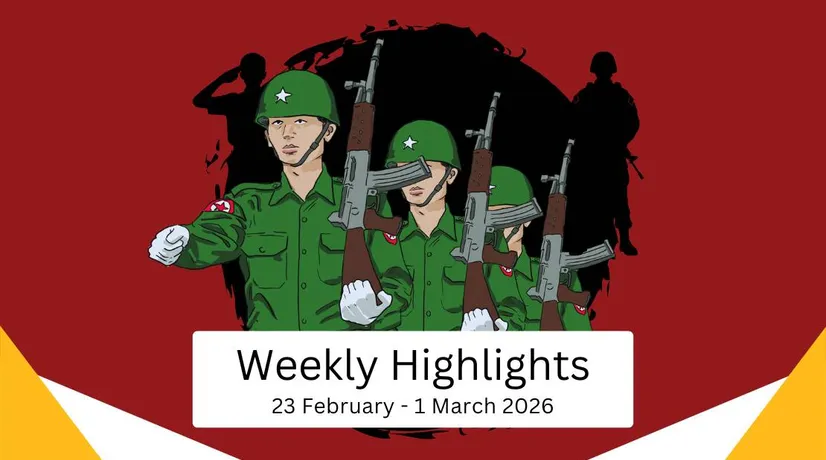
It has been more than two years since the Myanmar military junta launched its forced conscription campaign in February 2024. Since its inception, the junta has targeted young people, including teenagers, to fill its ranks amid mounting battlefield losses against resistance forces. Importantly, the junta is placing Myanmar’s youth in grave danger by forcibly sending many to the frontline, where they are often used as human shields. Now, the junta is ramping up efforts to compile lists of women for conscription.
Notably, the use of human shields is strictly prohibited under international humanitarian law and constitutes a war crime. The international community must act decisively to end the junta’s impunity and hold it accountable. To protect young people in Myanmar, the international community, particularly ASEAN and Myanmar’s neighboring countries, must take decisive and practical action. This includes ensuring protection for those who have fled the country and taken temporary refuge in neighboring countries and cutting the junta’s access to financial resources, weapons, and aviation fuel—the backbone of its terror campaign against civilians.
Several recent media reports and testimonies continue to indicate how young people in Myanmar are systematically targeted by the military junta for forced conscription. In Yangon, the Rangoon Scout Network reported that 18 young people were arrested between 16 and 22 February, including those walking on the streets and those sitting by the roadside. In Taunggyi, Shan State, the junta is using drones to monitor civilians’ movements and abduct young people in isolated areas. In Mon State, junta forces have allegedly exchanged detained youth with ward and village administrators for 50 and 80 million kyats per person to fulfill monthly recruitment quotas. In the Paw Taw Mu village track, Thaton Township, Mon State, the junta is pressuring the village administrator to send six conscripts each month. At the same time, many young people are arbitrarily arrested on the streets in the area. In Dawei City, Tanintharyi Region, junta troops are intensifying arrests of young people at the town’s entry and exit checkpoints, raiding homes, and targeting places where young people often gather.
Junta forces and conscription committee members have intensified the collection of lists of women in several towns, including Monywa in Sagaing Region, Yangon, Mawlamyine in Mon State, and Taunggyi in Shan State. A resident from South Okkalapa Township, Yangon, said: “Names have already been collected, including those who fall within the age range set by the junta. They asked whether we have plans to go abroad and told me that I must pay 200,000 kyats for each batch if I do not want to be conscripted.”
Alarmingly, Myanmar youth targeted for forced conscription face the threat of arbitrary killing even before they are sent to serve. In Mahaaungmyay Township, Mandalay Region, a 17-year-old boy was reportedly beaten to death at a ward administration office after being taken for forced conscription.
To date, the junta has reached the 22nd batch of its forced conscription campaign. Although the exact number of conscripts remains unknown, the junta has likely forcibly conscripted over 100,000 people based on the estimated quota. The Myanmar Defense and Security Institute (MDSI), a research organization founded by CDM military officers of the people’s revolution, found that approximately 60 percent of the junta’s 99th Infantry Division’s 1,531 combat personnel were new conscripts. These conscripts are deployed as porters, used as human shields, and thrust into frontline combat against resistance forces with little to no training or preparation.
While the junta’s announcement sets the conscription age at 18–35 for men and 18–27 for women, in practice, both underage and overage individuals are reportedly being forcibly recruited. According to a report by the MDSI, young people who are snatched or abducted by junta troops are taken to administrative offices, police stations, or nearby military bases, where they are pressured and coerced into military service. Those who refuse face severe abuse, torture, and threats. The junta’s recruitment pattern now includes arrests at gunpoint, often carried out in isolated areas across cities and towns.
To escape the junta’s forced draft and mounting pressure, young people have no choice but to leave the country by any means possible. Yet even after taking these risks, they face another danger: deportation back to Myanmar from countries such as Thailand and Malaysia. Upon forced return, deportees are systematically targeted by the junta. Recent reports reveal that young men arrested in Thailand and deported to Myanmar are handed over at the border by brokers to junta’s administrators for military recruitment. One of the detained youths said that he and 17 others were held in a basement room in Mon State for 11 days. He also testified that administrators paid brokers between 4,000,000 and 5,000,000 kyats per person to recruit detained youths as substitutes.
Forced conscription is a grave and escalating threat to Myanmar’s youth and their families. It strengthens the junta while entrenching a system built on corruption, fear, and coercion—extracting money from families while forcing young people into war. In doing so, it directly sustains the junta’s ongoing campaign of terror against civilians.
The junta’s forced conscription campaign is a deliberate strategy to sustain its violence and atrocities against the people of Myanmar. The international community, including the United Nations Human Rights Council, must respond with urgency and resolve by imposing rigorously enforced, coordinated sanctions targeting arms sales and transfers, dual-use technologies, aviation fuel, and the financial networks that enable the junta to continue to commit war crimes and crimes against humanity with impunity. Neighboring governments must comply with the principle of non-refoulement under international law and immediately halt deportations of Myanmar nationals who face a real risk of inhuman treatment by the Myanmar military, including being used as human shields or porters, torture, and other forms of persecution. Protection pathways—including temporary protection status and access to legal documentation, work, healthcare, and education—must be expanded to safeguard Myanmar’s youth. Protecting a generation deeply traumatized by militarized coercion is both a legal obligation and a moral imperative.
_______________________
[1] One year following the 1988 pro-democracy uprising, the former military junta changed the country’s name from Burma to Myanmar overnight. Progressive Voice uses the term ‘Myanmar’ in acknowledgement that most people of the country use this term. However, the deception of inclusiveness and the historical process of coercion by the former State Peace and Development Council military regime into usage of ‘Myanmar’ rather than ‘Burma’ without the consent of the people is recognized and not forgotten. Thus, under certain circumstances, ‘Burma’ is used.
Progressive Voice is a participatory, rights-based policy research and advocacy organization that was born out of Burma Partnership. Burma Partnership officially ended its work on October 10, 2016 transitioning to a rights-based policy research and advocacy organization called Progressive Voice. For further information, please see our press release “Burma Partnership Celebrates Continuing Regional Solidarity for Burma and Embraces the Work Ahead for Progressive Voice.”
Resources
Statements & Press Releases
By 235 Civil Society Organizations
By European Union
Myanmar Junta Attacks on Farmers May Constitute War Crimes, New Investigation Finds
By Fortify Rights
Justice For Myanmar calls for new and coordinated sanctions on junta’s aviation fuel supply chain
By Justice For Myanmar
Timor-Leste’s Commitment to Accountability Marks An ASEAN Turning Point on Myanmar
By Special Advisory Council for Myanmar
By Ta’ang Civil Society Network
By Ta’ang Civil Society Network
UNICEF statement on new reports of children killed and injured in airstrikes in Myanmar
By UNICEF
Reports
Freedom of Expression During Myanmar’s Revolution: The Gap Between Legal Provisions and Practice
By Athan – Freedom of Expression Activist Organization
February 2026 Bulletin: Supporting The Gambia v. Myanmar at the ICJ
By Independent Investigative Mechanism for Myanmar
By Myanmar Witness
At A Glance on Armed Struggles (20 February – 26 February)
By Nyan Lynn Thit Analytica
Annual update on the Human Rights Situation in Myanmar – Overview of developments in 2025
By Office of the High Commissioner for Human Rights
Read Next

26 June 2026