Rare Earths, War Crimes, and the Urgent Need for Increased Sanctions
28 February 2026
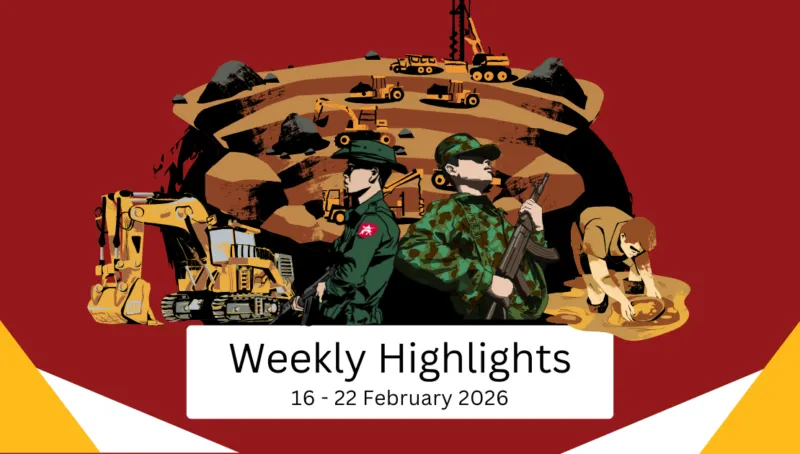
From jade concessions in Kachin State to projects linked to the China–Myanmar Economic Corridor (CMEC), mining and extractive industries have long functioned as financial lifelines for successive military juntas.
Since 1962, different military juntas have cloaked authoritarian rule in the rhetoric of development, peace, and stability while systematically commodifying land, forests, minerals, and rivers to consolidate power and wealth in Myanmar. From jade concessions in Kachin State to projects linked to the China–Myanmar Economic Corridor (CMEC), mining and extractive industries have long functioned as financial lifelines for successive military juntas. Now, this pattern of resource extraction continues as the current military junta’s survival strategy, particularly as rare-earth elements (REEs) become central to global technological competition and geopolitical rivalry. Since the military’s illegal coup attempt in 2021, unregulated Chinese rare-earth mining has rapidly expanded across Kachin and Shan States, generating severe harm to livelihoods, ecosystems, and community health.
In Mong Yawng Township in Eastern Shan State, 2025 satellite imagery and field documentation have identified at least nineteen Chinese-invested rare-earth mining sites operating in territory controlled by a Myanmar military militia group, the National Democratic Alliance Army (NDAA, also known as the Mong La group). Sixteen sites are active, and three remain under construction. In the absence of environmental safeguards, chemical runoff contaminates groundwater and tributaries feeding the Mekong basin, degrades agricultural soils, and accelerates erosion in fragile upland ecosystems. Communities report fish die-offs, livestock illnesses, and declining crop yields. These operations externalize environmental and health burdens onto rural ethnic populations and downstream communities.
In Northern Shan State, a recent ceasefire between the Ta’ang National Liberation Army (TNLA) and the junta has altered control over mineral-rich areas, including Namtu, home to the historic Bawdwin Mine. While the TNLA has invited foreign investment and pledged investor protection, local communities report severe road damage from heavy Chinese mining trucks, worsening dust pollution, reduced agricultural yields, and rising respiratory illnesses. Rare-earth extraction is expanding across Namtu, Namkhan, and Mongwi. Meanwhile, the Myanmar National Democratic Alliance Army (MNDAA) has confiscated community lands in Lashio for gold mining and Chinese tissue banana plantations. Peaceful protests were met with violent crackdowns by the MNDAA, including the beating and arrest of nine villagers. These patterns of land seizure, repression, and militarized resource extraction reflect serious violations of fundamental rights of local communities and the intensifying exploitation of local communities by the TNLA and MNDAA, in addition to the Myanmar military and its militias.
In Kachin State, extractive expansion intersects with protracted displacement and gendered insecurity. In Waingmaw Township, internally displaced persons (IDPs) have reported environmental destruction and drinking water contamination linked to Chinese mining conducted during their displacement. In Sam Mai village, extraction by external business actors has reportedly polluted streams and groundwater sources in territory controlled by the Kachin Independence Organization (KIO). Displaced women express deep concern over maternal and child health risks associated with contaminated water. A local midwife noted heightened vulnerability among pregnant women where safe water is unavailable. Furthermore, a community woman also reported exploitative labor conditions, including low wages, sexual exploitation, and coercive practices targeting women workers. These accounts reflect profound insecurity regarding environmental exposure, reproductive health, and gender-based exploitation within extractive zones.
The extractive surge extends beyond northern regions. Along tributaries of the Salween River in Karenni State, arsenic concentrations have reportedly exceeded safety standards, intensifying food insecurity and livelihood erosion, according to the Interim Executive Council (IEC) of Karenni State. In the southern Tanintharyi Region, mineral and gold mining has expanded dramatically since 2021, with at least sixty-six active sites covering more than 25,000 acres, approximately four times the size of Dawei. Rivers and streams have been degraded by sedimentation and chemical discharge, contributing to aquatic die-offs and the collapse of fishing-based livelihoods. In central Myanmar, the junta resumed gold extraction at the Phayaung Taung mine in Patheingyi Township, Mandalay Region, after regaining control from resistance forces in August 2025.
The extractive activities continue to expand without safeguards for livelihoods, food security, human rights, or ecological integrity expansion, underscoring the entrenched nexus between military authority and crony capital, in which natural resource governance is subordinated to revenue generation and the consolidation of military elite wealth and power. The international community must impose targeted sanctions against the junta and the illicit and conflict-linked extractive companies operating in Myanmar’s rare-earth and broader extractive sectors.
Following the military’s illegal coup attempt, the World Bank halted direct government funding and the Asian Development Bank suspended new contracts. In July 2023, the European Union sanctioned Mining Enterprise No. 2 (ME 2), which operates under the junta-controlled Ministry of Natural Resources and Environmental Conservation (MNREC) and remains a critical revenue source financing repression and atrocities. In 2024, the United States Government issued a serious warning about anti–money laundering and counterterrorism financing risks across the rare earth, base metal, gold, timber, and aviation sectors in Myanmar. These measures are steps in the right direction and must remain firmly in place.
Yet these measures remain insufficient to halt the destructive expansion of frontier rare-earth extraction, which not only entrenches military tyranny and militarized economies but also accelerates ecological devastation and erodes the foundations of an inclusive, accountable, and peaceful future for Myanmar. At a time when the junta is actively seeking international legitimacy and reengagement following its sham election, inaction would amount to tacit normalization of its violence and atrocity crimes against the people of Myanmar. Coordinated international pressure is therefore urgently required. Governments must impose expanded and rigorously enforced targeted sanctions on the military junta, its revenue streams, and the illicit, conflict-linked crony businesses that sustain its machinery of repression.
_______________________
[1] One year following the 1988 pro-democracy uprising, the former military junta changed the country’s name from Burma to Myanmar overnight. Progressive Voice uses the term ‘Myanmar’ in acknowledgement that most people of the country use this term. However, the deception of inclusiveness and the historical process of coercion by the former State Peace and Development Council military regime into usage of ‘Myanmar’ rather than ‘Burma’ without the consent of the people is recognized and not forgotten. Thus, under certain circumstances, ‘Burma’ is used.
Progressive Voice is a participatory, rights-based policy research and advocacy organization that was born out of Burma Partnership. Burma Partnership officially ended its work on October 10, 2016 transitioning to a rights-based policy research and advocacy organization called Progressive Voice. For further information, please see our press release “Burma Partnership Celebrates Continuing Regional Solidarity for Burma and Embraces the Work Ahead for Progressive Voice.”
Resources
Statements & Press Releases
By 235 Civil Society Organizations
Myanmar’s Move Against Timor-Leste Diplomat Undermines Justice, Southeast Asian MPs Warn
By ASEAN Parliamentarians for Human Rights
By Assistance Association for Political Prisoners
Statement on the Reproductive Health of Political Prisoners
By Assistance Association for Political Prisoners
NUCC Response to Thai-Myanmar Meeting in Phuket
By National Unity Consultative Council
Statement Condemning Intimidation of the Diplomatic Representative of Timor-Leste
By National Unity Government
WCC condemns violence against communities in Myanmar
By World Council for Churches
Reports
Freedom of Expression During Myanmar’s Revolution : The Gap Between Legal Provisions and Practice
By Athan – Freedom of Expression Activist Organization
January 2026 – Summary of Monthly Situation Update
By Burma Human Rights Network
Documenting the Monthly Impact of Arson Attacks on Civilian Homes (February 2026)
By Data for Myanmar
The Annual Report: Digital Rights in Southeast Asia 2025
By DigitalReach
Escalating Aerial Attacks Across Key Conflict Zones – Issue 190
By Myanmar Peace Monitor and Burma News International
At A Glance on Armed Struggles (13 – 19 February)
By Nyan Lynn Thit Analytica
By The Border Consortium