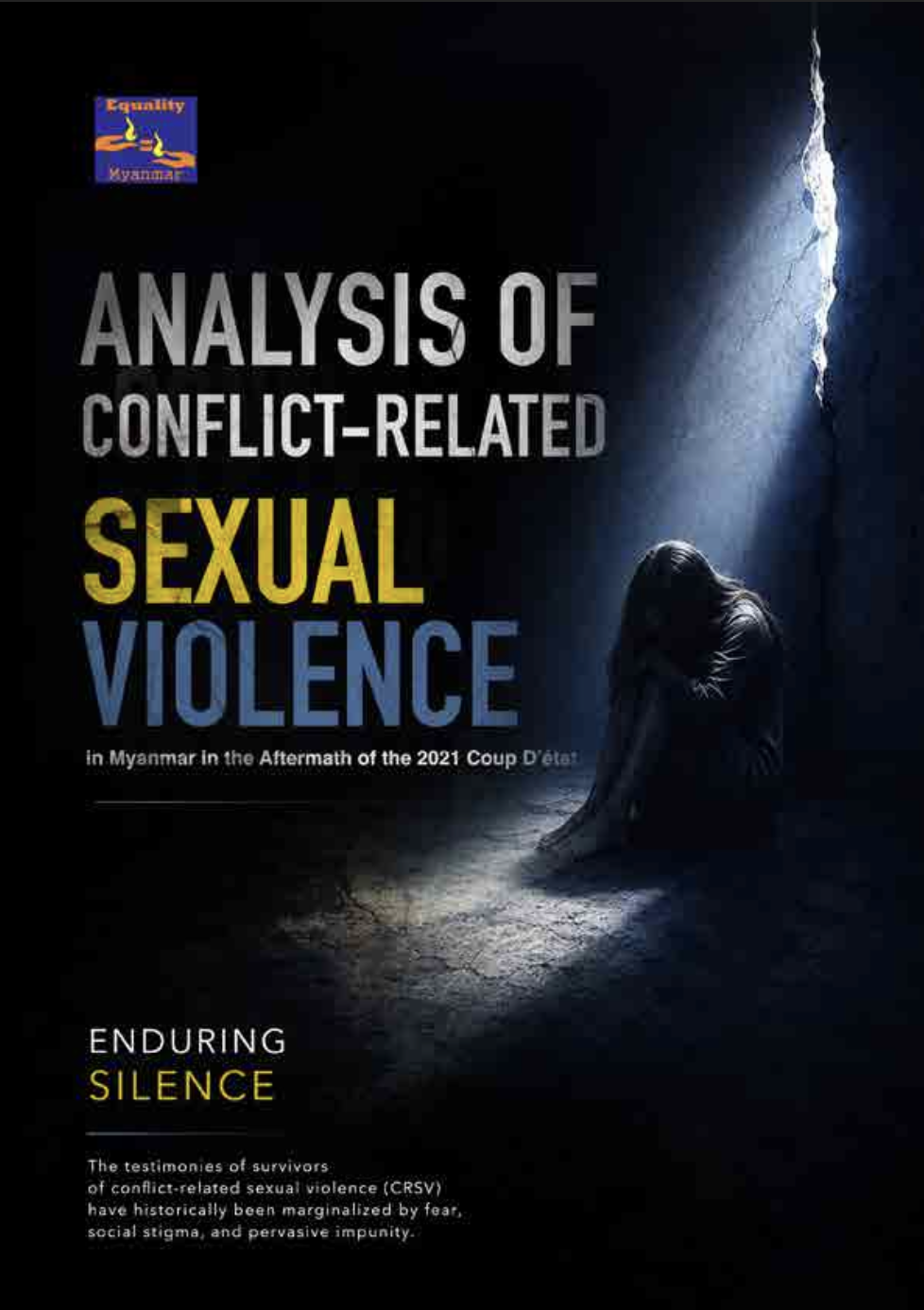
Analysis of Conflict-Related Sexual Violence in Myanmar in the Aftermath of the 2021 Coup D’état
19 June 2026

Executive Summary
This report presents findings from Equality Myanmar’s documentation and analysis of CRSV committed between February 2021 and December 2025. The findings are based on 217 verified CRSV incidents documented across different parts of Myanmar and one area on the Myanmar–Thailand border. These incidents involved 161 identified victims and/or survivors. Many victims and/or survivors experienced more than one form of sexual violence or multiple associated human rights violations.
The findings demonstrate the dire CRSV situation in post-coup Myanmar. Women and girls remain increasingly affected by CRSV in Myanmar. Of the 161 identified victims and survivors, 147 individuals, or 91 percent, were female. Among them, 39 were girls.
Approximately one in every four documented victims and/or survivors was a child. However, the findings show that CRSV is not confined to women and girls. Men, boys, and LGBTQIA+ persons were also subjected to different forms of sexual violence in conflict-related contexts. Male victims and/or survivors were identified, including three boys, who were identified, despite being a low number compared to the number of female victims and/or survivors. Eight victims and survivors were identified as having other gender identities.
The analysis of cases documented by different geographical areas reveals a strong concentration of CRSV in central Myanmar in the aftermath of the coup. Sagaing Region emerged as the most affected area, accounting for 38 percent of documented victims and survivors, followed by Mandalay Region and Magway Region. Significantly, a tremendous amount of violations were found in the Dry Zone, or Anya region, which had not historically experienced armed conflict before the 2021 coup. The emergence of widespread CRSV in these areas reflects the dramatic transformation of Myanmar’s conflict landscape and indiscriminate military attacks against the civilian population.
The findings further demonstrate a clear intensity of responsibility among the Myanmar military junta and its affiliated forces. 87.1 percent of documented violations were attributed to the Myanmar military and its affiliated forces. Local armed resistance groups, established after the 2021 coup, were implicated in 12 documented cases, while ethnic resistance organizations were identified in six cases.
Among the different forms of CRSV, rape was the most documented form in the post-coup context, accounting for 41 percent of all incidents. Gang rape constituted 27 percent of documented incidents, followed by sexual harassment at 28 percent and attempted rape at two percent. Collectively, rape and gang rape accounted for approximately two-thirds of the total documented incidents, which involved the most severe forms of sexual violence. Notably, all documented incidents of gang rape were attributed to members of the Myanmar military junta and its affiliated forces.
Rape and gang rape mostly occurred during raids, military offensives, detention, interrogation, hostage-taking, and other situations in which perpetrators exercised overwhelming power over victims. Moreover, in numerous cases documented, sexual violence was used as a means of punishment or together with torture and other forms of ill-treatment. Women accused of supporting the Civil Disobedience Movement (CDM), providing assistance to People’s Defence Forces (PDFs), or participating in anti-coup activities were subjected to rape, gang rape, and sexualised torture while in military custody. In several documented cases, victims died as a result of torture and sexual violence.
LGBTQIA+ persons faced specific forms of vulnerability, too. Those forms include sexual violence, attempted rape, and sexual humiliation, especially in detention settings. In these cases, sexual violence was frequently linked to illegal punishment, coercion, torture, or discrimination based on actual or perceived sexual orientation and gender identity. LGBTQIA+ individuals were particularly vulnerable to sexualised forms of torture and degrading treatment while in custody.
Importantly, the report highlights that CRSV rarely occurs in isolation. Sexual violence was frequently accompanied by other serious human rights violations, including arbitrary arrest, abduction, detention, torture, enforced disappearance, and extrajudicial killing. Among victims and survivors for whom associated violations could be identified, 40 individuals, or 27 percent, were reportedly killed following or in connection with acts of sexual violence.
Many documented cases reveal a pattern in which victims were raped or gang raped before being killed, while perpetrators concealed, destroyed, or abandoned dead bodies to obstruct accountability and conceal evidence.
CRSV was often linked to enforced disappearance. Women detained by the Myanmar military were subjected to torture and sexual violence before their whereabouts were concealed from family members and communities. Additionally, sexual harassment was reported in detention centers, interrogation facilities, and police custody, while sexual exploitation was documented in situations of displacement, captivity, and humanitarian vulnerability. Women are subjected to being held hostage during battles and reported being pressured to exchange sexual access for food and other necessities with armed group members.
At this scale and severity of documented violations, access to justice remains extremely limited for survivors, either in Myanmar or exile. Survivors face additional barriers, including legal restrictions, financial constraints, and limited access to legal assistance. As a result, impunity remains one of the defining features of Myanmar’s current conflict situation. This report manifests that the cases of sexual violence and the evidence described in this report go far beyond isolated acts of sexual violence. It demonstrates the existence of a larger reality where sexual violence is enabled through the armed conflict, militarization, discrimination, and impunity. As it is stated in the report, five years after the coup, victims of such violence still suffer from the consequences of the violation of their rights in all aspects, including physical, psychological, social, and economic.
This report highlights that the human rights situation in Myanmar has been concerning for decades. Since the military coup of 1 February 2021, Myanmar has experienced one of the most severe deteriorations in its human rights situation in its modern history. The illegal coup and the military junta’s atrocities triggered nationwide resistance, the expansion of armed conflict, and unprecedented levels of violence across the country. Areas that had never directly experienced armed conflict before the coup, particularly in central Myanmar, became one of the active conflict zones. Alongside killings, arbitrary arrests, torture, enforced disappearances, and mass displacement, CRSV emerged as one of the most serious human rights concerns in post-coup Myanmar.
This report finally reminds that Myanmar’s crisis is not confined to its own border when it comes to addressing human rights violations in a corner of the world. As a member of the international community, Myanmar has obligations to respect, uphold, and fulfill human rights under international law and international human rights standards. Vice versa, the international community has an obligation to help Myanmar bring justice for the survivors of human rights violations, including CRSV. The international community must take concrete actions to recognize and support the Myanmar people’s efforts to hold the perpetrators of heinous human rights violations, including CRSV, accountable.