Weaponizing Fuel: How the Junta Deepens Myanmar’s Humanitarian Crisis
3 April 2026
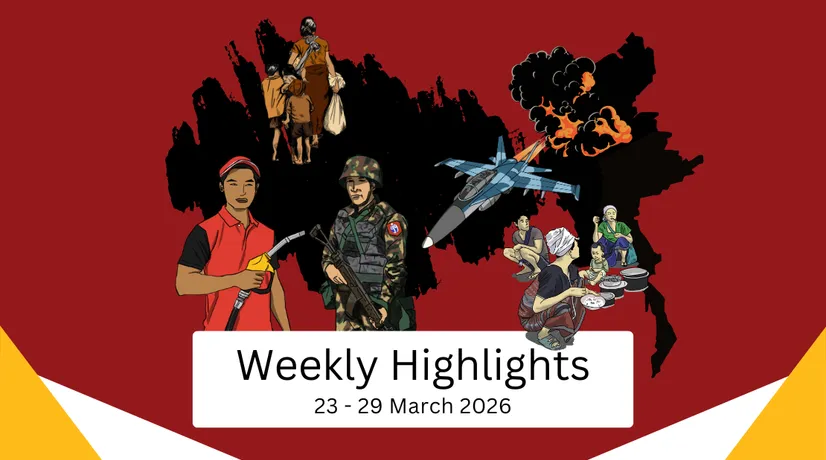
In Lashio, Northern Shan State, junta personnel receive unlimited fuel, while “ordinary people have to queue for a day,”
Shifting geopolitical tensions and the war in the Middle East have destabilized global energy markets, driving fuel shortages and price volatility worldwide. In Myanmar, these external shocks compound an existing human rights and humanitarian crisis precipitated by the military junta’s attempted coup in February 2021. Further, the junta’s ongoing campaign of terror—marked by aerial bombardments, extrajudicial killings, and mass atrocities has killed thousands of civilians—deepening an already dire situation. Together, these overlapping crises amount to serious violations of international law. According to World Food Programme (WFP), Myanmar is experiencing one of the worst hunger crises in the world and remains among the most neglected emergencies.
The international community must respond to this escalating crisis with urgent and coordinated actions. This includes directly supporting locally led humanitarian initiatives channeling through border regions that bypass the junta. States must also adopt stronger measures, including formal non-recognition and sustained diplomatic isolation. A comprehensive global embargo on aviation fuel, arms, and dual-use goods remains critical to constraining the military’s capacity to carry out further atrocities and to ensuring civilian protection.
Ground reports indicate the military junta’s systematic control and weaponization of fuel supplies. Despite sufficient reserves, fuel stocks in key Yangon locations are deliberately monopolized under junta authority, as reported by a member of Civil Disobedience Movement on 4 March 2026. Newly arrived fuel supplies are similarly centralized within military-linked networks, while access outside Yangon is further restricted through suspended withdrawal permits, “severely limiting diesel availability in regions such as Sagaing,” as reported by Democratic Voice of Burma on 22 March 2026. Even in Yangon, civilians endure long queues and at least four people have died while waiting for fuel access.
This control is deliberate—it has produced stark inequalities in access. In Lashio, Northern Shan State, junta personnel receive unlimited fuel, while “ordinary people have to queue for a day,” as stated by a community member on 26 March 2026. Similarly, a resident from Maha Aung Myay Township in Mandalay described how junta-affiliated personnel not only bypass queues but reportedly resell fuel for profit, further deepening public hardship.
These restrictions are cascading into broader economic distress, driving sharp increases in the cost of basic goods and essential services. Testimonies from urban residents reported by The Irrawaddy on 25 March 2026, illustrate a dramatic rise in the prices of food and other basic commodities. A standard sack of rice has nearly doubled, increasing from approximately 80,000 kyats to 150,000 kyats within a short period. In Mandalay, “At the beginning of this month (March), I bought one vis of eggs for 9,800 kyats. Now it has increased to 11,600 kyats. Cooking oil prices are rising as well. In just the past few days, the prices of vegetables and meat have also increased,” said a community member. Beyond food, access to essential medicines is collapsing. A resident from Hlaing Tharyar Township in Yangon described critical shortages: “Medicines for chronic conditions, including those for kidney disease, are completely unavailable. Pharmacies and medical suppliers say they are out of stock. Even though prices are rising, these are medicines we cannot skip, so we have to go out and search for them every day.”
In the Ayeyarwady Region, farmers harvesting summer paddy have been forced to halt operations due to fuel shortages, leaving fields partially harvested and vulnerable to loss. Preparations for the monsoon planting season are under threat. According to the WFP, fertilizer demand is expected to rise significantly in the coming months. Combined with escalating fuel prices, agricultural input costs could double compare to the previous year. This convergence risks triggering a secondary crisis and a severe decline in domestic food production that would deepen import dependence and exacerbate nationwide food insecurity.
In Karenni State, the crisis has further intensified amid economic collapse, rising costs, and the military’s ongoing aerial bombardments and ground attacks, driving a deepening humanitarian emergency that threatens the survival of internally displaced persons (IDPs). A merchant testified, “Rice that used to cost 90,000 or 100,000 Kyats per bag has now risen to 150,000 Kyats,” underscoring the surge in basic commodity prices alongside the junta’s blockades and restricted humanitarian access. These conditions have led to acute food insecurity and the collapse of livelihood among displaced communities.
As of early 2026, an estimated 18–20 million people—nearly one-third of Myanmar’s population—require humanitarian assistance, with over 16 million in urgent need of food, water, healthcare, and protection. More than 3.7 million people are internally displaced, though access restrictions suggest that actual figures may be higher. Hunger is escalating, with up to 12.4 million projected to face acute food insecurity in 2026, including one million at emergency levels. Gwyn Lewis, the UN Resident and Humanitarian Coordinator in Myanmar, has warned during her visit in Rakhine State in February 2026 that restricted access and underfunding have created one of the world’s most severe humanitarian crises.
The UN Human Rights Council in its resolution adopted by consensus at the conclusion of its 61st regular session has expressed deep concern over the systematic denial by the Myanmar military of humanitarian access for victims and survivors—including to life-saving aid, medical care and prosthetics. The international community, particularly the Association of Southeast Asian Nations (ASEAN), must move beyond rhetoric and take immediate and coordinated action. Targeted sanctions should disrupt fuel supply chains sustaining military aerial attacks against civilians, particularly through strict controls on aviation fuel, while reinforcing ongoing international efforts to hold the Myanmar military accountable under international law. Denying the junta legitimacy is equally critical; states must refrain from engaging with its representatives, including through “non-political” platforms that risk normalizing military rule and any outcomes from its sham electoral process.
Humanitarian assistance must be significantly expanded and delivered through independent, community-based channels through border regions. ASEAN, in particular, must collaborate with Myanmar’s legitimate representatives, including the National Unity Government, the Steering Council for the Emergence of a Federal Democratic Union (SCEF), and trusted local civil society and community-based organizations, to ensure aid reaches affected populations without junta’s interference. Failure to act decisively will further exacerbate the already dire humanitarian crisis while emboldening the junta to continue its terror campaign against the people of Myanmar. Urgent and sustained international action, grounded in human rights principles and the “do no harm” approach is imperative.
_______________________
[1] One year following the 1988 pro-democracy uprising, the former military junta changed the country’s name from Burma to Myanmar overnight. Progressive Voice uses the term ‘Myanmar’ in acknowledgement that most people of the country use this term. However, the deception of inclusiveness and the historical process of coercion by the former State Peace and Development Council military regime into usage of ‘Myanmar’ rather than ‘Burma’ without the consent of the people is recognized and not forgotten. Thus, under certain circumstances, ‘Burma’ is used.
Progressive Voice is a participatory, rights-based policy research and advocacy organization that was born out of Burma Partnership. Burma Partnership officially ended its work on October 10, 2016 transitioning to a rights-based policy research and advocacy organization called Progressive Voice. For further information, please see our press release “Burma Partnership Celebrates Continuing Regional Solidarity for Burma and Embraces the Work Ahead for Progressive Voice.”
Resources
Statements & Press Releases
By FORUM-ASIA and Progressive Voice
Japanese financial sector companies urged to end business benefiting the junta in Myanmar
By Mekong Watch, Pacific Asia Resource Center, Justice For Myanmar, Friends of the Earth Japan, Network Against Japan Arms Trade (NAJAT), ayus:Network of Buddhists Volunteers on International Cooperation and Japan International Volunteer Center (JVC)
By Justice For Myanmar
By Justice For Myanmar
Reports
At A Glance On Armed Struggles (20 March – 26 March 2026)
By Nyan Lynn Thit Analytica
Spillover Effects: How the Iran crisis threatens food security -Focus on Myanmar
By World Food Programme