Panel discussion examines what the Myanmar junta wants and what comes next
29 December 2025
Mizzima
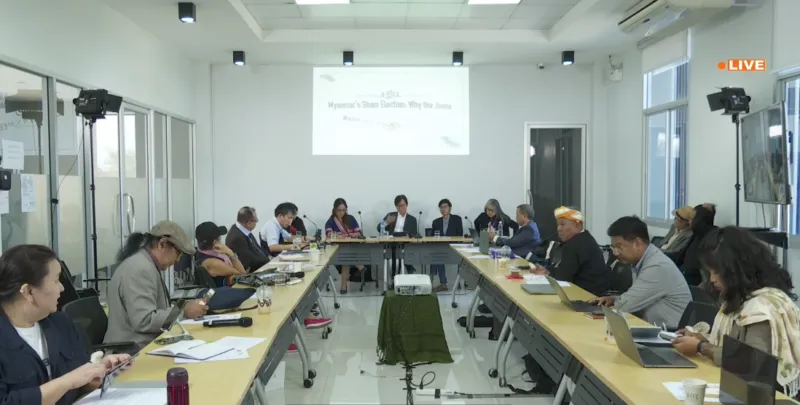
As part of the Myanmar media collaboration with Thai PBS in Chiang Mai, Thailand on Sunday, panelists discussed what may come of the Myanmar junta’s election.
The following is a transcript of the discussion:
Myanmar’s Sham Election: Why the Junta Wants It—and What Comes Next
Moderator/Facilitator: Kyaw Zwa Moe, Executive Editor, The Irrawaddy
Panelist: Htin Kyaw Aye, Executive Director, Spring Sprouts
Panelist: Dr. Surachanee Sriyai (Hammerli), Visiting Fellow, ISEAS Yusof-Ishak Institute
Panelist: Khin Ohmar, Veteran Burmese Activist
Panelist: Htaike Htaike Aung, Director, Myanmar Internet Project
Kyaw Zwa Moe: Good morning everyone. Before I introduce our knowledgeable, seasoned panelists, let me start with my remarks on this junta’s election. Everyone recognized or everyone sees this election as a sham election. So now, as we speak, the junta’s election has been taking place in Myanmar since 6:00 AM this morning.
At the time, since then, I talked to my reporters and my own resources inside Myanmar. And since 2:00 AM in the morning in Yangon, some townships, and the military and the security was beefed up since 2:00 AM this morning. Then in the morning, after 6:00 AM, there were just sparse groups or lines, people, and going to the polling stations to cast their votes. But mostly, not a lot of people. Which means that there are not many voters turning out. Until now.
So [there is a silent strike] against the junta’s election. So regarding this junta’s election, my observation is that there are three groups in our country. The first group is not really interested in the this election, the sham election. That group is the majority of the population. Probably more than 90% of the population. They are not interested in this election at all. But the second group is so exciting. They are the political parties contesting this junta election. Which means that they are aligned with the military regime. Because they are excited because they are hoping to get some seats in parliament and some positions in the new government next year. And then the third group is the military generals.
They have been strategizing or planning to hold this election. But, as far as we know, they have already planned to form a new government, even including specific ministry positions in the government. Which will come out at the end of the March next year. So there are three groups. This is my observation.
Why are Myanmar people not interested in this junta’s election? Because they have a solid experience with elections organized by military regimes in the past, especially over the past four decades. Since 1990, we have had four elections. Out of those elections, the results of the two elections in 1990 and 2020 were not honoured. Because pro-democracy parties, NLD, and some pro-democracy ethnic parties won by a landslide. That’s why the junta rejected the result.
So, as you know, the 2010 election was rigged. And I would say that all of Myanmar people, we all have the election trauma. So they know that today’s election is nothing more than another sham election. And definitely, the military will be trying to continue to rule the country. That is their political exit strategy. But like it or not, today’s election has been taking place in our country. And in the coming days, the junta will announce the military party, the USDP, has won by a landslide. And then at the end of March they will form a new government with these same brutal generals. But at the time, who will be wearing civilian outfits. So we will see definitely the new so-called civilian government by April 1st, 2026.
So, how will the international community, including our neighbouring countries, deal with this new political landscape? So this is our panel. And this panel will try to look beyond the surface of the junta’s sham election. How it will affect Myanmar’s democratic prospects, regional geopolitics, border stability with our neighbouring countries, individual freedom, including digital freedom, and the international community’s responsibilities.
Now we have four knowledgeable seasoned panelists here with me. So let me introduce. The first panelist is Htin Kyaw Aye. He is an Executive Director of Myanmar Spring Revolution Monitoring, election monitoring group, … And then today he will talk about how the junta’s electoral system will badly impact the country’s democratic prospects in the long term. In the next five years, maybe more than that. Another panelist is a social and political scientist, Dr. Surachanee. She is a visiting fellow at ISEAS-Yusof Ishak Institute. She is also the interim director of the Center for Sustainable Humanitarian Action with Displaced Ethnic Communities at Chiang Mai University. She is also a regular contributing writer to the Irrawaddy. She will talk about external actors, including China, Thailand, ASEAN, and probably the US on Myanmar issues. And the third panelist is Ma Htaike Htaike Aung. She is a digital rights advocate from Myanmar Internet Project. MIP is monitoring internet access censorship and the junta’s digital surveillance in Myanmar. She will explain about digital repression around the junta’s elections.
Ma Khin Ohmar, last but not the least, is a seasoned pro-democracy activist since 1988. I would say that everyone who knows Myanmar and about the Myanmar pro-democracy movement knows her and her work. So Ma Khin Ohmar and Htin Kyaw Aye are now involved in the junta’s election monitoring group, sham election tracker. So during this panel, she will focus on why this sham election is not a return to something similar to the post-2010 democratic transition in Myanmar.
So, our first panelist is Htin Kyaw Aye here. Before giving you the floor, let me ask you. How many times have you voted in Myanmar? Have you ever voted?
Htin Kyaw Aye: Yes, I did so in 2010 elections.
Kyaw Zwa Moe: Wow. Really?
Htin Kyaw Aye: Yes.
Kyaw Zwa Moe: So how many times?
Htin Kyaw Aye: So, three times. 2010, 2015, and 2020.
Kyaw Zwa Moe: Wow. So you got a lot of experience even as a voter. The floor is yours.
Htin Kyaw Aye: I would like to explain and go into some details into the election plan, … some call it an election plan, some call it an election exercise, with the illegal sham election. So we all know that this election will not be free and fair. So even the lobbyists of the military junta are kind of admitting that this election will not be free and fair. So, beyond being free and fair, so we look into the election, into another aspect, whether the election is held periodically. So yes, this election is held periodically in five years. Yes. But another key aspect, key essence of the elections that are held periodically, beyond being free and fair, is the whether this election will reflect the will of the people.
This election for sure will not reflect the will of the people. It is not by chance, it’s by design. In this election, millions of the voters will be disenfranchised intentionally by the military junta. So if you look into the details of this election plan, you will see the highest number record, highest numbers of townships canceled wholly for this election. So in previous elections, which I voted in 2010, 2015, 2020, in these elections, the complete townships cancellation, the numbers range from 10 to 15. In the 2020 election, we have 15 townships canceled wholly by the election commission. This time, 65 townships are wholly canceled by the military controlled electoral commission. Which is one fifth of the country. And they also cancelled the village tracts and wards even in the townships that they said they would hold the election. So they canceled about 3,000 village tracts and wards, which is one fourth of the whole country. But that’s not just one fifth or one fourth.
If you look into the maps, the areas that the elections are canceled are half of the country. So that you have evidence that you can say half of the country will not vote … In 2020 elections, there were nearly 40,000 polling stations across the country. So now this election, they can only hold the election in about 20,000 polling stations. So that’s millions of voters disenfranchised intentionally by the military junta. And also millions of voters decided not to participate in this election. That are very clearly seen in the previous 10 December silent strikes. So the whole nation became silent to show disapproval of this election plan.
So another thing, another evidence that this election will not reflect the will of the people is that popular popular political parties are disbanded. Like NLD, SNLD are disbanded by the junta. And also other parties like DPNS decided to boycott this election. So that’s is another reason that shows that this election will not reflect the will of the people. And other evidence shows that the junta is using laws to forcefully suppress the dissident voices, critics of this election. So they are using a new law called the Election Protection Law to silence the voices of the dissidents. So that’s another way that they are suppressing this election.
So the reason we hold elections across the world is that we want to have an electoral representative government that reflects the will of the people. This election is nothing [like this]. So another aspect that I look into in this election is whether this election will guarantee democratic representation. That’s another area that we need to deep dive into this election plan. So in every election fraud starts before the election. This starts with the gerrymandering of the constituency. So in this election, the junta redrew the constituency boundaries. These constituency boundaries are nothing like the constituency boundaries in 2015 and 2020. So they gerrymandered the constituency boundary … to let a specific political party win this election. In this election, that plan is not that. The plan… they already know that the election will be won by USDP. But the plan is that they want to show the world that they can hold an election across the country. So that’s why they gerrymander the constituency boundary to mix the area – where they can hold the election and where they can’t hold the election so that they can show the world that they can hold the election across the country.
Actually, what will happen after these three phases of election is that they will fill 88% of the parliament while holding the election in only half of the country. How can you fill the seats in parliament by holding the election in half of the country? So they employ like a mixed-member system, in mixed-member representation system in electing new members of parliament. So that’s a new system introduced in this election. So they call is a mixed-member proportionate system. Actually, it is a mixed-member majoritarian system. So the plan is to disorganize the election sporadically across the country and then fill the utmost numbers of seats in the parliament. So in doing that, they will use one vote for both systems. So they will use the First Past the Post vote to count for the PR system as well. So that’s the way they try to favour the ruling political party, the powerful party, aligned to the military, which is the USDP.
So by doing that, this election will seriously lack legitimacy because this election will not be supported by the people, it will disenfranchise a lot of the voters, millions of the voters. That can be evidenced in some initial evidence we have been seeing. So one of them is advance votes. Around the world, we have millions of diasporas, millions of the citizens, migrant workers living abroad. So only through that millions of migrant workers diaspora community around the world, they only get 5,000, more than 5,000 advance votes. That’s compared to the previous election, that’s just a fraction of the previous numbers. And that’s also evidence in the people checking the voter lists. So even the junta admitted that the voter lists will not be correct this time as well. So the reason the voter lists will not be correct is the people are not checking the voter lists. Because they don’t approve of this election. And also this election will not just lack legitimacy, it will also lack integrity as well. Because they will use electronic voting machines in this election. Which is not independently organized or [monitored by] civil society. So this will be used for mass surveillance and also for voting fraud in this election as well.
So last but not least, I would like to share a point which is this election, we usually talk that some observers usually compare this election with the [election in] 2010. So this election will not be an exit strategy for the junta. It will be the plan for strengthening its control on power, hold onto the power. Because this is evidenced in the how they administer the political parties in the country. Even the political parties and candidates who seem to be loyalists of the military are suppressed in this election. So their candidates were disqualified, the parties are disbanded using the reason that they are not justifying, their appeals are rejected outright. So that’s more evidence that they are suppressing their own loyalists as well. And this election, today I think we should remember today as a day that Myanmar opened a new chapter. Today we should remember as the day that military started its own new front, new political front beyond the military front. Today is the day that the military started or initiated its new strategy, a new tactic to suppress the people. So thank you, that’s all my points.
Kyaw Zwa Moe: Thank you. I think maybe one question from me just to follow up. You talk about the difference between 2010 or 2020 and also now this election. You are saying that this is not a political exit strategy for the junta, right? But this is trying to prolong their rule, probably as long as they can. Just one quick question. Do you really think they can really make it, rule the country forever?
Htin Kyaw Aye: So they have, as my previous panelists already shared, they have a different strategy, a different plan to hold onto the power. This time they will have the non-elected military appointees in parliament and also the military-backed political parties in this parliament and also they will have the military, they will have full control over the military with no oversight from civilians. And also in this election they are creating not a democratic institution, they are creating military-backed people, former generals holding public office as a civilian, under the disguise of the civilian. So all of the elected officials through this election will be tools of the commander in chief which is Min Aung Hlaing. So this is why they changed the political and electoral system.
Kyaw Zwa Moe: Thank you. Our second panelist is Dr. Surachanee. And floor is yours.
Dr. Surachanee: All right. Thank you. So I’m assigned to talk about the external actors’ reaction to the sham election. And each of these external actors probably deserve 10 minutes on its own, right? But I will try my best to fit all this within the 10 minutes allocated to me. So let me first start with establishing the parameters of the discussion here that I think what we are seeing in terms of external actors’ reactions to the elections probably culminates from the global geopolitical climate of the world that we see now, right?
We’re living in reality, we’re living in a world that is more polarizing and more protectionist than ever before that we that we’re seeing, right? Countries are pursuing their own self-interested goals more aggressively than ever as well. And so what it means for Myanmar I think is that some external actors, right, are so preoccupied with their own issues and other issues surrounding them as well, right? So they fail to articulate a clear stance on the Myanmar elections. That being said, some governments have already outright denounced the elections, but that’s pretty much it, right? We’re not seeing much action, but a lot of words, right?
To me personally, the most bizarre and painful to watch is the US reaction, right? For instance, you guys have probably been following the news about how the US have now revoked the TPS, the temporary protection status for right now is 4,000, I think the figure is 4,000 Burmese nationals, right? Citing that Myanmar has been making progress in terms of governance, including quote “the free and fair election.” Mind you, this came after less than a week of the US Senate Committee on Foreign Affairs actually denouncing the election, right? Saying that the Myanmar election is, again quote, “a sham election.” So such a big, mixed signal, right, coming out from a great power. And so a mixed signal from great power like this can be pretty counterproductive for Myanmar in my opinion, right? Especially when another powerful regional hegemon, aka China, we know that, is so determined to see this election happening.
For instance, just to give you an example of why this matters, this mixed signal, why it matters, right? I think this may also push ASEAN countries’ reaction towards an implicit support of the election by remaining silent. In the previous panel, although I don’t speak Burmese but I hear a little bit of ASEAN bashing and we can go all day long talking about by why ASEAN failed on Myanmar. But at least in so far ASEAN have not sent their official observers to monitor the election. Vietnam did, Vietnam is sending, Cambodia is sending their representative to monitor the election. And also Belarus as well. And by the way, Thailand just to set the record straight, at least from checking my sources, Thailand have not sent any official observers to monitor the election.
But ASEAN’s remaining silent is probably what the junta needs. This is probably all it needs, right? They don’t want an outright legitimizing from ASEAN. They don’t think that much about ASEAN as long as ASEAN is legitimizing them on the global stage. But the silence from ASEAN actually means an exit strategy for the junta. And this is not just lack of legitimacy, it will also lack integrity as well. Which is the electronic voting machine, which is not independently organized or provided by civil society, which will be used for mass surveillance and also for voting fraud in this election as well.
And it matters, I think it matters for the stability of the region because in the end of the day, it is an ASEAN problem, right? And we see that time and time again even in the UN meetings, in different meetings, in the US and also other countries have made it clear that they support a Myanmar-led Myanmar-own solution or ASEAN’s initiative to Myanmar. So it’s basically means, we we’ll help you a little bit but, in the end, we’ll leave it to ASEAN to decide what to do with Myanmar. So in the end, I feel like ASEAN will end up having to deal with Myanmar and the fallout and spillover and whatever that comes out of this sham election.
Thailand is my country and also another country who’s been sending mixed signals all the way since the coup, right? I think we will pay the price more than any country in this world for what we’re doing to Myanmar and with Myanmar, right? Especially if this strategic communication or miscommunication is proven to be a miscalculation, right? The hedging, the things that Thailand or Thai diplomatic circle value itself the most, you guys are probably familiar with the term “swirling bamboo,” right? We’re not picking sides, you know, this has been the doctrine since the Cold War that makes Thailand survive to a certain extent. But this will not work in this polarizing geopolitical climate anymore. If this election, for instance, leads to more instability in Myanmar, increased violence, we’re already seeing that, right? And the mass exodus. Thailand will again be impacted. And I don’t think we’re ready. We don’t have the policy that is set up to manage the amount of people who would flee the country, because of the conflict and things like that. At least from a policy perspective, we’re not ready.
And I think I’d like to end my first round remarks by emphasizing on the potential miscalculation in hedging seen from external actors a little bit more. Actually borrowing from Kyaw Zwa Moe his point in the previous discussion that we had. What we know now is that the SSPC [the junta] won’t be able to hold a nationwide election. It’s not representative of the will of the people. And it won’t be able, even after the election, it won’t be able to secure territorial controls in many key areas either. So what then, right? The question to external actors is, what then? Right? For countries that hope for stability in Myanmar so that they can do business as usual, right? What now? Right? So this question not only should be posed to a big country like China, but also the United States and the neighbouring countries like Thailand as well. Thank you.
Kyaw Zwa Moe: Thank you. I think this is a very good remark. But at the same time, I think the sad truth is ASEAN, neighbouring countries probably they all have been intimidated by the generals in Naypyidaw. I’m not sure whether this is the right word or not, but at the same time I think the generals in Naypyidaw have been manipulating ASEAN countries and maybe all of the leaders in the world not only this time, [but] over the past 30, 40 years. Because they are always trying manage to continue to rule the country. Thank you for your remark. Our next panelist is Ma Htaike Htaike Aung. The floor is yours.
Ma Htaike Htaike Aung: Thank you. So apart from what my panelists mentioned about the political situation of the sham election, this sham election in Myanmar is also a very high-risk digital moment for us as well. During this period, digital repression becomes more aggressive, more coordinated and more normalized. So what we are seeing are actually not new tools. What we are seeing are the existing systems being pushed harder, faster and also with fewer restraints by the people as well.
So when we talk about digital repression for the state of Myanmar, the system actually has from our observation three main main components. So they are surveillance, information control and also connectivity restrictions. So when we talk about surveillance, since the start of the military coup, the junta is expanding its arsenal of surveillance tactics and tools. So it started with enforcing SIM card registrations and also getting control of the telecom metadata and also combining with monitoring of social media platforms and through other messaging apps as well. And we can see the system has morphed into what is reported as a PSMS system, which is called the Person Scrutinization and Monitoring System, which is a digital surveillance system fueled and powered by data points and contributed by many different departments by the military and enforced by the junta.
So in the previous years and months, we have heard a lot about how people are being pinpointed and arrested by using this PSMS systems maintained by the military junta. And then what we are also seeing on surveillance is right now using VPN in the country is not an option. It’s mandatory. But from the current recent investigations, it is actually found out that the military is using a system which is from China called the Geedge Networks, which is the same as what powered the Great Firewall of China. So this surveillance for hire from China is also being implemented and used very thoroughly in the country as well. So in the surveillance, when we are looking at the digital repression surveillance component, we can see that there are tools, there are tactics and there is a sense of fear that is being instigated by the military towards the people as well.
And another another component of the whole digital repression system is around information control. So when we talk about information control, it’s not just about censoring on the platforms, on the internet as well. It’s also more about flooding the information ecosystem. For instance, we are seeing coordinated pro-military networks utilizing a lot of social media platforms and right now we are seeing them utilizing newer platforms such as short video platforms like TikTok and other things as well. And then we are also seeing military pro-military influencers laundering military narratives and we are seeing that a lot on different social media platforms. And of course that leads to a lot of fake engagement, boosting certain messages, particularly surrounding this sham election.
And this actually when we talk about information control, censorship and flooding works hand in hand to exhaust and also confuse the people in the country as well. So another layer of the digital repression that we are seeing in Myanmar is selective connectivity or internet restrictions. So we no longer see only nationwide internet shutdowns. Instead, we are seeing cases where there is throttling in specific areas. So from yesterday and today, we have cases from a few regions that report about how their mobile data has been throttled and the data speed has been slowed down quite significantly. We are encountering platform specific blocks. So for instance, Meta, Facebook or YouTube or other very prominent social media platforms utilized by the majority public only are accessible through VPNs and subject to connectivity disruption in key moments. So that might mean internet restrictions in various areas and we have some reports from the ground reporting about the restrictions as well. So in the past, we have seen cases where signal jammers have been sent out in areas where there is a high political climate and we are also expecting that this might happen today as well. So this digital repression with selective connectivity right now is also becoming very conditional. It’s something that can be withdrawn quietly, selectively by the military and this is also uh a big digital repression factor that we are looking into in the current situation.
Kyaw Zwa Moe: Thank you Ma Htaike. I think this is a really new thing to us. What I mean is we never heard of this kind of digital repression in the 2010 election, right? 2015 election, even in the 2020 election. We never I mean heard about it. But you talk about the China’s role in this digital surveillance. How about Russia and you know other countries? I think that’s why maybe the junta managed to repress the digital population whatever. So what do you know about how this might impact the election result or turnout?
Ma Htaike Htaike Aung: So when we talk about the Russian role, I think I mean in our observation it will fall mostly under information controls and around information flooding as well. Because the Myanmar military has been very closely working with Russia around propaganda narratives and and I always mention that the whole propaganda scene in Myanmar, Russia is where they are providing the narratives support and China is actually providing the infrastructure support of that. So that definitely is not only flooding the disinformation and misinformation, right? Not only controlling. Exactly.
Kyaw Zwa Moe: Thank you. Our last speaker, Ma Khin Ohmar. The floor is yours.
Ma Khin Ohmar: Good morning everyone. Just to follow up on my co-panelists who actually shed the light on very important issues. For me, I would like to actually share with you more of the lesson learned from the past to compare with where things are now. Ko Htin, you talked about the military junta now is starting this sham election today, you’re saying that it is a their political front? Right? That’s what you were saying. I think I see your point. Because for the last four years, almost five years, since they tried to stage the illegal coup attempt in 2021, they were not having a chance to seize the political space or take control of the legitimacy of the country as much as they wanted to.
I mean if you look at the ASEAN Five-Point Consensus, even in ASEAN, Min Aung Hlaing was not able to go and attend the summits. And his foreign minister, who is the second in line the highest in ASEAN, was not able to go and attend any of those foreign ministers or the ASEAN ministerial meetings for the last four years. So what we can say for sure is that this illegal junta was recognized as an illegal entity. And that’s the very reason that they were not able to have the representation in the United Nations system at the highest level of representing Myanmar in the UN General Assembly in New York or even in Geneva at the Human Rights Council. They couldn’t actually enter the Human Rights Council since the June 2021 session. Because we as a civil society, we were so strong, we were informing to the Council and made sure that the junta’s illegitimate illegal junta representative cannot come and take the seat of Myanmar within the Human Rights Council. And we’ve been successful so far. But with what you said Ko Htin, this is something that we need to look into, right? Because after like what also our moderator talked about, what will happen in the post-sham election? There will be a post-sham election regime by February, March, April. And this is where this junta is going with the whole plan of this deception. Not the election, but the plan of deception is to actually deceive the world to gain legitimacy from the international community.
But then why do they actually need their political legitimacy? Is it the only one? Of course not. Political legitimacy will actually allow them to have access to other things that they really need. Which is of course the lifting of the sanctions. If they are able to gain some sort of political legitimacy from some part of the world, their next target will be lifting the sanctions from the United States, Canada, UK, EU and others including Australia. But of course afterwards, their next step is to resume international foreign investment. This is all in line in the pipeline for them. That they want to actually take one step after another to achieve.
But then also you hear from people at this corner and that corner as much as I’m sure you hear as much as I’m hearing. There are many people who are saying, this sham election can be an entry point for Myanmar to return to a position somewhat similar to the post-2010 democratic transition. And some are saying that even though we know this is a sham election, it’s better to have it than not, having it so that the landscape has some kind of shifting. But of course they don’t get to look into it deeper like what kind of shift are we actually talking about?
And I’ve been responding to this fanciful thinking of some Myanmar observers with some ground realities and some lesson learned from the past. So if I may share with you some of my thoughts from the current landscape realities in contrast to the post-2010 sham election. This is the second sham election by the way. In 2010, the previous military regime leader Than Shwe, compared to Min Aung Hlaing, he was more or less a bit more strategic in my opinion. He had this thinking of opening the country with some sort of power-sharing model with the democracy movement. Particularly with Daw Aung San Suu Kyi and the NLD. As well as also opening the country’s door to media freedom and also space for the civil society. And I think he and his advisors were smart enough to think that sharing some sort of power with Daw Aung San Suu Kyi and the NLD, opening the space to the media and civil society would also open the door for the western re-engagement.
Which they did. They really got it. But people from the outside world who came back to re-engage fully with Myanmar at that time, what they didn’t understand or know is there was already a premeditated plan. The premeditated plan even in the media sector and civil society sector. The junta’s people were already transforming themselves to become media as well as civil society. They were wearing a mask of media and civil society. So when the spaces were opened up, of course people were happy. There were open media, open space for civil society. But many of the people internationally in particular didn’t know those groups were already a part of the centralized system of the Myanmar military to actually play the game along with them.
And then at the same time there was this divide and rule peace agenda that was actually played by Than Shwe’s regime in the name of quasi semi quasi military government led by Thein Sein that time. It was the incentives versus the defeat. Some of the ethnic resistance groups were given incentives such as the Karen, the KNU. While some others were given more of the military offensives such as the Kachin. Which was the diverse, which is very different. In the past, Kachin were given the incentives, while the Karen were defeated with the four-cut strategies. So this divide and rule strategy that Myanmar military used all along their history has always been working. But I don’t see that much after 2010. But then I’m not really feeling that confident yet at this point because we have to wait and see what will happen after the post-sham election regime comes.
But for now what we can see is that time in the post-2010 era, you will see like including Daw Aung San Suu Kyi and NLD basically join and play along the tune that was played by the junta, the military. And they play along with the game, right? So we can see that the whole country now is in revolution, which is what we didn’t have back in 2010. So that is a huge difference that we have. Back in 2010, in post-2010 you had that largest opposition of the country joining along with the game of the military. At this point we have the whole country in revolution fighting against the military. And that time the revolution forces or the resistance forces are mostly actually placed along the border line with Thailand, India, China and including in like the India side and China side and Bangladesh side and Thailand side. But now the revolutionary forces are right within the country. I think that’s a huge difference of the landscape.
But you will also see that revolution overall has more effective control over the Myanmar’s land more than the military. That’s the fact and that’s the reality. And I think this is something that international actors who think that post-2025 sham election might actually give some opening up that is going to be a very illusional delusional thinking which I will say no. There is independent civil society which is very strong and determined and they are all working so hard to advance the protection of human rights even within the revolution time. Local humanitarians are filling in the gaps for the humanitarian aid delivery to the most vulnerable population that the UN agencies and INGOs are unable to have access. You see? And independent media as we see here is very strong. Very strongly remain and very determined for the freedom of media alongside the other actors, other sectors of the country.
So now let me share with you my last part that I really want to share with you. It’s some of the experiences and lessons, key lesson that I learned from the international community’s reaction after the post-2010 election time. That time the international community branded the opening as the velvet smooth democratic transition. Which is very different than I saw. There were quite a few mistakes that I will say the international community had made back then. The first mistake. The international community shifted their policy towards Myanmar from giving the human rights democracy as first priority to economy and business and development agenda as the first priority. So no matter how people cry out on the ground for their land being grabbed, the international community was able to neglect that. And then say the first priority is business.
And then you will also see another big mistake from the peace donors. Peace donors and the businesses, they are usually you can see them in one basket together in many occasions, you see? The peace donors supported the military’s one-sided peace agenda without even having other stakeholders come involved and discuss. The NLD and EROs had no say over what the peace agenda that military has set it up. The international peace donors starting from Norway poured the money in. And then the military dominated the peace agenda or the peace process. And the peace donors, not only did they pour money into the hands of the Myanmar military, but guess what? They told us the civil society and the women organizations in particular who were actually trying to end the military’s impunity and the military’s decades-long use of rape and sexual violence as a weapon of war. We were advocating to end that violence. Guess what we were told by some of the donors? Please don’t talk about it. If you talk about it out loud, it will disturb the peace process.
Kyaw Zwa Moe: Your funds will be cut.
Ma Khin Ohmar: Yes. And we were seen as peace spoilers because we talked about these situations. And you can really see how that one-sided military’s peace agenda was one-sidedly supported by the peace donors. Knowing that the military is the dominant actor in the whole process. It doesn’t matter. So now, I want to tell you the last point. This is what I’m going to be calling on the international community. I have warned the international community back in 2010. Let me share with you my face-to-face experience with one of the diplomats from the EU, one of the EU countries. After I talked about all of the problems and then he came and told me, “Khin Ohmar, what you were saying is true. All true. But we also want the same share that China is getting from your country.” Aha. It’s very clear by then what is the real agenda behind democracy and human rights.
So, learning from that, now I’m going to warn the international community again. Because I don’t want them to make the same mistake. I don’t want them to see the same mistake repeated after the post-2025 sham election regime. Because some of them I think are looking into that opportunity. I won’t be able to name the names now but I think we will see by their own actions as the time comes. So I want to call on the international community, don’t repeat the same mistakes that you have done in post-2010 election time because your mistakes already led to further suffering of our country’s people that we are seeing right now. That further entrenched the military’s impunity and allow them to continue to commit all these international crimes and crimes against humanity and war crimes. And we want them to renounce not only the sham election as started today, but its result. Because we already know what is coming anyway. I think it is for their own credibility of democratic countries that they need to take a clear stand with the Myanmar people. We want them to also increase targeted sanctions, particularly sales and transfer of arms and ammunitions, especially aviation fuel and dual-use good technology. And we want them to join the existing international accountability efforts at the ICJ and ICC to prosecute Min Aung Hlaing and his junta under the international law. And we want the international governments to increase and redirect their decisions to provide further channeling of the humanitarian aid through the local humanitarian actors that are acting independently from this military junta. And we need that. And we want the world to support the civil society and independent media to be able to do our very important job to make sure that our Myanmar people’s revolution wins sooner rather than later. With that I end here. Thank you.
Kyaw Zwa Moe: Thank you Ma Ohmar. I try not to interrupt you even though you talk a lot. But it’s really good. Because I mean your remarks are very blunt, brave and outspoken, even for donors. You know. So I think Ma Ohmar talking about how even the western countries, pro-democracy countries are more interested in investment in Myanmar all the time. And then the second one is a peace which is an industry in our country. You got a lot of cash and dollars coming from Norway and other countries. You point it out openly. So is this really true? So what will we see after the 2025 election? And then China’s role. Whether the western countries have been really investing or maybe supporting our pro-democracy movement which have been crushed many times repeatedly. But what are they really doing? Helping us or countering China in the region? This is a very good question.
Maybe we will invite questions from our audience. I’m sorry because we have a time limit. Now we are running out. So probably maybe two questions or maybe not more than three questions. Very short, precise. And identify yourself, who you are and what is your organization. Make it short. No speech. Please.
Audience Member 1: Thank you. Thank you for the panelists. I’m from Taiwan, I’m working for Taiwan Public TV. There’s a one question that actually is kind of like the elephant in the room. Especially for China is helping the junta very obviously and very dire—direct. Which means they’re helping the suppressor or oppressor. And my question is what do you think or what do you suggest for the NUG or for all the resistance force in the future, is there any possibility to cooperate or get in touch with Taiwan in the future? Thank you.
Htin Kyaw Aye: I think for the revolutionaries we are all democratic loving. We are all for the rights of the people. And then we should be cooperating with anyone around the world who is working for democracy and human rights. So that will be my short answer. It will be for either NUG or any revolutionary organization. So we should be principled first and foremost. So I think we should be principled not just for the revolutionary period but after winning for the period after winning the election. We should be principled, we should be principled actors in the world. So the reason we are fighting in this revolution is we want to make our country not be a another transactional another country participating in the transactional world politics right now. We want our country to be the principled democratic human rights loving country in the future. So that that’s my short answer to that.
Audience Member 2: My name is Shigehumi Kitagawa from the Tokyo Shimbun newspaper. I have two questions. The first one is what do you think the military will do after the election? Like releasing prisoners including Aung San Suu Kyi or acting like Thein Sein regime. The second one is what will happen in the civil war? So will the military propose a ceasefire to different various groups? Will the fighting go on? Thank you.
Ma Khin Ohmar: Thank you for the question. So the scenario that you could build is the release of the political prisoners including Daw Aung San Suu Kyi is definitely possible. Would that be after the formation of the quote unquote so-called government? Or right after the convening of the so-called parliament? We don’t know yet. I think it of course it always goes with their calculation. Even in the three phases of the so-called election, we will be seeing you know like after today, I’m sure they will review and then they will see what they need to make adjustment for the next phase, right? So along the different phases, I’m sure the release of the political prisoner is a part. Whether that will include Daw Aung San Suu Kyi and the president and how many will be released or all will be released, I think it all goes with their own calculation, which hard to say for us right now.
But what is very obvious for the people’s movement is the people’s movement is ready. They are very well aware. They’re not going to fall for that trap. It’s just a matter for to make sure, for us to make sure that the international community don’t fall for that trap. Of course, everyone will be happy and welcoming the release of all political prisoners, anyone including Daw Aung San Suu Kyi. We want to see them released. But that is not going to be using the political prisoners as bait, right? Daw Aung San Suu Kyi is like the largest bait or largest card. But we are in the revolution, as far as I listen to the people’s [views] they are not going to go fall for that kind of trap. They will continue what they need to do. While they will welcome their country’s leaders being released from the prison. That’s one thing.
Your next question is will they have a ceasefire. The ceasefire is definitely a part of their plan for sure. You have I’m sure seen it already even in this year and last year with China’s pressure. So there were some kind of ceasefire that the junta offered with the groups in the north. But then they will never follow it anyway. So now the question is will the junta, the post-election post-sham election regime offer the nationwide genuinely nationwide ceasefire? I would say definitely not. But they will still use the divide and rule. They will use divide and rule between the EROs who stay who continue to stay with the nationwide ceasefire agreement from the past time and those who already left from the NCA. And they will also play between the EROs who are fighting now and the PDFs who are fighting now. And they will try to divide and rule as much as they can. But again I think our people by generations already learn this divide and rule. But you know when it comes sometimes it’s difficult. And we have to also keep in mind that their divide and rule is not only on the ground during the fighting. But they will be also divide and rule between the civil society, media as well. We will see some of those elements in the coming time. But saying that, will the revolution be ready for that? Because of our intergenerational fight against this military, I sincerely hope the current revolution from all generations and all sectors will be ready for that kind of divide and rule approach.
Audience Member 3: You’ve been talking about Russia providing propaganda narratives to Myanmar. I would like to ask about specifics of how they do it and which forms it takes if Russia is opening I don’t know news agencies in there or providing specialists for the junta on how to manage propaganda. And in general I would love to ask about the role of Russia and what Russia may gain in return. As much as I know there is big military cooperation. And also since this summer we were receiving some messages about citizens of Myanmar participating in the war in Ukraine. And do you think junta might allow Russia to take Myanmar people to the war in exchange for some benefits it needs? Thank you.
Ma Htaike Htaike Aung: Yes to answer the first portion of the question about Russian propaganda, we have evidence and cases of the Myanmar military sending scholars to Russia for a very long time. So it has been decades that it’s been ongoing and I think it’s still ongoing. So I think there is strong evidence that Russia has been supporting Myanmar on the information front. And then I also talk about pro-military influencers propagating disinformation and military narratives on social media. And cases we have seen where the pro-military social media influencers having relationships with people from the Russia-Myanmar friendship associations and things like that. So there is already evidence on how Russia has been influencing and supporting Myanmar for propaganda information for a very long time.
Dr. Surachanee: Just to quickly add on Russia’s contribution to the battlefield. They obviously also have been supplying the junta with drones to attack the EAOs control area. Those drones are much harder to jam, much harder to develop countermeasures against them compared to Chinese drones. And that usually came from Russia or Belarus which is Russian’s partner. What will Russia get out of that? If you follow the news already, an MOU has been signed between the junta and the Russian government on a nuclear power plant exploration. So that’s already one key thing. And also the Dawei Sea Port interest, right? These are some of the clear signals of collaboration between Russia and the Myanmar junta.
Ko Soe Myint: I know we don’t have much time but we are looking at the two elections, so-called elections, that begins today. And we are looking at beyond this. My question that I have been wondering about is okay how about the future or near future or fate of those IDPs, internally displaced people, millions of people, 7.4 to 7.5, 6 million refugees, migrant workers, for example in Thailand 7 million plus Burmese migrant workers in Thailand. And Rohingyas. 1 million plus. What will happen with them? What is their future? Can we foresee their future? Will there be any betterment than what it is already bad? Thank you.
Ma Khin Ohmar: Thank you for the question, Ko Soe Myint. Let’s touch on the IDPs first? Because since the IDPs are fleeing from the military’s violence like airstrikes and ground attacks within the country, that means we need to take care of these people. And very simply because the UN agencies and INGOs who are, you know, in MOU with the military junta don’t have access to these most vulnerable population. And they the junta will not give them access. So every consignment of international aid going through the hands of the military junta is not getting to the people. So really like for the last four years, the civil society and other like-minded private donors are the ones trying to fill in the gap. And we have to continue to do that. I mean in doing that, one of the approaches is the way we are supporting the communities on the ground is self-sustainable local initiatives, you support them. Basically, like the people are not waiting for the UNHCR or UN or WHO to bring the things for them. But they are actually looking into what is available within their communities to make it sustainable. And that they know that if they have to flee, they will still have access to food even though there is food scarcity as we all know like in Rakhine and even in Karenni. But you know our country, if we can be innovative enough and we are more strong enough in supporting each other like we’ve been doing. I mean look at the diaspora. How active they are, right? From all over the world. So they are filling in those gaps too. So together we will have to continue to take care of those who are in the country. Because the INGOs and UN agencies will not be able to have that access. But then if you talk about the refugees, we will still need to push the international donors to really share the responsibility among them. I mean for the a million Rohingya refugees in Bangladesh camps, we have to do the same thing. Keep advocating for the international donors to really share that responsibility. But look at Thailand. Because you have those who are in the refugee camps but a lot more are outside the refugee camps, right? And I think that is where we have a gray area where we need to figure out how the Thailand government and Thai authorities will be able to look into a temporary protection solution. And that is where Thai government will also need help from the international community and international donors which we all need to join the Thai government and advocate for together. That’s what I would say. I don’t think there is any safe and secure voluntary potential return to Myanmar not next year, at least not next year and not in 2027. Even though the revolution wins, it will be within the country, the revolution will have to take care of what is needed such as the interim or transitional authority governing body and all of the people within the country including those 4 million internally displaced persons to be able to return home first before we are able to bring those outside the country to come back in from the Thailand border or India border. That’s how I see it.
Kyaw Zwa Moe: Okay time’s out. But let me steal a little bit of more time to wrap up this session. Uh because we have a lot we talk a lot and then I think you have a lot of uh lessons to take away. [Can we have one word of phrase from the panelists to take away?]
Ma Htaike Htaike Aung: Resist will be my word.
Kyaw Zwa Moe: Thank you. Surachanee talking about ASEAN and the international community.
Dr. Surachanee: Do better, be better.
Htin Kyaw Aye: In short beyond this election, we should not look into whom the junta would release after this election. We should look into what kind of repressive law will the junta keep after this election. Election law, Election Protection Law, Cyber Security Law, and others endless repressive laws. So that’s the key.
Kyaw Zwa Moe: Thank you. Recently Ko Soe Myint raised the question. There is hope in the future. So Ma Ohmar, what will be your response to that you know question? Is there any hope?
Ma Khin Ohmar: Oh yeah. One if we are to talk about the hope, there is always hope. I think like hope is something that is not for us to feel good of what we are doing. Hope is something what is right. I think that’s what we are doing. So definitely that is hope. And especially for the young generation who have made immense sacrifice on the ground for saying that their generation has to be the last to suffer from this military tyranny. And they’re going to end this military tyranny and dismantle this tyranny with their generation must be the last. I think we have to really believe in that. Because they are not saying as rhetoric, they are showing that to us with their own actions. So yes, definitely hope. My message to the international community: You have seen the same wine in the old bottle in 2010. Let’s not be deceived again. But let’s be decisive. And let’s not allow the junta to play you a fool again this time because once you played – you are played fool because you don’t know. But if you continue to be played a fool again and again, it’s just simply because you just probably want to be a part of it. In that case, you are not helping the Myanmar people and you are not on the side of the Myanmar people’s fight for dignity and humanity. And we are not asking you to fight for us. We’re just asking you to take the right side of humanity. That’s all we are asking. Thank you.
Kyaw Zwa Moe: Thank you everyone. I think my last word is I think whatever happens in the coming months or in years in our country, our Burmese people, all of the people, ethnic people are really strong. And always they are never down, they never bow. And they always come back. And that is a I think the very encouraging spirit of our people I think. So let’s keep strong. Thank you everyone.
Announcements
Read Next
08 July 2026
အရေးနိမ့်နေသော စစ်အုပ်စုကို “ငြိမ်းချမ်းရေး” မျက်နှာဖုံးတပ်ကာ ပြစ်ဒဏ်ကင်းလွတ်ခွင့် မပေးပါနှင့်
07 July 2026