Briefing Paper: The Myanmar Military Junta’s Weaponization of Humanitarian Aid (2021–2025)
9 December 2025

9 December 2025
I. Introduction
On 28 March 2025, a catastrophic 7.7-magnitude earthquake devastated central Myanmar, killing at least 4,000 people, injuring up to 11,300, and destroying homes and critical infrastructure.[1] As the people rose up to care for one another, the Myanmar military junta once again exploited a catastrophe for its own political, military, and financial gain by calling for international aid and then obstructing its distribution.[2] At the same time, the junta launched an intense airstrike campaign on resistance-held areas, particularly in Sagaing Region and other quake-affected areas. This weaponization of aid, combined with lethal attacks against quake-affected communities, was not an isolated incident but a well-rehearsed strategy in the junta’s playbook of terror.
Since its failed coup in 2021, the junta has primarily weaponized aid through administrative controls, physical obstructions such as checkpoints, seizures of aid, and violence against aid providers—worsening the human rights and humanitarian crisis it caused at every stage. First, it creates and exacerbates humanitarian needs through its widespread atrocities, and then blocks aid from reaching the people harmed and displaced by its violence or natural disasters. The junta further sabotages whatever aid does get through by seizing supplies, as well as intimidating, attacking, or arbitrarily arresting aid providers. This cycle of exploitation is part of the Myanmar military’s decades-old four-cuts strategy, which aims to collectively punish the people by cutting off “food and/or humanitarian aid, funds, intelligence (including internet and telephone reception), and recruits from a community in an effort to sever resources to [Ethnic Resistance Organizations] and [People’s Defence Forces].”[3]
The military’s aid weaponization has been most stark following its attacks on communities, as well as after natural disasters, including Cyclone Nargis (2008), Cyclone Mocha (2023), Typhoon Yagi (2024), and the Sagaing earthquake (2025)—the impacts of which have been severely compounded by the junta’s decimation of infrastructure, the economy, and the health care system since 2021.
Across Myanmar, local communities and independent civil society groups,[4] often working in conjunction with border-based organizations, continue to lead and provide the most reliable humanitarian support, despite escalating junta violence and a severe lack of resources. Meanwhile, international and regional aid organizations operating inside the country have accepted the junta’s restrictions, lending false legitimacy and channeling material benefit to the junta. Their complicity—combined with massive and callous cuts in aid funding by the United States, the United Kingdom, and Sweden—deprives displaced communities of urgently needed support.
Going forward, the international community and donors must urgently ensure that their support to Myanmar neither fuels the junta’s international crimes nor becomes vulnerable to the junta’s weaponization thereof. Given the proven effectiveness of local and border-based humanitarian responders, for aid to reach the most vulnerable populations, donors must channel it directly to locally led independent civil society groups through border-based channels, avoiding avenues of junta control.
II. Denial of Humanitarian Access: Administrative Control
Seeking to control all forms of humanitarian aid, the junta uses legal and administrative mechanisms to manipulate all aid procurement and distribution. These moves are carried out despite the military junta lacking both de jure and de facto control over large swaths of the country or as Myanmar’s government. In 2024, it was estimated that 86% of the country’s territory and 67% of the population were not under stable junta control.[5] To consolidate its fragile territorial and administrative control and restrict resistance groups’ operations and advancements, the junta uses legal and administrative restrictions to block the movement of supplies and people—including humanitarian aid and aid providers—into resistance-held or contested territories. These blockages also aim to collectively punish civilian populations and cut supply lines to resistance groups in these areas beyond the junta’s control.
In October 2022, to formalize and entrench control of humanitarian operations, the junta repealed and replaced the Association Registration Law (2014) with the more restrictive Organization Registration Law (2022).[6] This illegitimate law demands compulsory registration of international and local aid-providing organizations with the junta, imposes onerous administrative procedures carrying criminal penalties for non-compliance, and ultimately disallows independent aid operations.[7] Further, co-opting the Natural Disaster Management Law (2013), the junta forces aid groups responding to natural disasters under oversight of the junta-run Natural Disaster Management Committee, stripping organizations of independence during crisis response.[8]
To prevent or delay local and international aid groups’ physical access to communities in need of humanitarian support, the junta routinely refuses to provide travel authorizations to resistance-held or contested areas—confining aid groups to junta-occupied areas by use of checkpoints—or simply denies visas to foreign aid workers. In the aftermath of Cyclone Mocha in May 2023, the junta systematically denied visas for foreign aid workers and travel authorization documents for those already in Myanmar, prohibiting travel to the worst-affected areas of the country.[9] In addition, the junta refused to release urgently needed supplies from its customs and junta-controlled warehouses, citing arbitrary and illegitimate bureaucratic requirements needing to be fulfilled.[10] Three weeks after the cyclone, on 8 June 2023, the junta revoked Médecins Sans Frontières (MSF) staff’s travel authorizations in Rakhine State, temporarily halting urgent and essential aid operations by MSF and local groups for over 450,000 people.[11] Upon resumption of MSF’s activities in Rakhine State, no operational scale-up from pre-cyclone projects was permitted despite needs assessments indicating far greater humanitarian assistance was urgently needed.[12]
The junta imposes excessive and unachievable administrative demands on local and international aid providers operating in Myanmar to delay and block aid distribution. In the aftermath of the Sagaing earthquake, under its illegitimate Organization Registration Law, the junta issued a directive for all local and international rescue teams, as well as local volunteer groups, to obtain its approval to operate in target areas, submit lists of volunteers’ personal details, provide itemized lists of relief supplies, and gather endorsement letters from junta-affiliated township administrators in target areas.[13] Without passing these requirements, aid providers were turned back at military checkpoints and denied access to the worst-affected areas of Sagaing Region, Mandalay Region, and Shan State.[14] In this time-sensitive emergency, these bureaucratic hurdles prevented a swift response to the hundreds of thousands of people in need of food, clean water, medicines, and shelter supplies.
In addition, the junta weaponized aid distribution following the earthquake to gather data on civilians receiving humanitarian aid. For example, the junta demanded that affected communities register with junta-appointed local administrators before being permitted to receive aid.[15] Thus, for reasons of personal security, individuals living in military-occupied areas who fear retribution over real or alleged association with resistance groups need to remain hidden from the junta and are effectively prevented from accessing vital support. The junta’s continued attempts to harvest data on civilians to identify members of the resistance forces, even in times of natural disaster, prohibit impartial and equal access to humanitarian support—vastly contravening humanitarian principles and instilling a climate of fear among aid recipients and providers.
The junta also seeks to profit financially from control of internationally imported aid through taxation, currency manipulation, and restrictive transfer rules that allow it to siphon a large share of humanitarian funds before they reach civilians.[16] By enforcing an arbitrarily low official exchange rate, the junta may be capturing up to half the value of foreign currency entering the country in the form of humanitarian aid, while heavy taxes and mandatory processing through junta-run banks further drain aid budgets.[17] These financial barriers are designed to generate revenue for the junta, providing stable foreign currency which it then uses to purchase weapons, ammunition, aircraft, aviation fuel, and dual-use goods such as drones—enabling it to continue its attacks on civilians across the country. As a result, much of the aid intended for vulnerable communities is lost to bureaucratic theft before it can offer real relief. The hostile financial environment also discourages many donors from sending aid to Myanmar, with many donor organizations fearing that their contributions will be siphoned, misused, or openly stolen. It must be clearly understood that when passing aid through junta-controlled financial channels, it is nearly impossible for donors to guarantee that aid will reach vulnerable communities.
III. Denial of Humanitarian Access: Checkpoints and Physical Obstruction
The junta uses military checkpoints as its primary mechanism of restricting access in areas under its control across Myanmar. At checkpoints, aid groups are hassled for documentation—risking arrest, intimidation, or assault if they fail to produce it—and aid supplies are commonly turned away or confiscated. The UN Office for the Coordination of Humanitarian Affairs has repeatedly criticized the “heighted scrutiny at checkpoints” facing aid providers.[18] In acute humanitarian crises, particularly after natural disasters, time is of the essence, and the junta’s long, deliberate delays at its checkpoints prevent timely emergency responses that save lives and reduce suffering.
In February 2023, the junta denied access to local aid groups trying to reach internally displaced persons (IDPs) in Karenni State, confiscating their food and medicines at checkpoints leading to Loikaw Town, the capital of Karenni State.[19] The junta had recently regained control of Loikaw and feared resistance forces’ advances if entry into the town was relaxed, using hollow arguments of maintaining security to intentionally inflict further harm on IDPs already displaced by the junta’s violence. Prior to the checkpoints’ establishment, aid had flowed freely and supplied IDPs with essential foodstuffs and medicines.[20]
In January 2024, the junta denied IDPs in Tanintharyi Region emergency food supplies, prohibiting access to any area where People’s Defence Forces were suspected to be operating.[21] Similarly, in April 2022, the junta denied access to a World Food Programme (WFP) convoy carrying basic food supplies intended for IDPs in Yaw and Kyaukhtu Townships, Magwe Region, and Mindat Township, Chin State.[22] For decades, this callous strategy has played out time and again across Myanmar, severely escalating since 2021, with the junta first driving IDPs from their homes by its violence and then further punishing them through intentional deprivation of basic supplies.
International and local aid groups reported severe physical restrictions following the catastrophic Sagaing earthquake.[23] WFP cited at least 86 humanitarian “access-related incidents” in the month after the earthquake, referring to the junta’s increasingly prohibitive use of checkpoints on the roads connecting Yangon with Mandalay and Sagaing Regions.[24] Further, the Myanmar Emergency Response Coordination Unit—a network of independent Myanmar civil society groups which coordinate with local stakeholders and volunteers on the ground in quake-affected areas—reported access had been entirely blocked to resistance-held areas, such as Madya, Singu, and Thabeikkyin Townships, Mandalay Region.[25] The deliberate tightening of access restrictions following such an acute natural disaster cannot more clearly demonstrate the junta’s inhumanity and its systematic infliction of extreme hardship on the Myanmar people. As the UN Special Rapporteur on the situation of human rights in Myanmar expressed, “The junta turned a natural disaster into a humanitarian catastrophe by seeking to turn the earthquake to its own advantage as it obstructed the delivery of humanitarian aid.”[26]
Using checkpoints, the junta frequently confiscates relief supplies or forcibly diverts them to military-occupied areas—particularly Naypyidaw. In one incident following the Sagaing earthquake, perishable aid supplies bearing the Association of Southeast Asian Nations (ASEAN) logo, including tents and food intended for immediate use, were stockpiled in Naypyidaw warehouses, presumably for the military’s own use.[27] Similarly, two Australia-based doctors coordinating earthquake responses reported that medicines sent to Mandalay and Sagaing Regions did not arrive and were stolen by the military between their import in Yangon and their distribution to intended destinations.[28] Further, after the earthquake, the junta stopped four to five trucks carrying aid supplies to Sagaing Town and confiscated their contents, with soldiers claiming they would “re-distribute” the supplies.[29] Likewise, food items intended for humanitarian distribution frequently find their way onto the black market, indicating their theft and sale by the junta.[30] For instance, following the earthquake, WFP fortified biscuits—intended to offer immediate emergency nutrition for those most in need after the disaster —were being sold in markets in Naypyidaw.[31]
IV. Violence Against Aid Providers
The junta further weaponizes aid by deliberately targeting aid providers in Myanmar with violence, harassment, intimidation, arbitrary arrest, and even death, using these attacks to restrict the provision of lifesaving assistance.[32] There have been at least 165 violent incidents involving aid providers since the failed coup in 2021, with the junta and junta-affiliated militias killing at least 35 aid providers and arresting 271, including health care workers.[33]
At junta checkpoints, aid providers often face intimidation, arrest, and physical violence, typically justified arbitrarily by the junta’s illegitimate Organization Registration Law or unfounded accusations of supplying resistance forces.[34] Aid providers who do not register the relief items they carry—either because of personal or organizational security, or their refusal to engage with or recognize authority of the junta—face an even higher risk of arrest and detention when stopped by junta personnel.
Intimidation of aid providers during their distribution activities is also common. Following the Sagaing earthquake, eyewitnesses in Sagaing Region reported that junta-affiliated local administrators intimidated local aid providers, closely following and monitoring them and even threatening them not to provide aid to IDPs affected by the earthquake.
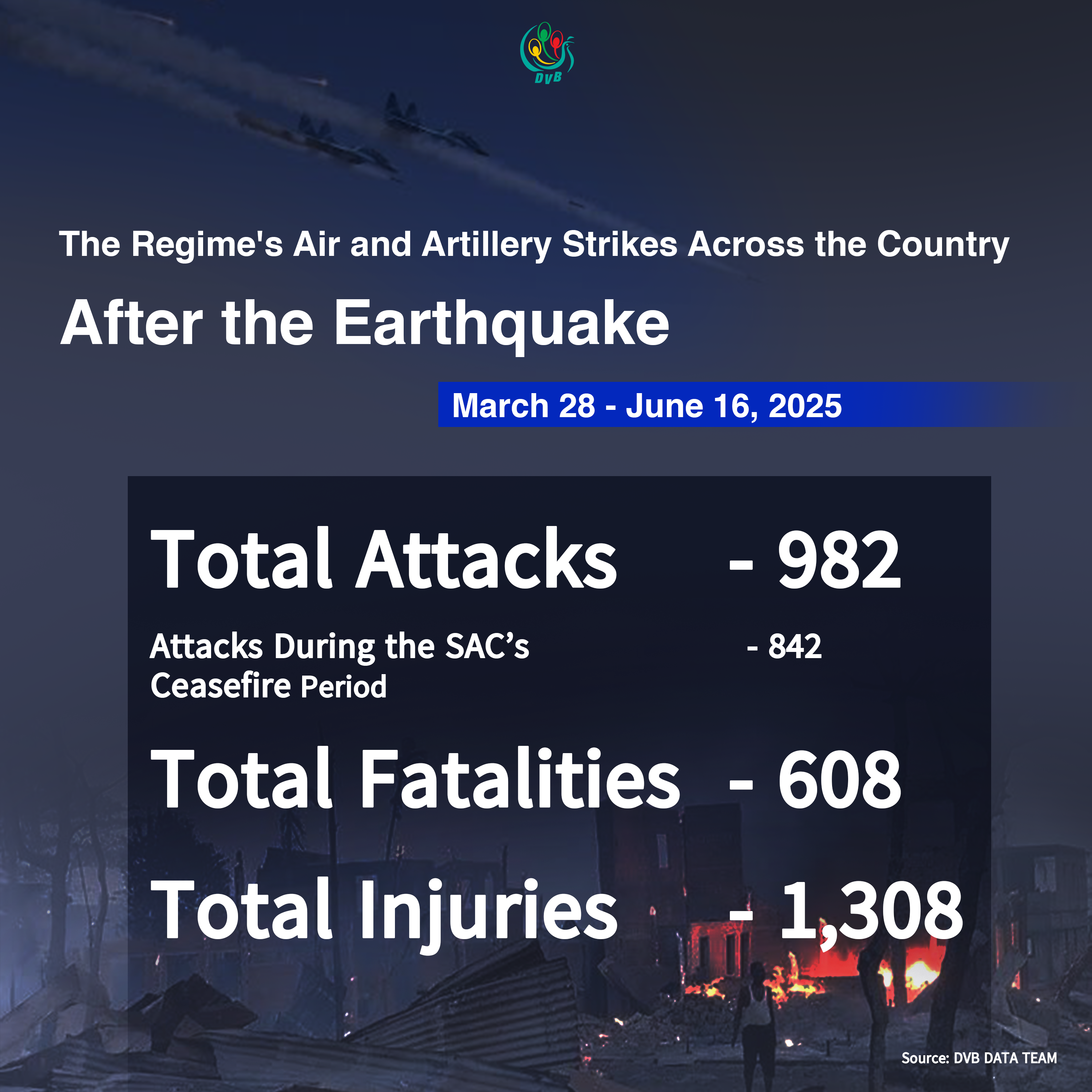
As the junta escalates attacks on disaster-stricken communities, aid providers are targeted alongside civilians.[35] In the six weeks following the Sagaing earthquake, the junta launched at least 200 airstrikes on Mandalay and Sagaing Regions, the areas worst affected by the quake.[36] Civilian deaths from airstrikes in Sagaing Region more than doubled during this period; junta airstrikes killed at least 89 civilians between 28 March and 31 May 2025, compared to 41 between 1 January and 27 March 2025.[37] This surge in violence against civilians immediately after a major natural disaster underscores the junta’s deliberate targeting of aid providers—who deliver the aid that civilians need to survive military-made and natural disasters.
In conjunction with its targeted violence against aid providers, the junta also frequently commits violence against humanitarian property, including confiscating and destroying relief items. In June 2022, junta troops looted and burned down a WFP warehouse in Maungdaw Township, Rakhine State, destroying 1,175 metric tons of food and supplies—enough to support 64,000 people for a month.[38] Through this act of violence, the junta deliberately punished civilians in an area held by the Arakan Army (AA). The military justified this destruction of aid with alleged claims that the food and supplies would be provided to resistance forces, including the AA—thus alleging that WFP and any affiliated aid providers are supporters of resistance forces, and manipulating this claim to justify further violence against them.
V. Conclusion
The illegal Myanmar military junta continues to devastate the country at every step—first through widespread and systematic attacks targeting civilians, then the punishment of aid providers responding to those attacks, and the deliberate obstruction and manipulation of aid for “its own political and tactical advantage.”[39] Since its failed coup, and most blatantly in the aftermath of natural disasters, the junta has exploited the crisis it created—and now exacerbates—to further fuel its tyranny over Myanmar and enrich itself at the expense of Myanmar’s most vulnerable communities. By imposing illegal administrative controls, physically obstructing the delivery of aid, and directing violence against aid providers, the junta weaponizes humanitarian aid to sustain its terror campaign across the country. These are blatant violations of international humanitarian law.
Furthermore, international aid revenues channeled through the junta most likely finance its airstrikes and the preparations for its illegal sham election in December 2025—which serves as an attempt to manufacture false legitimacy for the junta and usher in a return to military dictatorship. In the words of Adelina Kamal and Rin Fujimatsu, “While donors and governments may have good intentions in firewalling the humanitarian principle of neutrality, when assistance is distorted and abused on a large scale and becomes a convenient political weapon by the junta that is at war with its own people, this well-intended assistance can do more harm than good.”[40]
To avoid further harm to the people of Myanmar, the international community must urgently recognize that channeling aid through the junta in any form is both illogical and dangerous. Aid cannot and must not be routed through the very perpetrators whose violence against civilians created and perpetuates the human rights and humanitarian crisis in Myanmar. The junta is neither a legitimate actor nor a trusted partner in the delivery of aid. Instead, channeling aid through junta-linked entities guarantees manipulation, diversion, ineffectiveness, and harm to the people. In sharp contrast, Myanmar’s locally led civil society groups have demonstrated decades of reliability, access, trust of local communities, and operational integrity in delivering aid to the country’s most vulnerable populations safely, effectively, and efficiently.
The people of Myanmar are building an inclusive federal democracy—free from military tyranny, where human rights are protected, and unfettered, unrestricted humanitarian access is a reality. To genuinely support humanitarian needs in Myanmar, the international community must unequivocally support the people’s efforts by taking concrete and coordinated actions to end the junta’s terror campaign. These actions must include a global arms and aviation fuel embargo; targeted, coordinated, and enforced sanctions on the junta and its linked entities; and the complete diplomatic, economic, and military isolation of the junta. In tandem, in addition to being responsible to their taxpayers, donors have a moral obligation to ensure their funds do not cause harm. As such, it is essential that donors channel aid directly to locally led organizations and frontline humanitarian responders, independent of the military junta, through border-based channels that avoid the junta entirely.
VI. Recommendations
To the international community and donors:
- Cut all ties—including political, business, and military engagement—with the illegal Myanmar military junta immediately, and stop lending false legitimacy to the junta, including through international and regional forums or endorsing the junta’s sham election plan including sending observers.
- Ensure transparency and accountability to prevent aid from being weaponized, manipulated, or obstructed by the military junta or its auxiliaries.
- Recognize the contribution of, increase financial support for, and form equal partnerships with trusted local frontline humanitarian responders, including ethnic civil society groups, community-based organizations, and other Myanmar civil society groups independent of the military junta, in delivering aid through border-based channels.
- Increase financial and technical resources for independent Myanmar civil society groups to implement and expand their emergency humanitarian responses.[41]
- Provide more flexible funding to Myanmar civil society groups, relax onerous reporting requirements, and end registration requirements.
[1] “Aid Under Attack: How Myanmar’s Military Junta is Weaponizing Humanitarian Relief,” Ministry of Foreign Affairs, National Unity Government of the Republic of the Union of Myanmar, 2 April 2025, https://mofa.nugmyanmar.org/my/aid-under-attack-how-myanmars-military-junta-is-weaponizing-humanitarian-relief/.
[2] “Military junta,” “junta,” and “military” refer herein to the Myanmar military—and its administrative body, the “State Administration Council,” recently renamed as the “State Peace and Security Commission”— following its attempted coup in 2021, to underscore the fact that the junta is an illegal, illegitimate entity and that Myanmar’s people have categorically resisted the attempted coup and rejected the junta as their government. The terms “military junta,” “junta,” and “military” are thus used interchangeably in this briefing paper to refer to this entity.
[3] “Setting the Tinderbox Alight The Humanitarian Crisis in Myanmar’s Dry Zone,” Progressive Voice, 31 August 2022, https://progressivevoicemyanmar.org/2022/08/31/setting-the-tinderbox-alight-the-humanitarian-crisis-in-myanmars-dry-zone/.
[4] Throughout this briefing paper, “civil society groups” refers to civil society organizations (CSOs), community-based organizations (CBOs), CSO/CBO networks, and groups of human rights defenders (HRDs) and local humanitarian responders.
[5] “Briefing Paper: Effective Control in Myanmar 2024 Update,” Special Advisory Council for Myanmar, 30 May 2024, https://specialadvisorycouncil.org/wp-content/uploads/2024/05/SAC-M-Effective-Control-in-Myanmar-2024-Update-ENGLISH.pdf.
[6] “Law on the Registration of Organizations,” The Pyidaungsu Hluttaw Law No. 31/2014, https://www.myanmar-law-library.org/law-library/laws-and-regulations/laws/myanmar-laws-1988-until-now/union-solidarity-and-development-party-laws-2012-2016/myanmar-laws-2014/pyidaungsu-hluttaw-law-no-31-2014-law-on-the-registration-of-organizations.html; “Organization Registration Law,” State Administration Council Law No. 46/2022, https://www.law-democracy.org/wp-content/uploads/2023/06/Myanmar-Organization-Registration-Law-consolidated-English-version.pdf; “Myanmar State Administration Council Organization Registration Law 2022: Legal Briefing,” International Commission of Jurists (ICJ), November 2022, https://www.icj.org/wp-content/uploads/2022/11/Myanmar-ORL-final.pdf.
[7] UN Human Rights Office for South-East Asia, “Myanmar News Release: NGO Registration Law Amendment,” 28 November 2022, Office of the High Commissioner for Human Rights, https://bangkok.ohchr.org/news/2022/news-release-myanmar-un-human-rights-office-deeply-concerned-new-ngo-law.
[8] “Natural Disaster Management Law,” The Pyidaungsu Hluttaw Law No. 21/2013, 31 July 2013, https://www.preventionweb.net/media/96991.
[9] “Junta Blocks Lifesaving Cyclone Aid: Restrictions on Humanitarian Access, Supplies, Movement Threaten Millions,” Human Rights Watch, 20 June 2023, https://www.hrw.org/news/2023/06/20/myanmar-junta-blocks-lifesaving-cyclone-aid.
[10] Ibid.
[11] “Cyclone Mocha: Aid Efforts Severely Hampered by New Restrictions,” Médecins Sans Frontières, 26 July 2023, https://www.msf.org/cyclone-mocha-aid-efforts-severely-hampered-new-restrictions.
[12] Ibid.
[13] English Editor, “Regime blocks aid groups from providing relief to earthquake survivors in central Myanmar,” Democratic Voice of Burma, 8 April 2025, https://english.dvb.no/regime-blocks-aid-groups-from-providing-relief-to-earthquake-survivors-in-central-myanmar/.
[14] RFA Burmese, “Volunteer groups pause quake aid in Myanmar citing junta restrictions,” Radio Free Asia, 9 April 2025, https://www.rfa.org/english/myanmar/2025/04/09/myanmar-aid-groups-halt-junta-restrictions/.
[15] RFA Burmese, “Myanmar junta says international groups must be ‘approved’ for quake aid,” Radio Free Asia, 7 April 2025, https://www.rfa.org/english/myanmar/2025/04/07/myanmar-aid-groups-approval-earth-quake/.
[16] Sean Turnell, “The Military, Money, and Myanmar: Breaking the Nexus,” Special Advisory Council for Myanmar, 11 February 2025, https://specialadvisorycouncil.org/wp-content/uploads/2025/02/SAC-M-The-Military-Money-Myanmar-ENGLISH.pdf.
[17] See Aung Naing, “Junta further restricts access to dollars as kyat continues to fall,” Myanmar Now, 28 August 2023, https://myanmar-now.org/en/news/junta-further-restricts-access-to-dollars-as-kyat-continues-to-fall/.
[18] “Myanmar Humanitarian Update No. 42,” UN Office for the Coordination of Humanitarian Affairs, 27 November 2024, https://reliefweb.int/report/myanmar/myanmar-humanitarian-update-no-42-27-november-2024.
[19] RFA Burmese, “Volunteer groups pause quake aid in Myanmar citing junta restriction,” Radio Free Asia, 9 April 2025, https://www.rfa.org/english/myanmar/2025/04/09/myanmar-aid-groups-halt-junta-restrictions/.
[20] Ibid.
[21] Independent Mon News Agency, “Tanintharyi IDPs struggle for food amid junta blockade,” Burma News International, 11 January 2024, https://mmpeacemonitor.org/en/en-news/tanitharyi-idps-struggle-for-food-amid-junta-blockade/.
[22] “Authorities block UN World Food Programme convoy from reaching IDPs,” Mizzima, 4 April 2022, https://mizzima.com/article/authorities-block-un-world-food-programme-convoy-reaching-idps.
[23] RFA Burmese, “Volunteer groups pause quake aid in Myanmar citing junta restriction,” Radio Free Asia, 9 April 2025.
[24] “ Myanmar – Meeting Minutes, Coordination Meeting, 30 May 2025,” World Food Programme & Logistics Cluster, 30 May 2025, https://reliefweb.int/report/myanmar/myanmar-meeting-minutes-coordination-meeting-30-may-2025.
[25] Libby Hogan, “Myanmar junta accused of hoarding aid as local groups scramble to respond to earthquake,” ABC News, 30 April 2025, https://www.abc.net.au/news/2025-04-30/myanmar-earthquake-survivors-battle-heat-hunger-and-the-military/105231356.
[26] “Report of the Special Rapporteur on the situation of human rights in Myanmar,” UN Doc. A/80/490, UN General Assembly, 20 October 2025, https://www.ohchr.org/sites/default/files/documents/countries/myanmar/a-80-490-auv-en.pdf.
[27] Libby Hogan, “Myanmar junta accused of hoarding aid as local groups scramble to respond to earthquake,” ABC News, 30 April 2025.
[28] Kate Lamb & Rebecca Ratcliffe, “Myanmar junta accused of blocking aid for earthquake victims as airstrikes continue,” The Guardian, 1 April 2025, https://www.theguardian.com/world/2025/apr/01/myanmar-earthquake-junta-accused-blocking-aid.
[29] “Myanmar junta forces and Pyu Saw Htee militias confiscate earthquake relief aid in Sagaing,” Mizzima, 3 April 2025, https://eng.mizzima.com/2025/04/03/20958.
[30] “‘Let the World Know’: Responses to Humanitarian Aid After the 28 March Myanmar Earthquake,” Insecurity Insight, 6 June 2025, https://insecurityinsight.org/wp-content/uploads/2025/06/1.-Tracking-Aid-Narratives-on-Social-Media_-Emerging-Trends-in-Myanmar-.pdf.
[31] Eleven Media, “UN warns of action against resale of nutritious biscuits distributed in Myanmar’s quake-hit areas,” Asia News Network, 25 April 2025, https://asianews.network/un-warns-of-action-against-resale-of-nutritious-biscuits-distributed-in-myanmars-quake-hit-areas/.
[32] United Nations High Commissioner for Human Rights, “Situation of human rights in Myanmar since 1 February 2021,” UN Doc. A/HRC/53/52, UN Human Rights Council, 15 November 2023, https://docs.un.org/en/A/HRC/53/52.
[33] Humanitarian Data Exchange, “Myanmar – Aid Worker Security Database,” OCHA Services, last accessed 20 October 2025, https://data.humdata.org/dataset/aid-worker-security-database-mmr.
[34] “Report of the Special Rapporteur on the situation of human rights in Myanmar,” UN Doc. A/80/490, UN General Assembly, 20 October 2025.
[35] Between 28 March and 16 June 2025, the military carried out at least 982 attacks—including airstrikes and artillery barrages—that killed at least 608 people and injured at least 1,308, in quake-affected areas and beyond. “The Regime’s Air and Artillery Strikes Across the Country After the Earthquake: March 28 – June 16, 2025,” Democratic Voice of Burma, 16 June 2025, https://english.dvb.no/wp-content/uploads/2025/06/Air-strike-MM_ENG-V5Airstrike-eng-2.png.
[36] United Nations High Commissioner for Human Rights, “Situation of human rights of Rohingya Muslims and other minorities in Myanmar,” UN Doc. A/HRC/60/20, UN Human Rights Council, 29 August 2025, https://www.ohchr.org/sites/default/files/documents/hrbodies/hrcouncil/sessions-regular/session60/advance-version/a-hrc-60-20-aev.pdf.
[37] Ibid.
[38] “WFP condemns looting and burning of its warehouse in Myanmar,” UN World Food Programme, 26 June 2024, https://www.wfp.org/news/wfp-condemns-looting-and-burning-its-warehouse-myanmar.
[39] Adelina Kamal & Rin Fujimatsu, “From humanitarian resistance to resilience: Nation-building in active conflict,” Humanitarian Practice Network, 10 April 2024, https://odihpn.org/publication/from-humanitarian-resistance-to-resilience-nation-building-in-active-conflict/.
[40] Ibid.
[41] “‘Our Shared Responsibility’: How Civil Society is Strengthening Local Resilience for a Federal Democratic Burma/Myanmar,” 18 civil society organizations, 30 September 2025, https://progressivevoicemyanmar.org/2025/09/30/our-shared-responsibility-how-civil-society-is-strengthening-local-resilience-for-a-federal-democratic-burma-myanmar/.