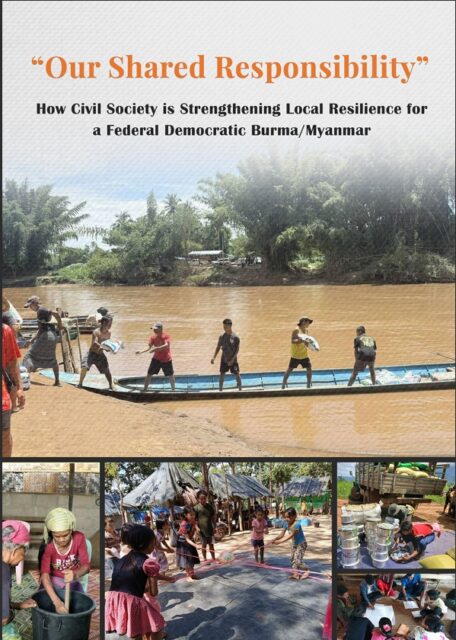
“Our Shared Responsibility”: How Civil Society is Strengthening Local Resilience for a Federal Democratic Burma/Myanmar
30 September 2025
Executive Summary
Following the Myanmar military junta’s illegal coup attempt on 1 February 2021, an unprecedented people’s revolution emerged—aiming to end military tyranny and establish federal democracy—as the junta plunged the country into a severe human rights and humanitarian crisis. Since 2021, as collective punishment of the people for their resistance, the junta has escalated its terror campaign against them, including airstrikes, artillery shelling, ground attacks, arbitrary arrests and detention, mass displacement, and the deliberate obstruction of aid. In the face of these atrocities, the Myanmar people are pursuing a homegrown political transformation by establishing bottom-up governance in the country’s liberated areas and caring for each other in response to disasters—both natural and military-made—through collective and coordinated action.
Operating independently of the junta, Myanmar’s civil society groups have met this moment with diverse and multifaceted initiatives to strengthen local resilience, bridging the urgent humanitarian needs of today with Myanmar’s federal democratic future. These groups are delivering lifesaving humanitarian aid, pursuing sustainable community initiatives, protecting human rights, and supporting the ongoing establishment of inclusive, bottom-up federalism. These groups include civil society organizations (CSOs), community-based organizations (CBOs), CSO/CBO networks, and groups of human rights defenders and local humanitarian responders.
Drawing on qualitative research with 28 diverse civil society groups operating in Myanmar, this report provides examples of how Myanmar civil society is strengthening local resilience through support for:
- Responsive humanitarian aid: Providing tailored and lifesaving emergency assistance—such as food, cash, health care, and shelter—that directly responds to the needs of Myanmar’s most vulnerable communities and is based on deep community trust, often in areas under attack by the junta and inaccessible to international agencies.
- Sustainable community initiatives: Promoting community-led agriculture and home gardening, vocational training, development of small-scale infrastructure, and community health care—to enhance food security, self-reliance, social cohesion, psychosocial well-being, and sustainable livelihoods.
- Bottom-up federalism and human rights: Protecting human rights defenders; providing education about human rights and federal democracy; empowering women and youth to participate actively in their communities, especially in political decision-making and bottom-up governance; and supporting institution building to establish an inclusive federal democracy.
In doing this work, Myanmar civil society groups face immense challenges, including physical and digital security threats, attacks, and surveillance; transportation and communication barriers; funding delays; and major funding cuts by governmental donors. In particular, the dearth of adequate and flexible funding—compounded by onerous reporting requirements—poses a major challenge to the groups’ “do no harm” approach, as well as their personal and organizational safety and security. Despite these challenges, equipped with decades of expertise, in-depth understanding, and quick adaptability, Myanmar civil society groups continue to respond to the needs on the ground—driven by people-to-people solidarity and a strong sense of shared responsibility to Myanmar’s communities.
These independent Myanmar civil society groups are holding up the sky—saving lives today while laying the democratic foundations for an inclusive, just, and peaceful future free from military tyranny. The international community must urgently take principled action to support their ongoing efforts and deprive the junta of the means to carry out further atrocities against the people of Myanmar.
Announcements
19 May 2026