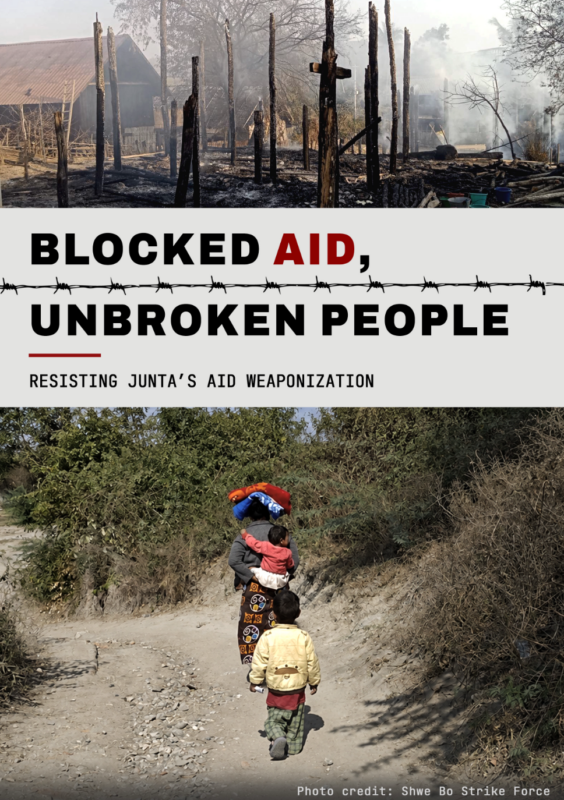
Blocked Aid, Unbroken People: Resisting Junta’s Aid Weaponization
22 July 2026
Executive Summary
The human rights and humanitarian crisis across Sagaing, Magwe, and Mandalay Regions in Myanmar has worsened significantly since the military’s illegal coup attempt in 2021. The attempted coup was overwhelmingly rejected and resisted by people across Myanmar, to which the military junta responded with scorched-earth campaign of aerial bombardments, ground attacks and massacres across Myanmar’s central Dry Zone, as documented in Progress Voice’s previous briefing paper, “Setting the Tinderbox Alight: The Humanitarian Crisis in Myanmar’s Dry Zone (Sagaing, Magwe and Mandalay Regions),” published in August 2022. Since then, the military junta has intensified and recalibrated its campaign of terror while blocking and weaponizing humanitarian aid, and systematically destroying civilian livelihoods, resulting in a dire human rights and humanitarian catastrophe.
The evidence presented in this briefing paper demonstrates that the junta’s obstruction of humanitarian assistance is not merely a consequence of conflict but a deliberate extension of its broader strategy of collective punishment, creating humanitarian catastrophe while simultaneously restricting access to relief.
Deploying its long-standing Four Cuts, or Phyat-Lay-Phyat, strategy as a tool of collective punishment, the military junta has waged a campaign of airstrikes, artillery shelling, arson, landmine contamination, targeted killings, forced conscription, conflict-related sexual and gender-based violence, and the systematic destruction of civilian livelihoods. Notably, the junta has recalibrated its aerial campaign by diversifying its methods of attack, increasingly employing drones, ultralight aircraft—including paramotors and gyrocopters—and coordinated mass-barrage airstrikes targeting civilians. Together, these atrocities have driven repeated displacement, prevented safe returns, and deepened the humanitarian crisis, leading to protracted displacement, chronic insecurity, economic devastation, and widespread human suffering, and systematic denial of access to healthcare and education.
This briefing paper draws on qualitative research involving 32 participants from Sagaing, Magwe, and Mandalay Regions, including representatives of grassroots civil society organizations (CSOs), members of strike groups, and internally displaced persons (IDPs). It centers the experiences of IDPs and examines how grassroots CSOs, CBOs, and frontline humanitarian responders have stood alongside affected communities, delivering emergency assistance while supporting them to rebuild their lives, strengthen their resilience, and survive amid the junta’s escalating campaign of violence.
Key Findings include:
- Delivering lifesaving emergency assistance:Despite severe resource constraints and operating amid ongoing junta attacks and violence, frontline humanitarian actors continue to deliver lifesaving emergency assistance. By mobilizing support from private donors, diaspora communities, local networks, and civil society organizations, they work alongside affected communities in areas otherwise inaccessible to international agencies.
- Surviving while displaced: As displacement becomes increasingly protracted, many IDPs can no longer rely solely on lifesaving emergency assistance and are forced to adopt survival strategies that continue to fall short of meeting their basic needs. Under increasingly challenging circumstances, IDPs adapt their livelihoods by engaging in seasonal agricultural wage labor, small-scale trading, and other informal income-generating activities. However, these coping strategies remain fragile, unsustainable, and insufficient to meet their basic needs.
- Strengthening resilience through community-led initiatives: Frontline humanitarian actors and civil society groups are implementing locally led livelihoods, food security, healthcare, education, protection, and infrastructure initiatives to complement emergency assistance and support displaced communities beyond day-to-day survival. Tailored to the actual needs and the realities of the crisis, these initiatives strengthen self-reliance, protect women, girls, and children; improve access to essential services; foster social cohesion; and enhance the long-term resilience of displaced and conflict-affected communities.
The military junta’s relentless and escalating campaign of violence—marked by rising civilian casualties, widespread human rights violations, and repeated mass displacement since its illegal coup attempt more than five years ago—must serve as an urgent alarm for the international community and the Association of Southeast Asian Nations (ASEAN). The people of Myanmar are not enduring these sacrifices in vain. They continue to resist with the shared aspiration of building a federal democratic future in which all people can return home safely and with dignity, free from the threat of military violence. The international community and ASEAN must stand with the people of Myanmar by urgently taking the following decisive and meaningful actions:
Recommendations:
To the Association of Southeast Asian Nations (ASEAN)
- Urgently implement the October 2025 Summit decision to advance the safe, effective, and transparent delivery of humanitarian assistance through border-based channels that directly reach conflict-affected internally displaced persons without discrimination. As ASEAN Chair, the Philippines must operationalize this commitment without further delay;
- Ensure that humanitarian assistance bypasses the junta and its controlled mechanisms, including the ASEAN Coordinating Centre for Humanitarian Assistance and the Myanmar Red Cross Society;
- Facilitate aid delivery through border-based channels in collaboration with EROs, NUG and trusted CSOs, CBOs, grassroots networks, and emerging federal governance units including in Sagaing, Magwe, and Mandalay Regions;
- Move beyond the Five-Point Consensus and engage meaningfully and formally with Myanmar’s legitimate stakeholders, the NUG, the National Unity Consultative Council (NUCC), the Committee Representing Pyidaungsu Hluttaw (CRPH), Steering Council for the Emergence of a Federal Democratic Union (SCEF), and federal governance units to support the bottom-up federal democracy building process;
- Reject all institutions and representatives emerging from the junta’s sham election and deny any form of legitimacy to the junta’s rebranded “civilian” façade by halting all diplomatic, political, economic, and military engagement;
- Impose coordinated restrictions on weapons and aviation fuel supply lines, targeting the shipping and transport infrastructure that powers the junta’s aerial bombardments;
- Ensure that no ASEAN Member State serves as a conduit for resources used in the junta’s attacks against civilians;
- Work in tandem with the UN and Myanmar’s legitimate stakeholders, including the NUG, EROs, SCEF, federal governance units, and local civil society and humanitarian organizations to effectively address the Myanmar’s deepening and expanding human rights and humanitarian crises; and
- Support international accountability efforts focused on Myanmar including the exercise of universal jurisdiction in Timor-Leste and Indonesia.
To the International Community and Humanitarian Donors
- Bypass the military junta and all junta-controlled mechanisms to ensure humanitarian assistance reaches the internally displaced persons and other vulnerable communities;
- Recognize the essential and critical role of Myanmar’s frontline humanitarian responders and civil society groups and provide robust, direct support to internally displaced communities through locally led, border-based mechanisms;
- Ensure that international humanitarian agencies apply the Do No Harm principle and human rights due diligence in all engagement with local civil society groups and affected communities, including protecting the confidentiality of identities and locations to prevent junta surveillance, reprisals, and other harms;
- Work in equal and meaningful partnership with local civil society and CBOs and affected communities, respecting their leadership and agency while facilitating assistance through locally led, border-based mechanisms;
- Provide/increase flexible financial support and technical resources for Myanmar civil society groups to sustain and expand their emergency humanitarian responses and sustainable community resilience initiatives, relax burdensome reporting requirements, and remove unnecessary registration requirements that create barriers to deliver assistance safely and effectively;
- Provide robust financial support for the protection and livelihoods of Myanmar HRDs, frontline humanitarian responders, and civil society actors to strengthen protection efforts to enable them to continue their human rights and humanitarian work;
- Provide flexible, multi-year funding and technical support directly to Civil Disobedience Movement (CDM) health workers, community-based health organizations, and other groups independent of the junta through border-based mechanisms that strengthen people-led health systems and ensure access to health care for IDPs;
- Support locally led gender-responsive protection and referral pathways by providing direct and flexible funding to women-led and women’s rights organizations;
- Recognize and support Myanmar people’s will and democratic aspirations and ongoing efforts to establish a federal democracy from the ground up, including providing technical and financial support for local governance infrastructure, administration, communication, and justice mechanisms to strengthen effective governance, civilian protection, and humanitarian aid delivery;
- Support efforts by resistance forces to undertake landmine demarcation and removal of landmines to strengthen the safety of local communities, particularly for livelihoods, humanitarian service activities, and travel;
- Reject all institutions and representatives emerging from the junta’s sham election and deny any form of legitimacy to the junta’s rebranded “civilian” façade by halting all diplomatic, political, economic, and military engagement;
- Impose a comprehensive global arms embargo against the junta, including targeted sanctions on aviation fuel, and ban all sales, supplies, and transfers of weapons, aircraft, drones, dual-use technologies, and related equipment that power the junta and enable atrocity crimes; and
- Advance accountability efforts to hold the perpetrators of atrocity crimes through all available international legal avenues.
To the National Unity Government, EROs, People’s Defense Forces, and Federal Governance Units
- Respect and adhere to international humanitarian and human rights law and related codes of conduct at all times;
- Strengthen measures and take maximum precautions for civilian protection during military operations, including by providing clear, timely, and accessible security alerts to civilians;
- Establish, strengthen, and support justice and accountability mechanisms to protect women, children, LGBTQIA+ persons, persons with disabilities (PWDs), and other at-risk groups from sexual and gender-based violence and other forms of violence;
- Ensure full, equal, and meaningful participation of women, youth, ethnic and religious minorities, LGBTQIA+ communities, and PWDs at every level of decision-making, including in local governance structures, humanitarian response and protection mechanisms, and justice seeking processes;
- Recognize and support the critical role of women-led and women’s rights organizations and CSOs that provide protection, humanitarian assistance, healthcare, psychosocial support, safe shelter, and monitoring and documentation of sexual and gender-based violence in conflict-affected areas, and fully cooperate in their efforts to advance justice seeking for victims and survivors;
- Recognize the independent role of and cooperate with frontline local humanitarian responders, human rights defenders, CSOs, and CBOs;
- Respect the agency, leadership, and independent decision-making of local CSOs, CBOs, and frontline humanitarian responders as primary actors in addressing the humanitarian crisis through collaborative approaches that strengthen humanitarian access, community protection, resilience, and accountability; and
- Facilitate secure passage for humanitarian delivery by the local responders through equal, meaningful, and sustained partnerships to ensure that assistance reaches conflict-affected populations in a timely, effective, impartial, and non-discrimination manner.