How the military blocked independent media during the 2025-6 elections
16 March 2026
Summary
This groundbreaking report uses big data to reveal how the military intensified internet blocking of independent media, social media platforms, and VPNs during the sham elections, aiming to prevent the public from accessing any independent reporting or communicating with each other. The report is the first of three published in partnership with IPCM and is available in Myanmar language.
Executive Summary
Several hours before the military launched the February 2021 coup, it raided the offices of telecommunications companies, ordering them to shut down internet access and restore it only once a comprehensive set of digital blocks had been implemented. The military’s targets included social media networks and many of the country’s independent media outlets. Five years later, during the military’s 2025–26 sham elections, these blocks became the cornerstone of the regime’s digital election strategy.
This report reveals the evolution of these blocks, tracking their intensification during the elections. As the first in a series of investigations which will later cover journalists’ experiences, this report exposes the military’s weaponisation of internet infrastructure to systematically censor the media and deny the public their fundamental right to access information.
Key Findings
- The military significantly increased its website blocking during the elections, obstructing 93% of public attempts to access the large independent media websites.
- The blocks increased according to each outlet’s criticism of the military with those most critical facing over 90% obstruction compared to 0% for those complying with the military’s narrative.
- To stop people evading the blocks, the military increased blocks on encryption and circumvention tools to 97% and 93% while simultaneously unblocking unencrypted platforms in an attempt to funnel the public into a more heavily surveilled digital space.
- The military tried to gaslight the public, classifying blocks as State secrets, threatening telecommunications companies (telcos) with severe imprisonment for leaks, and concealing 98% blocks as technical failures.
- All telcos failed in their responsibility to respect human rights and have become active enforcers of the military’s blocking regime, including State-owned telcos MPT and Mytel which have led the crackdown with near-100% blockades of the media.
Introduction
Following five years of systemic human rights atrocities, the military regime tried to finalise its coup objectives by holding long-promised elections phased between December 2025 and January 2026. The polls were widely condemned as a sham by the international community and failed to gain recognition from regional bodies, including ASEAN.
The illegitimacy of the electoral process was rooted in the military’s deliberate attacks on the information ecosystem. By blocking significant portions of the internet, the military denied prospective voters the ability to exercise their right to seek and receive the information necessary for informed decision-making. Since the 2021 coup, blocking as an act of mass censorship has functioned as a digital barrier between the public and the truth.
This report investigates the military’s media blocking prior to the election cycle and analyses the subsequent ratcheting up of blocks during the critical three-month countdown from September to December 2025. By evaluating these changes during the campaign period, the report demonstrates how technical interference was leveraged to manipulate the electoral outcome and secure regime survival.
Analysing the military’s blocking regime
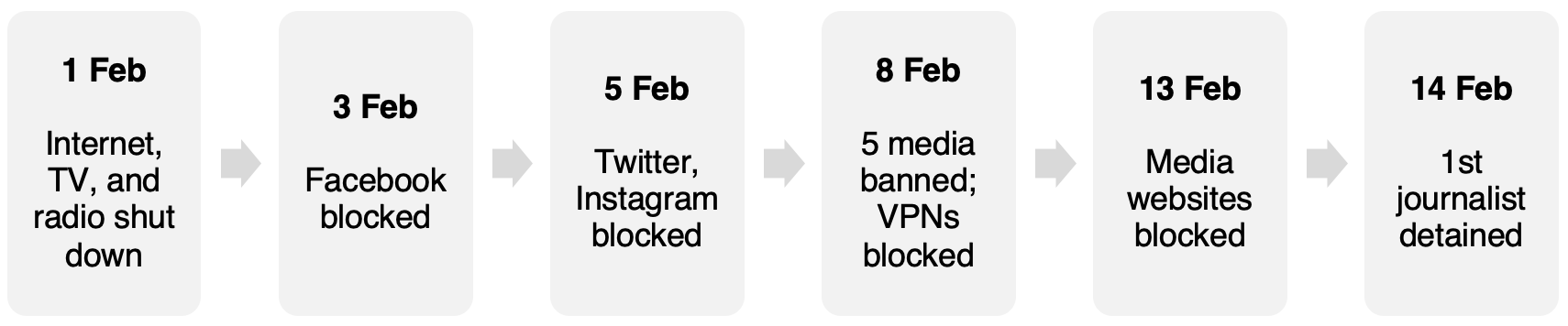
The architecture of the digital coup was established at 3:00 AM on 1 February 2021. Soldiers forcibly entered the offices of telecommunications companies (telcos), television stations, and radio broadcasters, demanding immediate service shutdowns. In the chaotic days following the coup, the public’s only viable link to the outside world was through foreign SIM cards, an avenue that was eventually identified and systematically shut down too.
While total internet shutdowns characterised the early weeks of the coup, the military eventually transitioned to a more surgical strategy of targeted internet blocks. The military first ordered the blocking of large social media platforms including Facebook, followed by X (formerly Twitter) and Instagram. This was followed by blocking of the websites of the country’s largest independent media outlets, eventually expanding to include local media outlets reporting from Myanmar’s ethnic states and regions.
The blocks remain five years after the coup. This report is focused on the blocks in place in this electoral year and is based on a robust data set of 198,000 internet network measurements and 1.8 million indicators collected across Myanmar between January 2025 and January 2026. Each measurement tested if a desired website was accessible via a particular operator, such as MPT or MyanmarNet, and, if not, determined both the presence and type of block. Within this framework, network measurements are treated not merely as technical data, but as evidence of interference with the right to seek, receive, and impart information as guaranteed under Article 19 of the International Covenant for Civil and Political Rights (ICCPR) and the Universal Declaration for Human Rights (UDHR), which establish human rights obligations for the military. These network measurements allow the disaggregation of the data by time, location, and individual telco to expose the mechanics of the digital coup in the countdown to polling day.
The blocking regime relies on total secrecy enforced by the military. Only 2% of the blocks were transparent with declaratory pages or known censorship DNS. The remaining 98% were effectively secret blocks hidden by technical anomalies such as TCP resets or DNS tampering, which made websites appear broken or a connection appear slow.
However, by comparing these technical anomalies against error rates, control data, and the anomalies faced by pro-military platforms, it becomes clear that they were predominantly intentional, military-directed interference. This deliberate ambiguity is designed by the military to gaslight the public, obscuring censorship under the guise of technical failure. Such censorship can for example be seen in the blocks facing media websites.
Blocking targeted at the independent media
By the time the 2025–26 elections were officially announced on 28 August 2025, the military had spent five years trying to isolate the vast majority of the public from the free information ecosystem online. Prior to the start of the election campaign, the military-controlled infrastructure already obstructed 79% of all of the public’s direct attempts to access the websites of Myanmar’s largest independent media. Given that there were approximately 24 million people in Myanmar with internet access, this represents many thousands of attempts to reach the independent media blocked daily.
For the public, circumventing these blocks became a high-risk, high-cost endeavour. Maintaining access to the independent media required the regular download and installation of new VPNs in a constant game of whack-a-mole with the censors blocking the different applications as they became popular. It also required the payment of exorbitant data charges doubled by the military after the coup with the immediate effect of widening the digital divide.[7] Furthermore, in addition to the technical difficulty and cost, the physical risk of accessing the independent media was also high. Security forces at checkpoints routinely violated privacy rights by searching devices for evidence of independent media access to extort bribes or justify arbitrary arrests.
This environment of suppression also placed independent media outlets in a situation of permanent crisis. Most media, operating from exile on shoestring budgets, were forced to divert precious editorial resources toward larger IT teams and technical workarounds simply to ensure their content could reach a fraction of their audience.
Blocking escalation during the election countdown
During the three-month countdown to the election, the blocking of large independent media websites surged from 79% to 93%. A 14% increase over three months suggests that millions of additional people were affected, losing access to the independent media. This spike occurred precisely when voters required access to investigative reporting to vet candidates, identify election intimidation, and monitor overt influence campaigns. By engineering this spike, the military undermined the deliberative phase of the election and increased the likelihood of hiding any electoral manipulation.
While the previous 79% blocks was already significant, it was not total information control as it still allowed some access. By increasing the independent news vacuum during the elections, the military ensured that its own propaganda, disseminated via State-controlled media, faced less digital competition.
Following the election, the blocking rate marginally declined from 93% to 85% after the end of January 2026. This drop suggests that once the military’s electoral objectives were secured, the high levels of campaign-period interference were no longer deemed as necessary. This fluctuation confirms that network interference is a dynamic tool of political control, calibrated to the military’s calendar.
Precision blocks against critical media
The blocks have not been applied uniformly since the coup, but focused against the most credible threats to the military’s narrative. Media known for uncovering military atrocities and corruption faced the most severe website blockades. Before the election, the media outlets Myanmar Now, Mizzima, and The Irrawaddy faced the highest blocking rates of 85%, 84%, and 75% respectively. During the election countdown, these rates escalated to 98%, 92%, and 98%, rendering their websites virtually invisible to the domestic public without adequate circumvention tools.
Local, small and medium-sized media outlets have been similarly targeted since the coup, particularly those reporting from conflict zones where the military was conducting systematic human rights abuses. Myitkyina News Journal, covering Kachin State and the military’s attacks on the Kachin Independence Army (KIA), faced blocking rates of 76%. Narinjara News, reporting in Rakhine State on fighting between the military and the Arakan Army (AA) faced 73% blocks. Karen Information Centre, covering military attacks on the Karen National Union (KNU) in Karen State faced 69% blocking.
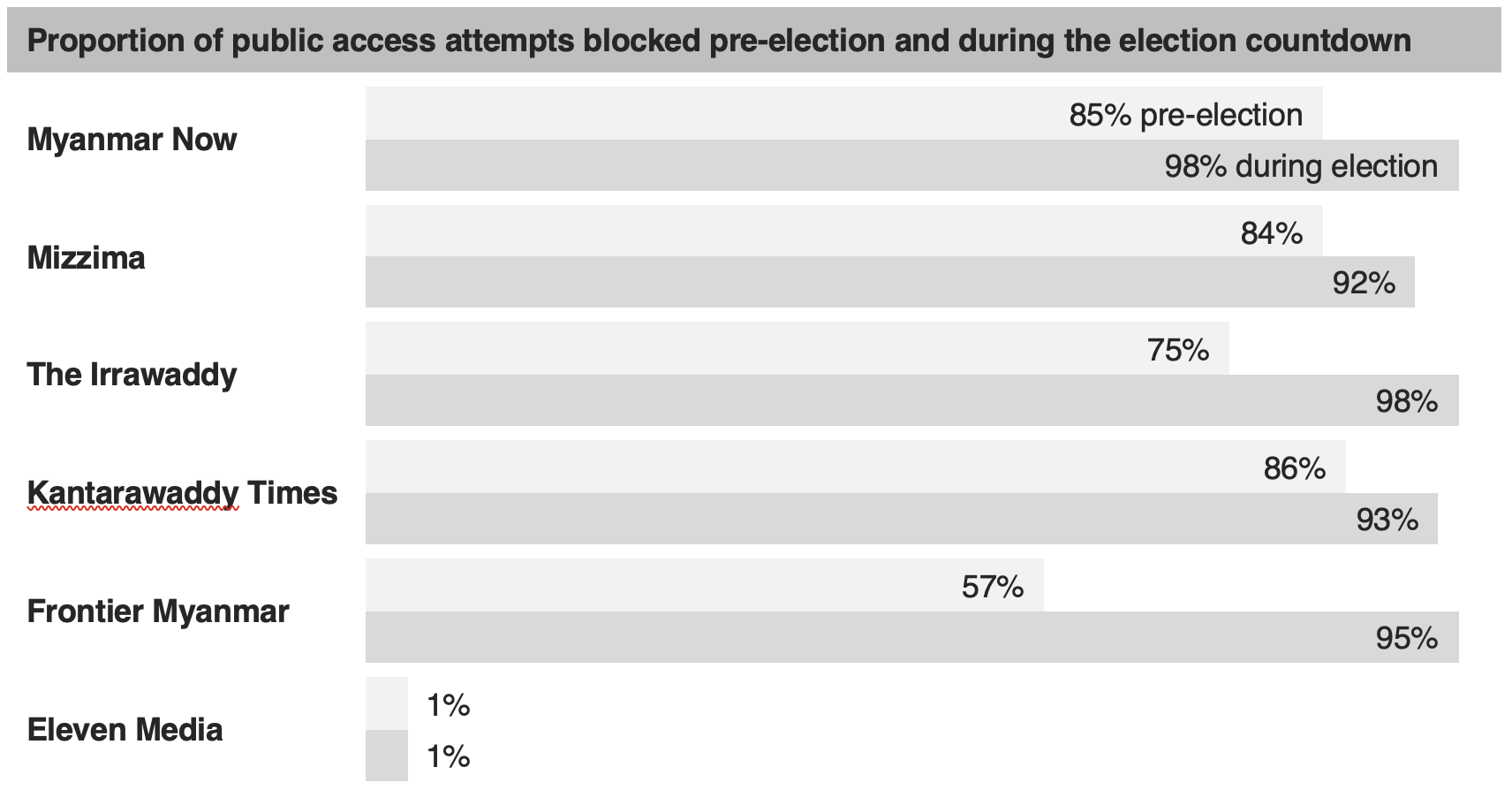
Once the election countdown had begun the blocks on small and medium media increased. Kantarawaddy Times, which reports from Karenni (Kayah) State where the Karenni Army (KA) is fighting the military, saw increases from 86% to 93% blocking.
The military’s intensified focus during the elections also included a more diverse range of media than before. Frontier Myanmar, an outlet focused on analytical and human rights reporting and with an audience primarily made up of English-language speakers and internationals, saw its blocking rate rise from 57% to 95% during the elections. All these increases demonstrate that the military was strategic in its targeting, aiming to censor the most critical voices and denying information to influential audiences.