Briefing Paper: Recent Developments Regarding the Myanmar Military Junta’s Sham Election Plan
3 November 2025

In late July 2025, the Myanmar military junta announced that it will hold a so-called election on 28 December 2025, despite the people’s widespread rejection of the junta and its lack of legitimacy and legality to hold any election. The junta also lifted the state of emergency, which it had repeatedly extended—in violation of the military-drafted 2008 Constitution—since its illegal coup attempt in 2021. In addition, the junta changed its name from the “State Administration Council” to the “State Security and Peace Commission.” In conjunction with this name change, the junta chief appointed himself “acting president” and named nine other active and former military generals to the new “commission.”
These maneuvers, compounded by escalating violence against civilians and repressive election laws, underscore that the planned sham election is designed to manufacture false legitimacy for the junta to whitewash its crimes and usher in a return to military dictatorship. The junta’s sham election will only intensify the already dire human rights and humanitarian crisis, cementing China’s influence and further derailing Myanmar’s economy.
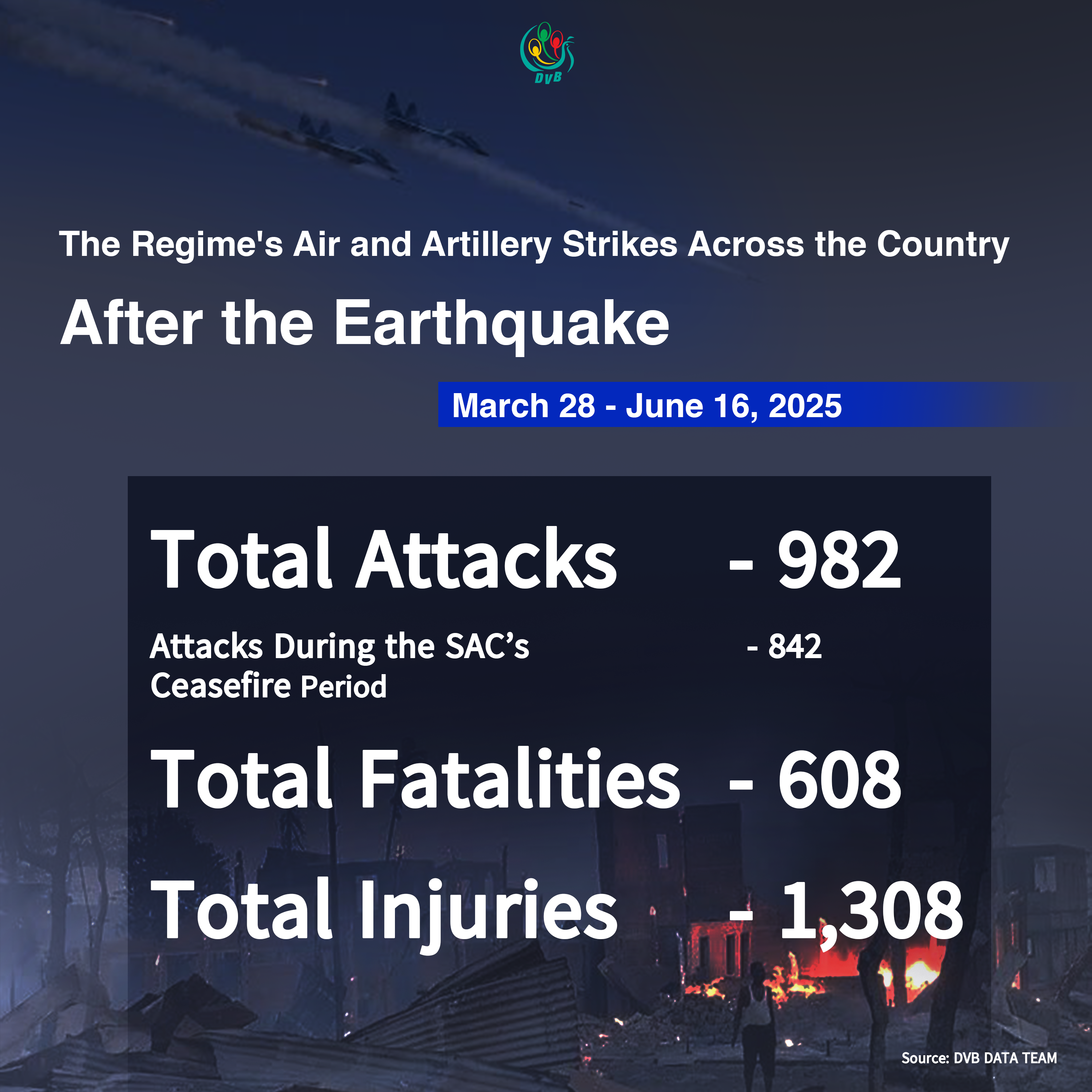
Increased junta attacks on civilians: Seeking to expand its territorial and administrative control in advance of its sham election, the military has intensified its airstrikes, artillery shelling attacks, and scorched-earth operations against civilians over recent months. In August 2025 alone, at least 235 civilians were killed in 204 junta airstrikes. These airstrikes target schools, religious buildings, health care facilities, civilian homes, and internally displaced person (IDP) camps. Since its coup attempt, the junta has launched more than 5,000 airstrikes, with the amount of airstrikes dramatically increasing year over year. In 2024, the junta conducted 104% more airstrikes compared to 2023, averaging nearly seven airstrikes per day. In 2025, the junta massively escalated its aerial attacks after the Sagaing earthquake on 28 March. Between 28 March and 16 June 2025, the junta launched at least 982 attacks, including airstrikes and artillery barrages, against the people.
Repressive election laws introduced by the junta
- “Political Parties Registration Law” (January 2023): This junta law drastically raised requirements for parties to participate in elections and re-register with the junta-controlled Union Election Commission (UEC). The new requirements to participate in national elections include at least 100,000 members, a minimum number of nationwide offices, and a large financial deposit, as well as prohibiting anyone convicted of a crime from joining a party. By requiring parties to re-register within 60 days of its enactment, this law effectively disqualified or “dissolved” many parties that have long stood against the military’s role in politics, including the National League for Democracy, which won the overwhelming majority of votes in Myanmar’s 2020 general election.
- First Amendment (January 2024): The junta reduced “required membership to 50,000 and the number of offices to 110 or one-third of townships,” for parties registering to participate in national elections. It also extended the deadline, giving parties until 90 days before the election to meet the requirements.
- Second Amendment (July 2025): This amendment allows the junta to dissolve “any party accused of electoral fraud or unlawful conduct during voting.”
- “Law on the Protection of Multiparty Democratic Elections from Obstruction, Disruption and Destruction” (July 2025): Introduced in July 2025, this junta law criminalizes many forms of election interference or dissent and imposes draconian punishments, including the death penalty and life imprisonment. Other punishments include “three to five years in prison for election sabotage; five to 10 years for damaging ballot boxes, polling stations, or voting machines (or life imprisonment if committed as a group); and 10-20 years for causing serious injury to voters, polling staff, candidates, or election officials.”
- First known person sentenced under this law: In a Facebook post on 25 August, a Myanmar man named Nay Thway criticized the junta for prioritizing its planned election over public safety. In a township-level court in Taunggyi, Shan State, the junta sentenced him to seven years of hard labor. The junta announced this sentencing on 9 September—two weeks after Nay Thway’s post and subsequent arrest.
- Over 60 people detained under this law: On 4 October 2025, the junta announced at least 64 people have been prosecuted under this “election interference” since it was introduced in July. In Loikaw, Karenni State, the junta arrested two 18-year-olds and three minors, the youngest of whom is 14, on 14 September. On 27 October, the junta arrested three Myanmar artists—including director Mike Tee, supporting actor Kyaw Win Htut, and comedian Ohn Daing—and announced that they will face charges under the same law for criticizing actors who appeared in Khit Ko Done Saing Myi Thu Myar, the junta’s sham election propaganda film.
Recent dissolution of more political parties: On 9 September, the junta’s UEC announced that it had deregistered four political parties for failing to meet its criteria by the 7 September deadline: the National Democratic Force (NDF) for not having enough members, and the Democratic Party of National Politics (DNP), the Women’s Party (Mon), and the Union Farmer-Labour Force Party for not having the required number of offices.
So-called “election” without opposition: As of 13 September, only 57 political parties are registered to participate in the junta’s sham election. Most of these parties are “pro-military or small outfits without public backing.” Only six parties will field candidates at the national level: the military junta’s proxies Union Solidarity and Development Party (USDP) and the National Unity Party (NUP), the People’s Pioneer Party (PPP), the People’s Party, the Myanmar Farmers Development Party (MFDP), and the Shan and Ethnic Democratic Party (SEDP). Both the USDP and NUP are led by ex-military generals, and the PPP is led by an ex-NLD lawmaker turned junta minister. Moreover, on 18 October, the junta-controlled UEC announced a ban on campaign rallies and street processions, restricting candidates to giving speeches at junta-approved times and places.
Electronic voting machines: The junta has announced that around 55,000 “Myanmar Electronic Voting Machines” will be domestically produced and used for the sham election, replacing paper ballots. Around 2,500 voting machines have already been produced for demonstration purposes. This year, the junta has held voting machine demonstrations, mock voting, and training sessions in multiple states and regions across the country. On 3 September, ward administrators in some parts of Yangon Region forced households to attend a trial vote, threatening to withhold household registration if they did not attend. Separately, during voting machine trainings, the junta has threatened teachers, who are required to staff the polls, not to share the training information with the public.
Martial law in 63 townships: On 31 July 2025, the junta announced three months of martial law for 63 townships across Kachin, Karenni, Karen, Rakhine, Shan, and Chin States, as well as Sagaing, Mandalay, and Magwe Regions. The junta is using martial law in attempt to gain control of these townships ahead of its sham election, as it lacks effective administration and territorial control in the majority of these 63 townships. Forty-six are under the control of resistance forces, namely Myanmar’s coalition government from 2020 election, the National Unity Government (NUG), People’s Defense Forces (PDFs), and Ethnic Resistance Organizations (EROs). In another 16 townships, resistance forces control most rural areas.
Junta announces no polls in 56 townships out of 330: On 14 September 2025, the junta announced that the sham election will not be held in 121 parliamentary constituencies, spanning 56 townships, most of which are under the control of ethnic resistance organizations or People’s Defense Forces. The majority of these 56 townships also overlap with the aforementioned 63 townships in which the junta has announced martial law. The junta also announced that the sham election will be held in phases, with the first phase including 102 townships on 28 December. In late October, the junta announced that the second phase of the sham election will be held on 11 January 2026.
Coercion of IDPs: The junta is systematically pressuring IDPs in areas under its control ahead of its sham election, using aid distribution efforts and “data gathering” operations to compile lists of IDPs that may serve as voter rolls and to coerce IDPs to vote. Recently, the junta has also been pressuring IDPs to return home in preparation for the sham election, threatening to confiscate their homes and land if they do not return.
Coercion of detainees and political prisoners: The junta is pressuring and threatening individuals detained and imprisoned in Insein Prison, Yangon—including labor activist, Daw Myo Myo Aye, while she was in detention—to cast advance votes for its sham election. Reports indicate that prisoners who refuse will be deemed as expressing a vote of no confidence and face solitary confinement or other severe punishments.
International support for the junta’s sham election
- China: China has openly backed the junta’s sham census in 2024 and the sham election, providing technical assistance and aid for both and inviting junta-registered political parties to visit China. The junta has invited China to send election observers.
- Russia: Russia has consistently expressed political support for the illegal junta, with Foreign Minister Sergei Lavrov praising its efforts to “stabilize” Myanmar and hold elections. Russia has agreed to send election observers and pledged cooperation to ensure the junta’s elections are framed as “free and fair.”
- Belarus: Belarus has accepted the junta’s invitation to send election observers. Belarus has also promoted inter-parliamentary exchanges and inter-ministerial cooperation with the illegal junta in connection with its sham election.
- India: According to junta-run media, India has said it will send observers for the election. India’s Ministry of External Affairs released a statement on 31 August that Prime Minister Narendra Modi hopes that the election will be “held in a fair and inclusive manner involving all stakeholders.”
International opposition to the junta’s sham election
- ASEAN: On 11 July 2025, ASEAN announced its position that the Myanmar military junta’s so-called election “is not a priority” and “will not solve any problems, but instead will worsen conditions.” At the ASEAN Summit on 26 October, ASEAN leaders reiterated this position by “emphasis[ing] that the cessation of violence and inclusive political dialogue must precede elections.”
- Japan: On 1 August 2025, Japan announced its position that “general elections should be positioned as a process toward the restoration of the democratic political system,” and expressed serious concern “that if general elections are held without seeing any moves toward political progress, such as the release of those who are detained and sincere dialogue among parties concerned, it could only provoke further strong backlash from the people of Myanmar and make a peaceful resolution more difficult.”
- European Union: On 31 January 2025, the EU stated, “Any elections held without a prior inclusive dialogue between all parties and lacking popular support and broad participation are likely to exacerbate violence and instability in Myanmar.”