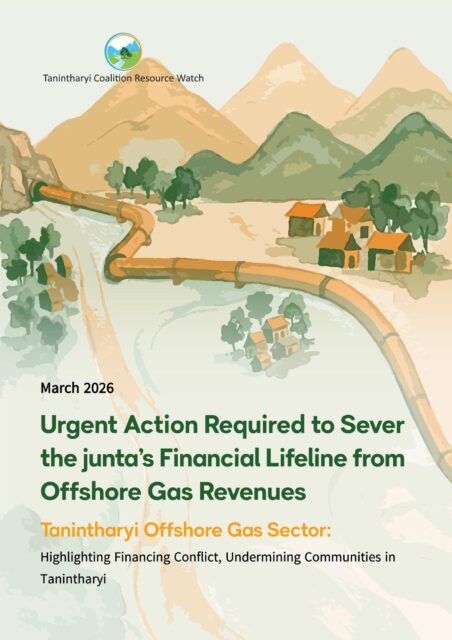
Urgent Action Required to Sever the Junta’s Financial Lifeline from Tanintharyi Offshore Gas Revenues
18 April 2026
Executive Summary
Myanmar’s offshore oil and gas sector has functioned for more than three decades as a central pillar of the country’s political economy and a major financial foundation of military rule. Since the 1990s, large-scale offshore gas projects in the Andaman Sea, such as Yadana, Yetagun, and Zawtika, have generated substantial foreign currency revenues through exports primarily to Thailand. These projects were developed through production-sharing contracts between multinational oil and gas companies and the state-owned Myanmar Oil and Gas Enterprise (MOGE), which has historically operated under direct military control.
Offshore gas revenues have provided Myanmar’s military authorities with stable and opaque income streams that reduce reliance on taxation and weaken domestic accountability. Following the February 2021 military coup, control over these revenues has further consolidated junta power. The suspension of transparency mechanisms, including the Myanmar Extractive Industries Transparency Initiative (MEITI), has significantly increased financial opacity. Despite economic contraction in other sectors, offshore gas exports have continued largely uninterrupted, generating an estimated US$3-4 billion annually in export value in recent years. Human rights organizations estimate that more than US$1 billion per year in foreign currency may directly support the military through gas-related revenues.
Historically, offshore gas revenues have also been embedded in broader systems of military controlled economic extraction. Following the 1988 coup, the military introduced foreign exchange policies that enabled systematic rent extraction through a dual-currency system and state-controlled exchange rates. This structure allowed military elites and connected businesses to capture significant economic value from resource exports while obscuring the true scale of revenue flows in official accounts. Tanintharyi Region remains at the center of Myanmar’s offshore gas sector and has experienced long-standing human rights impacts linked to pipeline and infrastructure security. Since the 1990s, communities near gas infrastructure have reported widespread land confiscations, forced labour, and militarization. In one major case, naval forces confiscated over 81,000 acres of community land in Yebyu Township to secure pipeline infrastructure, affecting thousands of households.
Since the 2021coup, armed conflict has intensified across Tanintharyi, resulting in widespread human rights abuses and civilian harm. Documented violations along the pipeline corridor between 2023 and 2025 include arbitrary arrests and detention of at least 129 civilians, custodial deaths, unlawful killings by multiple armed actors, forced displacement affecting thousands of residents, and systematic restrictions on movement, communication, and access to essential goods. Military operations have included artillery attacks in civilian areas, airstrikes, destruction of infrastructure, burning of homes, and the placement of landmines in civilian areas. These patterns suggest the use of collective punishment against communities living near strategic energy infrastructure.
At the same time, offshore gas revenues continue to play a critical role in sustaining the military’s war economy. Ongoing gas exports have provided stable foreign currency flows that enable continued military spending, including procurement of arms, aviation fuel, and internal security operations, even as public services have declined. Although Western corporate divestment from Myanmar’s oil and gas sector since 2022 has reduced some direct foreign corporate involvement, revenue flows have often shifted to regional companies and expanded MOGE control. Thai state-linked and private companies continue to play a major role in Myanmar’s offshore gas production and expansion, including new projects such as the Min Ye Thu block. This raises ongoing concerns about continued financial flows sustaining military rule.
In response, Myanmar civil society and international advocacy campaigns have mobilized to pressure governments, corporations, and international institutions to cut financial flows to MOGE. These efforts have contributed to targeted sanctions and corporate withdrawals; however, gas revenue continues to represent one of the military junta’s most important remaining sources of foreign currency. Overall, Myanmar’s offshore gas sector remains deeply intertwined with militarization, human rights risks, and authoritarian governance. Without effective revenue controls, transparency mechanisms, and corporate accountability measures, offshore gas revenues are likely to continue functioning as a financial backbone sustaining military rule and conflict in Myanmar.
Announcements
19 May 2026