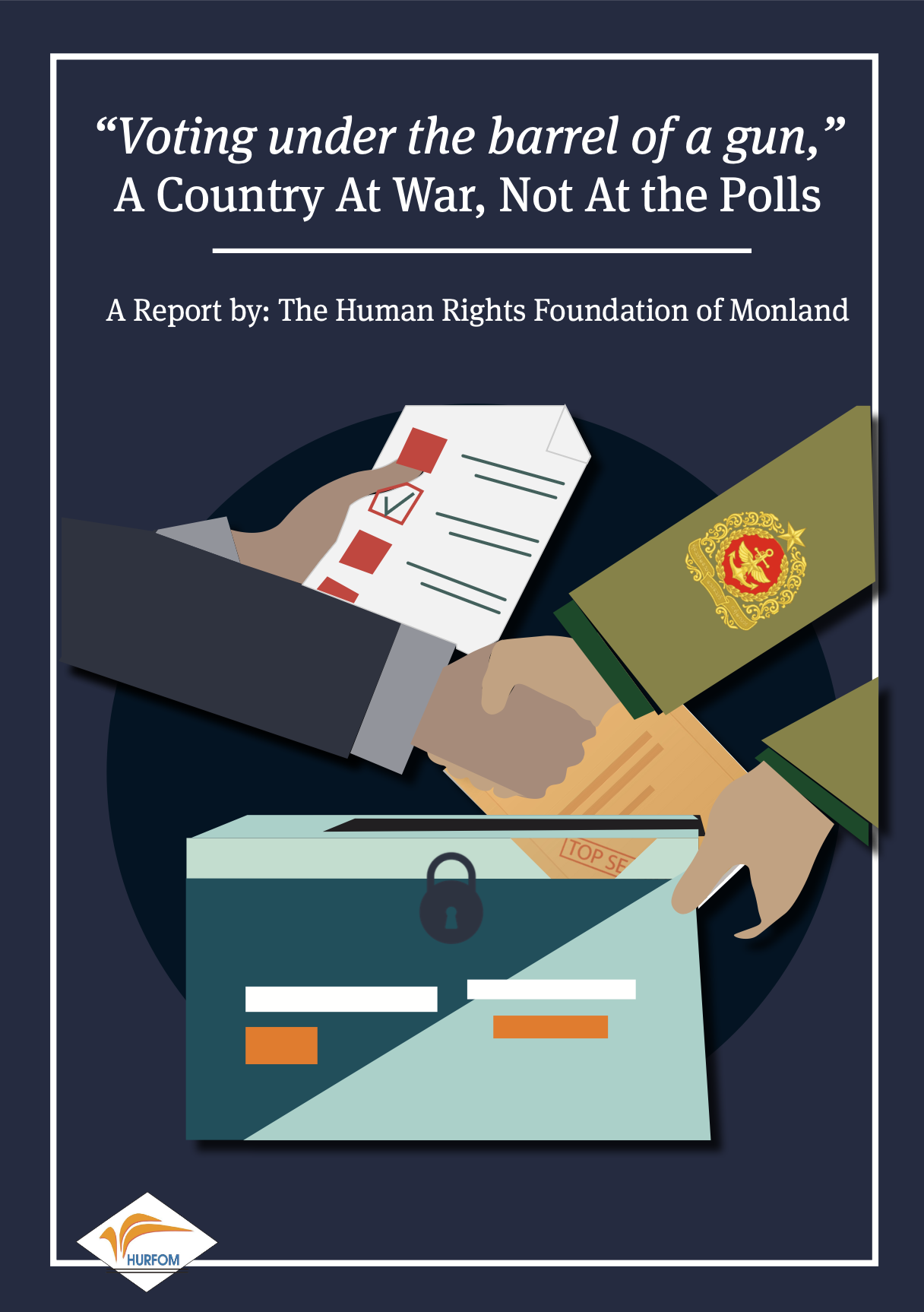
“Voting under the barrel of a gun,” A Country At War, Not At the Polls
13 November 2025

Over the past four and a half years, the human rights situation in Burma has rapidly deteriorated. The attempted military coup has resulted in the destruction and disruption of local livelihoods, as civilians are frequently shot at in their homes and in their villages, making it nearly impossible to find safe ways to work. Amid a faltering economy, rising costs of basic goods and commodities have added to the challenges faced by local people struggling to survive on essential supplies. Children, traumatized by the legacy of the junta’s violence, have been unable to find refuge even in schools or clinics, which have offered no shield from the barrage of bullets and bombs indiscriminately dropped by the junta.
The last year has seen an intensification of war and its devastating impacts across targeted areas of the Human Rights Foundation of Monland (HURFOM), including Mon State, Karen State, and the Tanintharyi Region. Civilians remain trapped in a cycle of fear, violence, and exploitation. Patterns of forced conscription, arbitrary arrest, airstrikes, artillery shelling, and extortion continue to devastate local communities.
The conditions on the ground make it clear that no genuine democratic process is possible with the junta at the helm. Over 3.5 million people are displaced, many sheltering in forests, caves, or border zones. Schools, clinics, religious sites, and homes are daily targets of airstrikes, drone assaults, and artillery fire. Families who survive bombardments face forced conscription, with their sons and daughters abducted from checkpoints and sent to the frontlines as cannon fodder.
Under these circumstances, even the most basic principles of an election—safety, freedom of movement, and the right to choose—are absent. As the junta prepares to stage what it calls a “multi-party democratic general election” between 28 December 2025 and the first week of January 2026, fear and skepticism are spreading across Mon State, Karen State and the Tanintharyi region. People living under constant military control view the planned polls not as a return to democracy but as another political maneuver to extend the junta’s power. Many communities, especially in conflict-affected and resistance-held areas, have already dismissed the process as meaningless. Their voices reflect deep distrust of the military’s intentions and frustration with ASEAN and the international community’s inaction.
The sham election is the junta’s latest in its scheme for legitimacy in Burma. After having claimed election fraud in 2020 despite no evidence, the junta has led the country down a path of violence and destruction, with more than 7,000 people killed and nearly 30,000 arbitrarily arrested. Voter suppression and exploitation are rife. Villagers are pressured to register, threatened with fines or arrest, and told their names will be “checked” by soldiers. Armed patrols accompany election officials, turning routine registration into a moment of fear.
Announcements
19 May 2026