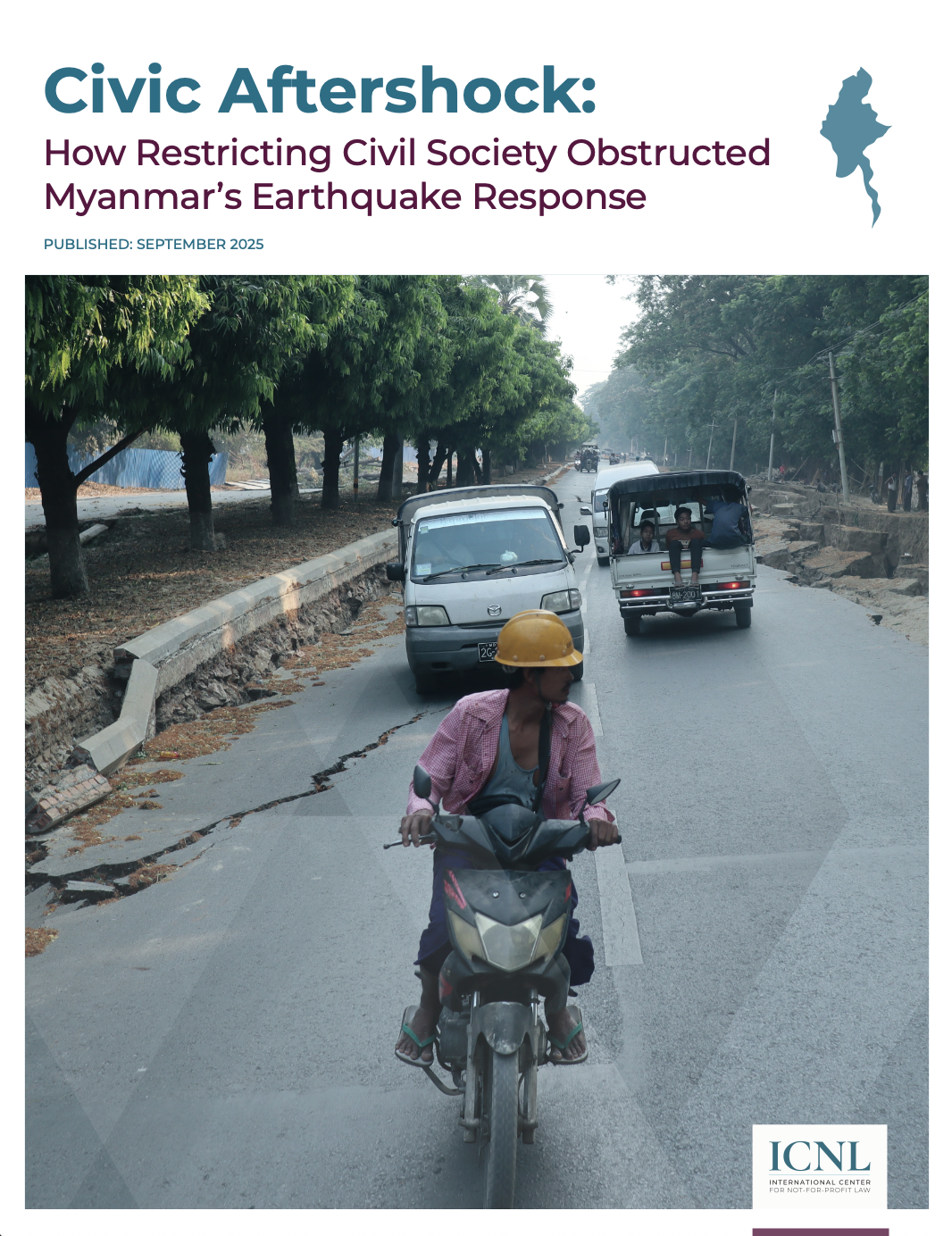
Civic aftershock: How restricting civil society obstructed Myanmar’s earthquake response
28 October 2025

Summary
After six months of interviews and research, a new report explains how the military deliberately obstructed the 2025 earthquake response, exploiting the humanitarian crisis to suppress civic freedoms. ICNL’s comprehensive report, based on key informant interviews with earthquake respondents, details how the military weaponised laws, imposed a complex system of permissions, and blocked access to particular affected populations. The report finds this strategy was not a failure of capacity but a re-run of the Cyclone Nargis response, deliberately co-opting aid, criminalising volunteers, and preventing the re-emergence of an independent civil society.
Executive summary
The devastating earthquake that struck Myanmar on March 28, 2025, was a profound human tragedy compounded by a harmful State response. This report finds that the military’s actions following the disaster led to the systematic suppression of civic freedoms. The military exploited the humanitarian crisis to accelerate its pre-existing restrictions on civil society, violating fundamental rights protected under international law, with lethal consequences. This strategy functioned to prevent the re-emergence of independent civil society, while directing humanitarian aid toward the military’s partisan interests.
Key findings
- The military used the Organization Registration Law (2022), which criminalized unregistered associations, to create a hostile legal environment for civil society. In the aftermath of the earthquake, it instituted an arbitrary permission regime for all emergency aid on top of existing restrictions, imposing a system of direct control that systematically obstructed and co-opted independent relief efforts.
- Civil society access to affected populations was systematically blocked through a web of intimidating checkpoints, restrictive travel permits, and curfews, preventing timely search and rescue operations and channeling humanitarian assistance to military allies.
- The military effected an information blackout by trying to control digital communications, banning independent media, repressing journalists, and simultaneously attempting to control the narrative via its own campaigns.
- Civil society workers and volunteers were subjected to violence, arbitrary arrest, and politically motivated charges under restrictive laws, creating a climate of fear that undermined independent relief efforts.
- Despite severe repression, informal, local, and unregistered civil society organized together, operating clandestinely to deliver life-saving aid, demonstrating profound resilience.
The international community’s approach must be guided by the reality that in Myanmar, the military remains a primary obstacle to a rights-respecting civil society response to natural disasters. Stakeholders should consider recognizing and directly funding informal civil society networks on the ground. This requires creating flexible, rapid, and trust-based funding mechanisms.
Simultaneously, consistent international pressure must be applied to demand civil society access and the repeal of the Organization Registration Law and other restrictive laws, while also investing in the long-term security and resilience of local civil society operating in this high-risk environment.
Announcements
19 May 2026