Myanmar Junta’s Planned Elections: Falling Short of Democratic Legitimacy
30 September 2025
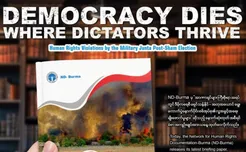
The Asian Network for Free Elections (ANFREL) launched its assessment report on the Myanmar junta’s upcoming planned elections, 30 September 2025.
The report “Myanmar Junta’s Planned Elections: Falling Short of Democratic Legitimacy” outlines 15 aspects of the electoral process which demonstrate that “the elections staged by the junta in Myanmar do not align with international standards and cannot be considered credible or legitimate.”
The review is an independent undertaking of election-related developments in Myanmar, based on extensive monitoring and dozens of consultations with diverse stakeholders.
The Myanmar military staged a coup in 2021 after the 2020 general election for alleged irregularities in the election. The military junta announced that it will hold elections on 28 December 2025 amid the current situation of civil unrest and humanitarian crisis.
EXECUTIVE SUMMARY
Since they unlawfully took power on 1 February 2021 and imprisoned civilian leaders and election officials, Myanmar’s armed forces (Tatmadaw) and junta leader Min Aung Hlaing have repeatedly promised new elections to “resolve” the ongoing political crisis and shore up legitimacy for a new régime of their design.
This strategy was laid out in the State Administration Council’s (SAC) five-point roadmap, where the first item was the nomination of a new Union Election Commission (UEC) to scrutinize the 2020 voter lists, and the last was the holding of “free and fair multiparty democratic elections” once the state of emergency ended, with the winning party taking over state duties from the military junta.
Min Aung Hlaing had initially hoped to hold these elections within one year of his power grab, but his plans were derailed by widespread fighting and protests against military rule. A new target date, August 2023, then came and went without elections being announced as the country fell deeper into conflict and the military council entrenched itself in Naypyidaw.
Almost five years after the coup, Min Aung Hlaing’s attempts at normalization of military rule have all but failed, but he has not given up on his election plans. While the situation in Myanmar is more precarious and polarized than ever, the nationwide state of emergency ended on 31 July 2025 after seven consecutive extensions, and the first of several election phases was announced for 28 December. Meanwhile, the SAC rebranded itself as the State Security and Peace Commission (SSPC), an “interim government” that will oversee the elections.
This report demonstrates that the junta’s elections will take place in an environment of widespread violence, restrictive laws, and intense repression, and will feature dubious electronic voting machines, handpicked political parties, and no independent scrutiny from media or civil society, all in the hope that the international community will accept the results and restore relations with Myanmar.
Our assessment reviews the junta’s upcoming elections according to established international standards and best practices for genuine democratic elections. These include fundamental rights such as freedom of assembly, freedom of association, freedom of expression, freedom of information, and freedom from fear, as well as election safety, integrity, transparency, inclusiveness, and the rule of law. They are enshrined in the Universal Declaration of Human Rights of 1948, the International Covenant on Civil and Political Rights of 1966, the Bangkok Declaration of 1967, the ASEAN Human Rights Declaration of 2012, the Model Commitments for Advancing Genuine and Credible Elections, and the Global Network for Securing Electoral Integrity’s Principles for Democratic Electoral Reform Processes, among others.
Through fifteen concise sections discussing different aspects of the electoral process, ANFREL will demonstrate that the elections staged by the junta in Myanmar do not align with international standards and cannot be considered credible or legitimate. These “sham elections”, as they have widely been referred to, have severe political and procedural shortcomings and cannot be a solution to the conflicts raging across Myanmar.
Worse still, Min Aung Hlaing’s ruthless pursuit of international and domestic legitimacy means that people are being killed and will continue to die because of the junta’s elections. More than a question of legality, these elections raise profound moral concerns given the ongoing suffering of the population.
The methodology for this assessment included a review of election-related developments in Myanmar and dozens of interviews with civil society, media, pro-democracy institutions, and political parties, including several that will compete in the upcoming elections. ANFREL has been working in Myanmar for nearly two decades, and observed the 2015 and 2020 general elections, as well as the 2017 and 2018 by-elections.
In parallel with this report, ANFREL will continue working with NGOs and civil society organizations in Myanmar, across Asia, and internationally to uphold democratic principles and to draw attention to the challenges and risks surrounding the junta’s planned elections.
Announcements
19 May 2026