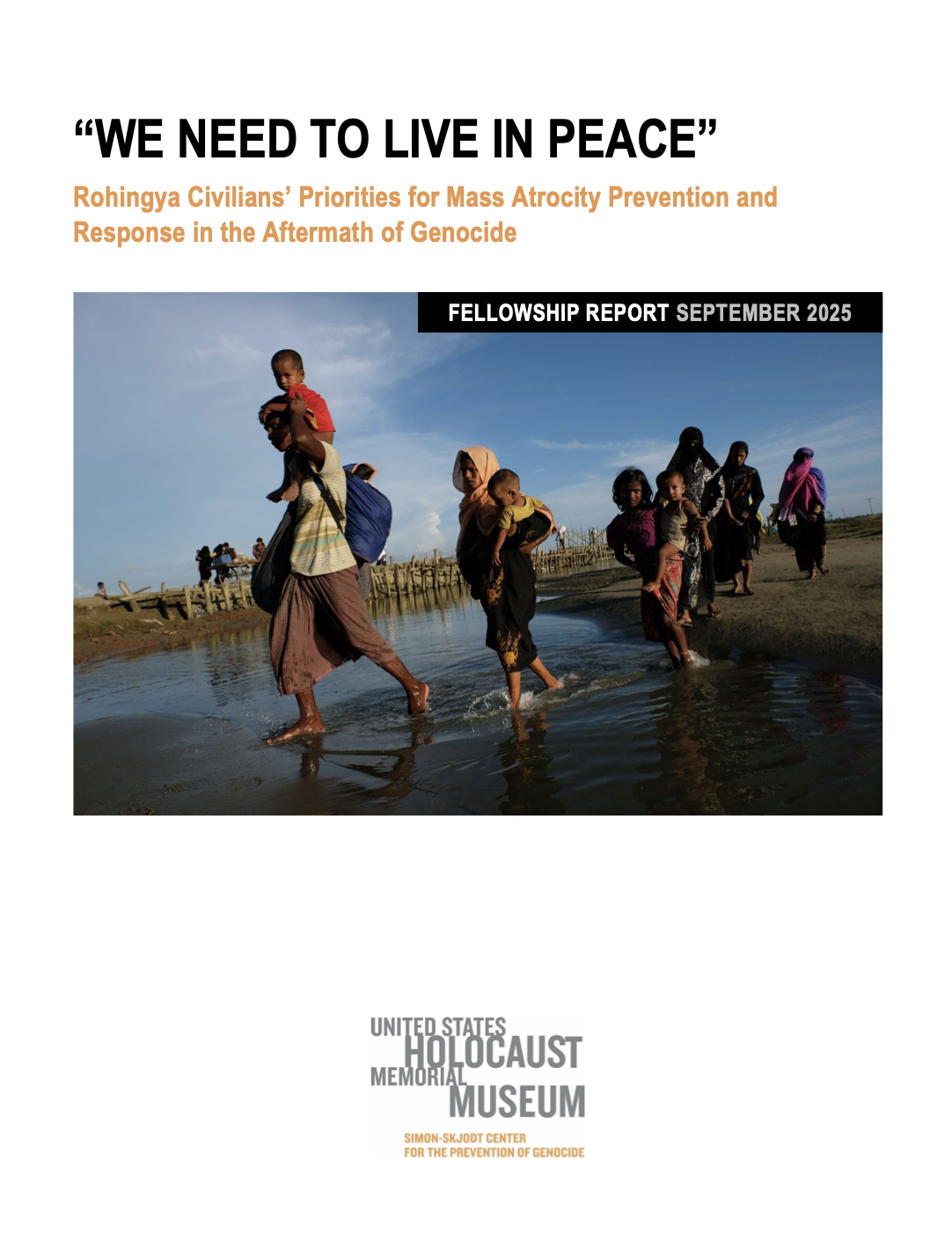
“WE NEED TO LIVE IN PEACE” Rohingya Civilians’ Priorities for Mass Atrocity Prevention and Response in the Aftermath of Genocide
26 September 2025
PREFACE
The United States Holocaust Memorial Museum teaches that the Holocaust was preventable and that by heeding warning signs and taking early action, individuals and governments can save lives. The Founding Chairman of the Museum, Holocaust survivor and Nobel laureate Elie Wiesel, directed us to do for victims of genocide today what was not done for the Jews of Europe during the Holocaust. With this knowledge the Simon-Skjodt Center for the Prevention of Genocide is dedicated to advancing research and education to prevent genocide. We undertake rigorous research focused on understanding warning signs, analyzing lessons learned from past cases, and providing in-depth reports on countries where crimes are ongoing or at serious risk, and that are receiving insufficient governmental or public attention.
The Rohingya are victims of a genocide that could have been prevented. For more than a decade, the Center has worked closely with civil society partners to analyze genocide and related crimes against humanity committed against the Rohingya and to support survivors’ calls for justice and accountability. In 2015, the Museum sounded the alarm on the risk of genocide against the Rohingya.1 In 2018, the Museum found compelling evidence that the Burmese military committed ethnic cleansing, crimes against humanity, and genocide against the Rohingya population.2 The Museum worked with Rohingya partners and others to create an exhibition, Burma’s Path to Genocide, that tells the story of the persecution of the Rohingya and how they became targets of a sustained campaign of genocide.3
For this report the Simon-Skjodt Center for the Prevention of Genocide worked with three Rohingya leaders –Tun Khin, president of the Burmese Rohingya Organisation UK; Wai Wai Nu, founder and executive director of Women’s Peace Network; and Yasmin Ullah, executive director of the Rohingya Maìyafuìnor Collaborative Network – to understand the varied perspectives and priorities of the Rohingya community who are facing an ongoing risk of mass atrocities and the ramifications of the impact of genocide. The leaders consulted with a diverse group of Rohingya civilians in Burma, Bangladesh, the broader Southeast Asian region, and the global diaspora to understand their needs and to share their recommendations for policymakers.
To inform this work, these Rohingya leaders conducted interviews with 86 Rohingya civilians living in Burma, Bangladesh, India, Thailand, Malaysia, Indonesia, and the Philippines. The researchers made deliberate efforts to gather insights from marginalized groups, such as women and young leaders. The diversity of respondents was reflected in their roles and backgrounds, which included Rohingya activists, refugees, artists, photographers, and representatives from both regional and Rohingya-led civil society organizations. This report is a summary of the concerns raised by members of the Rohingya community and the recommendations they shared for global action to confront genocide.
Announcements
19 May 2026