AI, misogyny, and the war on Rohingya women’s visibility
25 January 2026
Yasmin Ullah
There is a particular cruelty reserved for women who refuse to disappear.
I have seen it unfold in many forms over the past five years, but today it wears a new mask, one powered by artificial intelligence, fueled by misogyny, and sharpened by fear.
The target this time is Farhana Roshan, a Rohingya woman activist whose only crime was speaking plainly about women’s autonomy, dignity, and choice.
The punishment has been coordinated, sexualized, and terrifyingly modern: AI-generated revenge porn made from her videos, circulated to shame, threaten, and silence her.
To understand why this is happening—and why it should alarm all of us—we need to start with who we are.
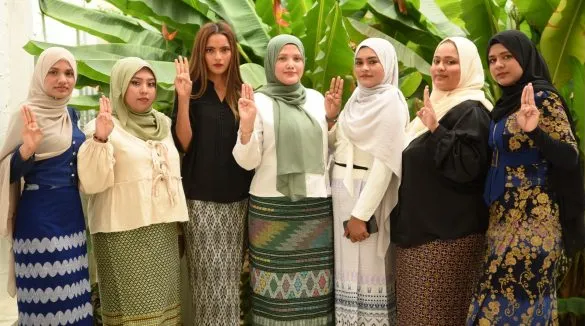
The Rohingya Maìyafuìnor Collaborative Network (RMCN) is a Rohingya women-led collective working across displacement settings to support women and girls who have been pushed to the margins by genocide, statelessness, and patriarchal control.
We raise emergency funds, support survivors of violence, assist unaccompanied minors, provide scholarships, and build what we call “threads of resilience”, quiet, life-saving networks of care.
In just two years, twelve Rohingya women have kept this network alive, supporting 81 unaccompanied minors and countless families when no one else showed up.
None of this could have been done invisibly. And that, perhaps, is the real offense.
The attacks began with something seemingly small: several posts discussing hijab and choice, featuring another Rohingya activist named Noor Azizah.
The reaction was mixed—some support, some hate—but beneath it lay an old, familiar question dressed up as moral outrage: Do women have the legitimacy to speak, to govern, to advocate, to represent?
This question is as old as time. I know it well. For five years, men from various corners of our community have expressed disgust, disbelief, and open hostility at the idea that women like me could amount to anything.
The skepticism is never about competence. It is about permission. Who allowed you to be here?
Rohingya women are told, constantly, that we should advocate, but quietly. Lead, but from behind a curtain. Be visible, but not too much. Exist, but not fully.
The contradiction is deliberate. Visibility is power, and power is something a certain brand of men believe should belong exclusively to them.
This belief has hardened in recent years, blending seamlessly with a new strain of red-pilled misogyny and a rigid Salafi-Wahhabi ideology imported alongside the rise of armed groups, none of which have genuine legitimacy to govern or liberate.
Their strategy is familiar across patriarchal movements worldwide: target the most vulnerable first. Punch down. Break women’s spirits. Shrink the space women occupy until silence feels safer than survival.
What makes this especially painful is the lie that this violence is “our culture.”
Rohingya culture is not monolithic. Islam as practiced in Arakan has historically differed greatly from the harsh, controlling version now being weaponized against women.
The further back you go, the more expressive Rohingya women were allowed to be. Genocide did not just destroy villages; it fractured social trust and bred fear.
In that fear, some men chose control over care, believing that hiding women would protect the community. Instead, it eroded everyone’s humanity, including their own.
Islam teaches care for women. Dignity. Choice. Mercy. Yet many who claim to defend “Islamic values” know little of their faith beyond what preachers and self-appointed leaders tell them. They follow loudly and blindly, mistaking domination for devotion.
This brings us to today.
As RMCN works to make Rohingya women visible again—visible in leadership, advocacy, joy, grief, humor—we refuse to present a single, sanitized version of womanhood.
Our community is diverse, and our women reflect that diversity. For this, we are accused of attacking Islam itself.
But when did one interpretation of faith become the only acceptable way to be Rohingya?
Are we not repeating the very logic used against us by the Myanmar military, that there is only one way to belong, and anyone who deviates deserves punishment?
The backlash intensified when Farhana spoke plainly—and wittily—about bodily autonomy and women’s right to choose how they dress. Her humor was treated as heresy.
Men began using her videos to generate AI revenge porn: stripping her image, sexualizing her body, imposing their own faces and fantasies onto her. A fully clothed hijabi was digitally undressed by the same men who police women’s modesty.
The irony is grotesque.
They harassed one woman for not wearing hijab “properly,” while sexually violating another to satisfy their own depravity. If this is morality, it is hollow. If this is faith, it is faith emptied of compassion.
What we are witnessing is not religious defense. It is power enforcement.
Some of the men leading these attacks are connected to armed groups like the Arakan Rohingya Salvation Army (ARSA). Others are preachers who fuel the fire with disinformation, falsely claiming RMCN is anti-Islamic or a “Christian conversion” effort.
This is both dangerous and absurd. There should be no religious imposition at all, but for the record, every RMCN member today is a devout Muslim. Devout enough to do this work with little support, constant risk, and immense personal cost.
The value we bring is immeasurable. Young Rohingya women—many of whom have never felt seen—finally feel they belong to something larger than fear.
And yet, the silence from the Rohingya leadership is deafening.
No public statements. No firm condemnations. Only private messages of sympathy, carefully worded to avoid upsetting the very men terrorizing women.
This silence is a litmus test. For years, we have heard the phrase, “We support women.” What it often means is: we support women until it becomes inconvenient.
Until it costs us something.
AI-generated sexual violence is not a fringe issue. It will become more common, more sophisticated, and more devastating, especially against women human rights defenders with marginalized identities.
If it can happen in a community with limited digital literacy, no community is exempt. Armed groups, authoritarian regimes, and bad actors are watching. They are learning.
Lateral violence against women, especially women activists, must stop.
This is not just about Farhana or Noor Azizah alone. Many women activists from Burma to date encounter endless online harassment and doxxing especially for being outspoken and supportive of Myanmar’s Spring Revolution against the military coup on Feb. 1, 2021.
It is about whether women are allowed to exist fully in public life without being punished for it. It is about whether technology will be used to expand human dignity or to automate its destruction. And it is about whether we will continue to look away while women pay the price for visibility.
We are still here. We are still working. We are protecting one another, even when others will not. But the world must understand; when women speak, and no one intervenes, silence becomes complicity.
Yasmin Ullah is a feminist Rohingya human rights activist, poet, and author of a children’s book. Her family fled to Thailand after a wave of violence in Arakan in 1995 and she remained a refugee for 16 years before resettling to Canada. She is currently leading a Rohingya-led, women-led and refugee-led organization called the Rohingya Maìyafuìnor Collaborative Network. She is also the Minority Fellow at the U.N.
DVB publishes a diversity of opinions that does not reflect DVB editorial policy. We’d like to hear what you think about this or any of our stories: editor.english@dvb.no
See the original post.
Announcements
19 May 2026
[Joint Statement] ASEAN must stand with the people of Myanmar, condemn military junta’s crimes
Read Next
18 March 2026