Interview: What Is the New Spring Revolution Alliance?
19 December 2025
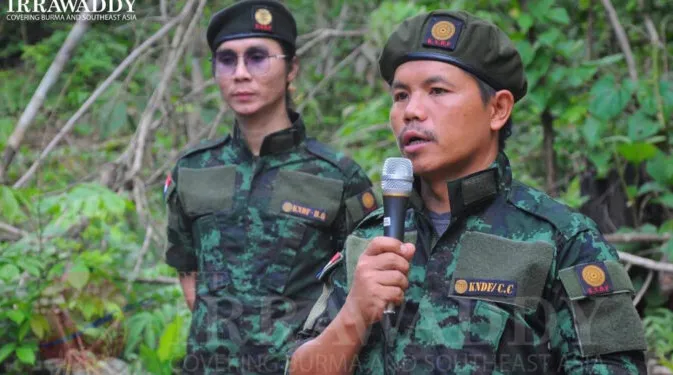
Let’s be clear: the SRA is a Spring Revolution coalition, not yet a nationwide army. But if we succeed in building a strong platform, more alliances may emerge, and this could eventually lay the foundation for a future federal army.
Nineteen armed resistance groups have joined forces to form the Spring Revolution Alliance (SRA), which will be operating independently of Myanmar’s shadow National Unity Government (NUG) and the Big Beasts—the major established ethnic armed groups.
The alliance brings together the Karenni Nationalities Defense Force (KNDF), Bamar People’s Liberation Army (BPLA), Chin Brotherhood (CB), Danu People’s Liberation Front (DPLF), Student Armed Force (SAF), and others.
The official spokesman for the SRA’s new Leading Committee is Khun Bedu, a prominent Karenni activist who also helms the KNDF. Here he talks to The Irrawaddy about the alliance’s aims, its plans for the future, and its relationship with the shadow government and the major rebel groups.
Why was the SRA formed?
Over the past four years, resistance forces that emerged during the Spring Revolution—including the KNDF—have been fighting the junta on multiple fronts. Some groups have grown stronger, but others continue to struggle.
Now the junta is preparing to stage a sham election, and some major ethnic armies are entering ceasefire arrangements, so smaller, more scattered resistance groups like ours need a coordinated path forward. Only through proper consultation and preparation can we sustain the revolution and ultimately win.
That is why we brought together forces that are not under NUG command. We fully recognize the NUG’s forces—PDFs, PaKaPha, PaLaPha—and encourage them to strengthen their own command structures. And of course we also acknowledge the many units operating under EAOs or local administrations like the Karenni’s Interim Executive Council, the Kachin PDFs under the Kachin Independence Army’s command, as well as in Chin and Rakhine states. We rely on these units and want to see stronger cooperation among all of them.
But the SRA is a coalition of Spring Revolution forces that are not under NUG or EAO command, formed to build stronger coordination between independent groups. We are not a political grouping but a military alliance. The idea was first discussed earlier this year.
Our organizational structure is such that each group has representation in the Leading Committee, which will coordinate military operations, logistics, fundraising, alliance-building, and external relations. The SRA is designed to be a tightly organized platform to push the revolution forward.
Will the SRA be the kind of unified force the public is hoping for?
It’s certainly a coalition. Previous attempts to form coalitions have failed, and we understand that building them takes time. Each group brings its own troops and resources, and then we will share resources, coordinate operations, and gradually move toward deeper integration—possibly even a single command or unified force in the future.
How does the SRA view Chinese pressure on armed resistance groups in Myanmar?
Our biggest challenge is securing supply routes and materials. We must work with our partners—federal unit administrations, EAOs and the NUG—and we expect both support and scrutiny from neighboring countries. Some neighbors assist the junta…
What we are doing is building a stronger political and military platform to navigate. Whether pressure comes from China, other neighboring states, or major powers, we must be ready to face it—and also to build better relationships where possible.
Did you consult with the NUG and EAOs about the coalition?
Yes. The SRA is an alliance of Spring Revolution forces, and we currently have between 10,000 and 15,000 fighters. There are long-established EAOs— the Karen National Union, Karenni National Progressive Party, KIA, Chin National Front, Arakan Army and others—who are leading the fight against the junta. Before forming the SRA, we consulted with them to understand their views, and they have been supportive. Building alliances with EAOs is our next step.
We also met the NUG’s acting president, ministers including Defense Minister U Yee Mon, and military commanders. You see, by organizing the forces outside NUG command, we are actually helping the NUG—because it then gets easier for it to coordinate with a single alliance rather than so many scattered groups.
Let’s be clear: the SRA is a Spring Revolution coalition, not yet a nationwide army. But if we succeed in building a strong platform, more alliances may emerge, and this could eventually lay the foundation for a future federal army.
How has the SRA designed its command structure?
Compared to the junta’s, our command systems are still weak. The junta follows Min Aung Hlaing’s orders through its chain of command. On our side, we do not yet have a single commander-in-chief or a unified national military strategy.
But the SRA aims to become one pillar of the broader revolutionary structure, and we’ll coordinate with others, including the NUG and EAOs.
How this develops will depend on our collective effort and the ability of all forces to connect and cooperate.
Which areas will become the SRA’s main operational zones?
There will be a headquarters, and we’ll operate across Sagaing, Magwe, Bago, Chin, Mon and Karen. Now the junta has gained an advantage through drones, we’re upgrading our own drone capabilities and other technologies to ensure the revolution can advance nationwide with greater strength. We don’t plan to seize or govern one specific territory. Rather, our purpose is to build a strong, interconnected alliance capable of working collectively across all regions.
What is your message to the people?
The regime has escalated drone warfare and strengthened its grip in some areas. But with the support of the people, our forces have always stood firm. We made a promise: to bring down the military dictatorship. We have not yet achieved that goal these four years, so we will keep fighting for that.
We will work toward a democratic system that guarantees justice and freedom for the people. We understand the suffering the public is enduring. We cannot say exactly when the revolution will end, but we are redoubling our efforts. Our networks are stronger than ever, and the revolution has entered a broader, more connected phase.
Do you have anything to add regarding the SRA?
Some have asked whether we are competing with the NUG. Absolutely not. We have strong coordination with the NUG, and those responsible within the NUG were informed of our plans in advance.
For the first time in the four or five years of the Spring Revolution, we are able to meet face-to-face, understand each other’s challenges, and build trust. We ask the public to wait and see before they criticize.
There are also some groups that are not yet part of the SRA. But even if they cannot join under a single name at this stage, many have issued statements welcoming cooperation. This is exactly the kind of military collaboration the revolution needs. Strengthening nationwide cooperation is essential, and that is what we aim to advance.
Announcements
19 May 2026
[Joint Statement] ASEAN must stand with the people of Myanmar, condemn military junta’s crimes
Read Next
18 March 2026